As a huge fan of Joshua Chaplinsky's work (including the recent Letters to the Purple Satin Killer), I'm proud to reveal the ominous and intriguing cover for his latest horror novel, The Man in the Watch Still Visits Me at Night. You can see that beauty in full down below, with art by Matthew Revert, who's done the cover art for all of Chaplinsky's books:
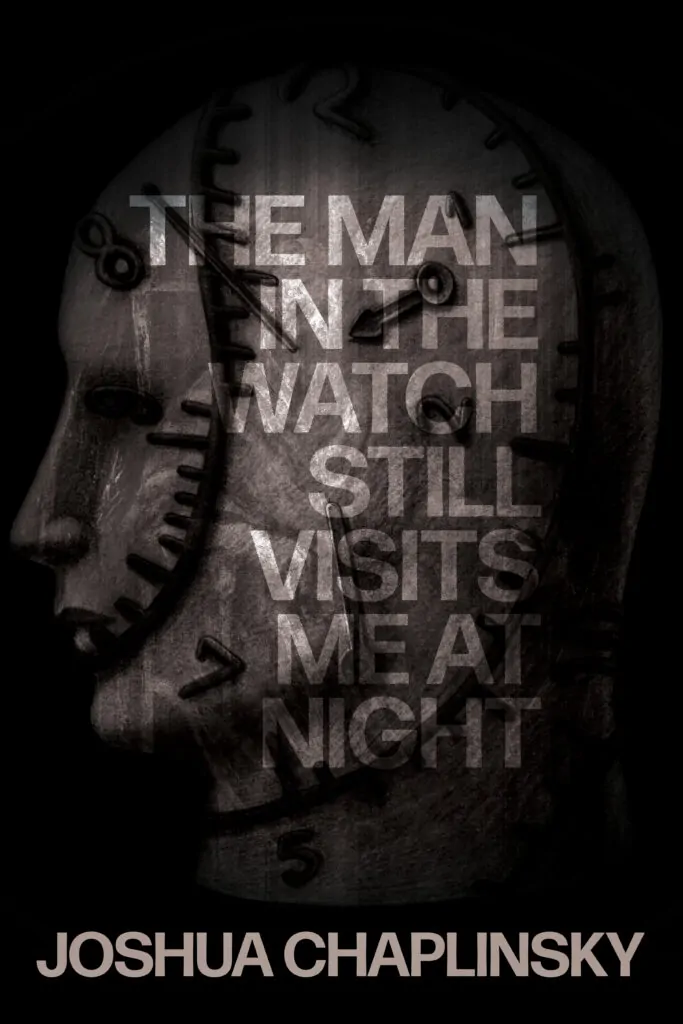
So what's a cover and a title like this trying to tell us? The synopsis shares a little more:
House of Leaves meets David Lynch in a surreal horror novel exploring generational trauma and the monsters it breeds, from Joshua Chaplinsky, cult author of Letters to the Purple Satin Killer.
The lives of three unlikely women unfold to reveal a shared history of neglect and abuse. At the center looms the Vogel House, a facade of rotten wood and sagging eaves that plays host to a parasitic dream—the malevolent entity known as The Man in the Watch.
After spending the night in an abandoned house, Jenna Thomas returns home haunted by someone else’s past. She revisits the scene in the hopes of exorcising her dreams, only to uncover something far worse. Mrs. Vogel receives an unexpected letter from her estranged daughter. It fills the old woman with hope for the future, even though her daughter is long since dead. Meanwhile, a young woman contends with the legacy of her father while simultaneously fighting for the future of her unborn child.
The Man in the Watch Still Visits Me at Night thrusts readers into a nightmarish dead zone of overlapping realities, presided over by a malignant force that manipulates memory and delights in human suffering.

The Man in the Watch Still Visits Me at Night hits shelves September 22, but you can pre-order it right now at Bookshop.org, B&N, Indie Pubs or, if you must, Amazon.
AND to tide you over, here's an exclusive excerpt from the book:
Jenna Thomas twitches in her sleep as a shadowy figure creeps into her room. A storm rages outside, held back by an eighth inch pane of glass—barely enough to keep the heat in, let alone the elements out. Still, the blankets are thrown back and her face shimmers with sweat. It collects at the nape of her neck, dampening the pillow.
The figure makes its way to the foot of the bed. A child’s boogeyman, undefined, shrouded in shifting gradients of black. Fat droplets of rain thud against the roof as if soft-bodied larvae fall from the sky. They fill the gutters with their wriggling and cascade onto the ground below. They gorge themselves on rotted wood as they burrow into the meat of the house to gestate, a transformation taking place outside the bounds of time, within the silence between seconds. Their collective chewing is the white noise of increased rainfall in the present.
The figure studies the sleeping girl, then moves toward a dresser opposite the bed. A monolith of chipped paint and missing knobs. The house and its furnishings are old, growing older. The deterioration accelerates, allowing cracks to become fissures, providing hungry things inroads into safe spaces. Vines rise from the soil and scale the exterior of the house. They cover the windows and crisscross the roof. They keep rotting walls from crumbling. Walls that prevent escape.
The flesh of gestating pupae splits as the life within forces itself free. It unfurls wings like damp sheets and emerges from holes in plaster to hover above Jenna’s bed. The fluttering is lost in the rain’s percussive thrum.
The figure guides the top drawer of the dresser open, coaxing the warped wood into motion despite its protests. Lightning flashes, rendering the black shape momentarily invisible—for it is only a shadow, nothing more. In that moment, the drawer seems to move of its own accord. Dozens of moths sparkle like sand in the brief illumination. A whip-crack of thunder follows a split second later.
Jenna bolts upright in bed and gasps for air. Takes huge, greedy gulps of it. Her eyes dart back and forth across the room. Afternoon sunlight pours through the window, highlighting peeling pink paint and second-hand furniture. Neglected stuffed animals with matted fur. Clothing strewn haphazardly about. Her door is closed and she is alone.
But the dresser drawer is ajar.
Fully alert now, she rolls to the side of the bed and plants her feet against the floor. Something squishes beneath her heel. She lifts her leg and inspects the underside of her foot.
“Ugh.”
But she is not to be distracted. She drags her heel across the rug, scraping away the guts of a dead moth. Hobble-steps over to the dresser as if wounded. She holds her breath as she pulls the drawer the rest of the way open, the word please trapped inside her lungs with the air, unaware of the pressure building in her chest until she lets loose a sigh of relief.
Still there.
She retrieves a handful of faded brown envelopes, Mother written atop each one in a delicate script. She runs a thumb along the edges where they’ve been torn open. Brings the bundle to her nose to inhale its musty odor. As strong as when she first discovered it.
The ritual complete, she settles back into bed, re-reads the letters for the umpteenth time. A now familiar story unfolds—a young woman far from home, tethered to her family by paper and ink. Darkness existing not in the words, but the spaces between. Capable of finding shelter in the maze-like folds of the human mind, where it can fester undetected. Undisturbed.
Not only does the narrative haunt Jenna’s waking hours, it has infiltrated the sanctity of her dreams. She’s invested in the woman’s story, which ends abruptly with a cliffhanger finale, a life on the line, truth hanging in the balance. Each re-read is an attempt to glean additional information, achieve some sort of closure. This one is no different, ending with an ellipsis, an echo of pain where a denouement should be.
Even at seventeen, Jenna understands a person’s life doesn’t always follow the basic rules of narrative. At least not the ones she learned in AP English. She finds this reality frustrating. Try as she might, none of the endings she comes up with on her own satisfy her. None are what you would consider “happy.” Her only option is to go back to the beginning and start again.
Dear Mother,
I hope this letter finds you well. I would love to be able to visit, but you know that isn’t possible. Maybe after the baby is born you can come and see us. I want my daughter to know her grandmother.
The Man in the Watch still visits me at night. We sit up together, waiting out the sunrise. He bargains for my unborn child, but I will not let him have her…