
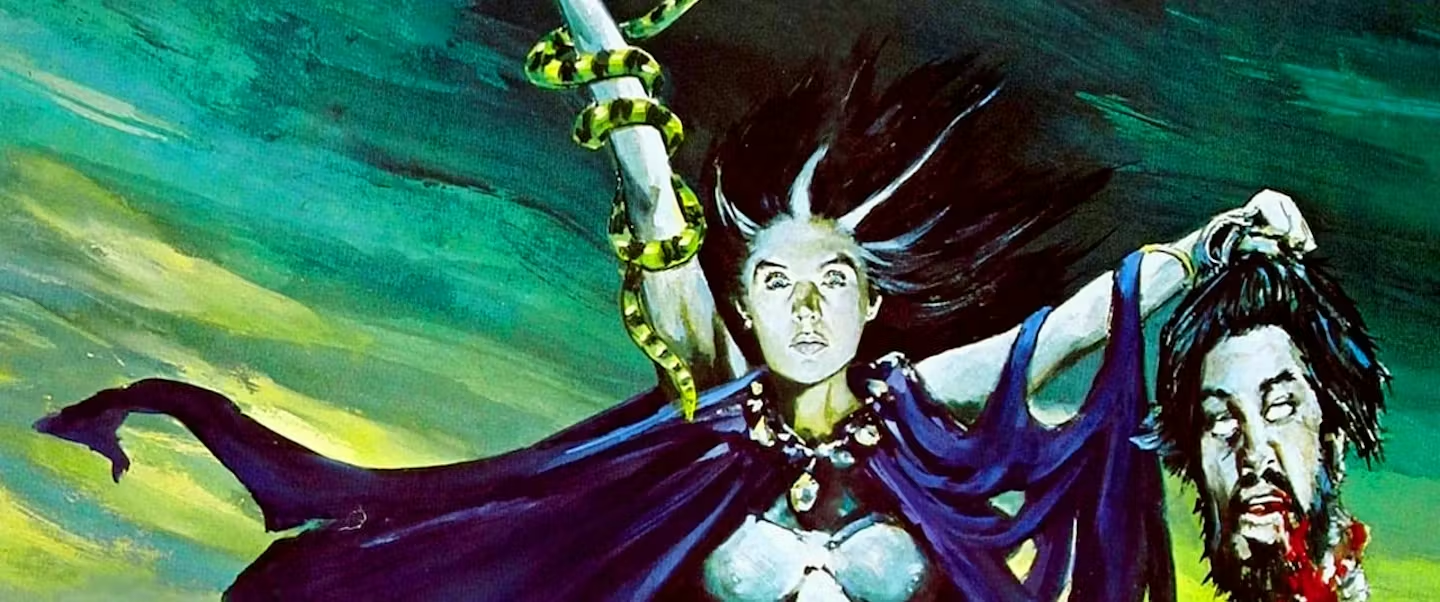
The poster for 1976's The Witch Who Came from the Sea shows a woman with ample breasts and a bare midriff wearing a dark, flowing cape. In one hand, she holds a bloody scythe above her head. In the other, she holds a man’s severed head. Blood drips onto the rocky islet where she stands, waves breaking around her, her long hair swept up in the wind. “Molly really knows how to cut men down to size!!” the tagline reads in bright yellow letters, “cut” underlined with a stroke of red.
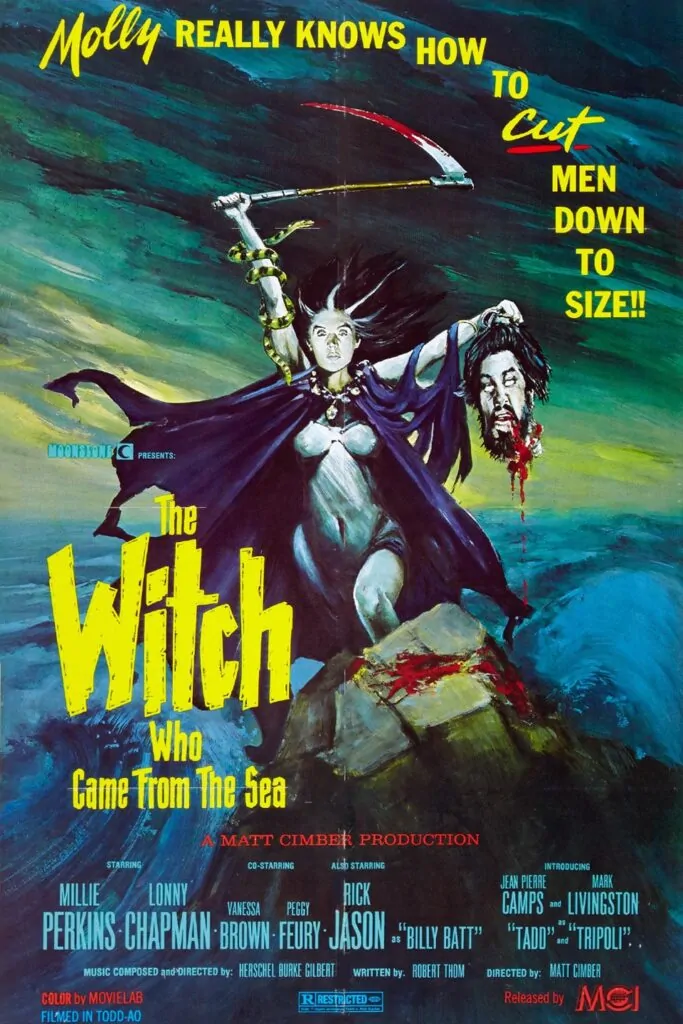
It’s a great poster, both trashy pulp advertising and beautiful painting, with impressionistic brushstrokes blurring the boundary between the turbulent sea and sky. It promises a supernatural fantasy with gratuitous nudity and pleasingly gory vengeance. The Witch Who Came from the Sea is not that movie. It’s something so much better.
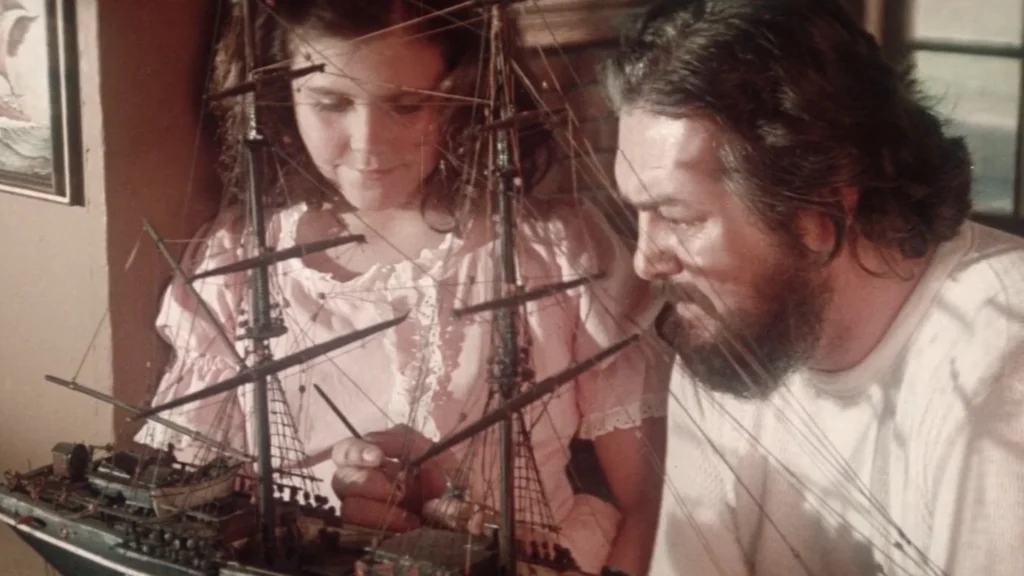
Millie Perkins plays Molly, a barmaid who spends her free time drinking (too much), watching television (too much), and babysitting her nephews while her sister Cathy (Vanessa Brown) sews clothes to try and make ends meet between welfare checks. She regales her nephews with tales of her sea captain father, whose body she says was lost at sea.
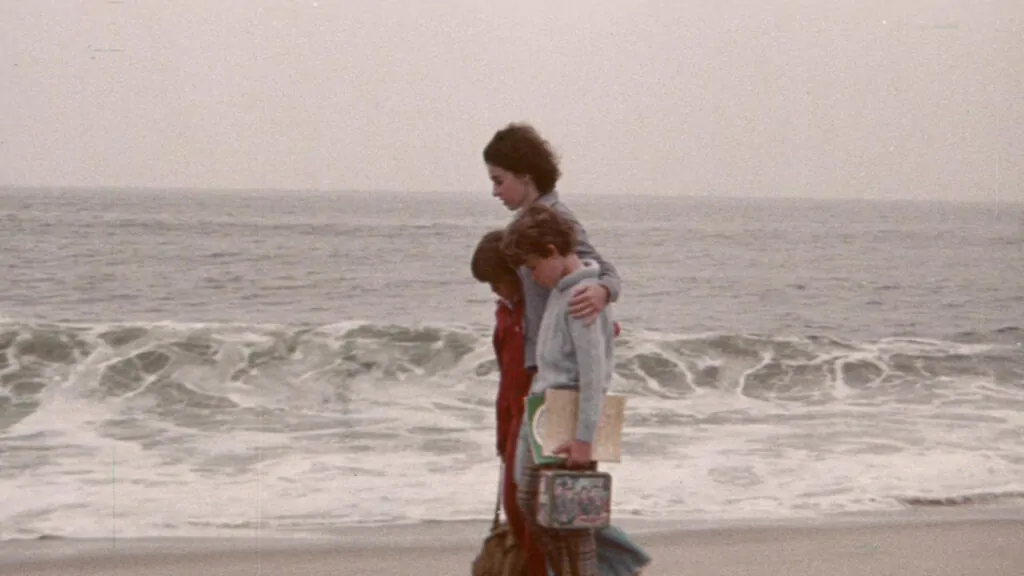
“Only his brains were lost at sea,” Cathy retorts. Her recollections of their father are sharply at odds with Molly’s romanticism: “He was an evil bastard. And more than anyone, you know it.” Molly is simultaneously traumatized by, in denial of, and riddled with guilt about her father's abuse, which, in flashbacks, is drowned out by the sound of roaring waves. Romanticizing is one way she copes; drinking is another. The third is murder.

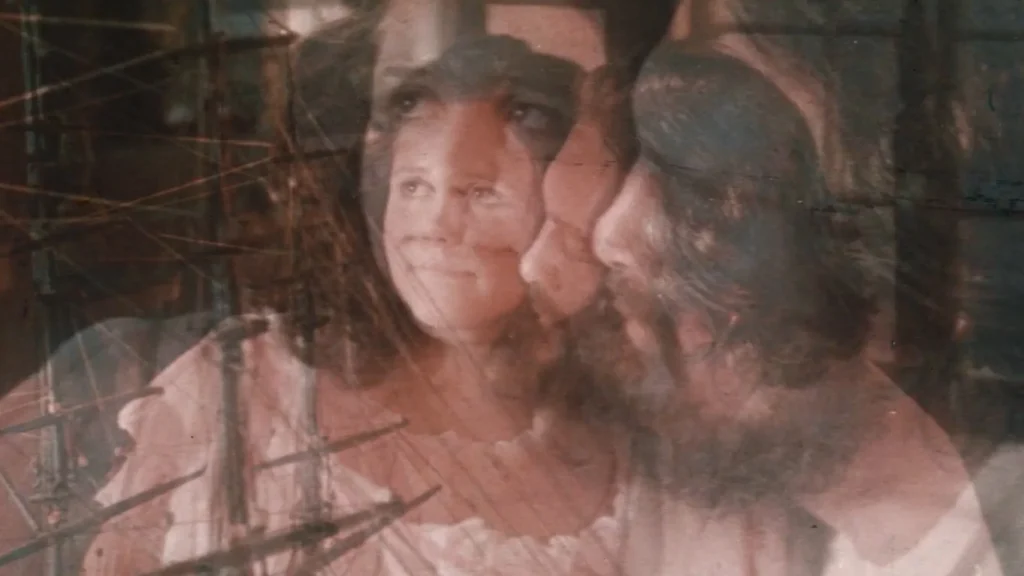
Several men who expect to have sex with Molly end up castrated and killed instead. The kills eschew the post-Psycho vernacular of cinematic violence – building tension that explodes in a rush of close-ups and quick cuts – to embrace a slow, unreal quality, using dreamy anamorphic lenses and audio effects that distort characters’ voices. Blood is already splattering by the time you realize the scene isn’t a dream or a fantasy, but really happening.
It creates a totally atypical shock effect: not a reaction to the gruesomeness of the kills, but to their congruity with the melancholy that pervades The Witch Who Came from the Sea. The film owes that melancholy heart to Millie Perkins’ extraordinary turn as Molly. She is at once childlike and maternal, fragile and frightening, rose-coloured and rageful. She’s thrilling to watch: a master at work.
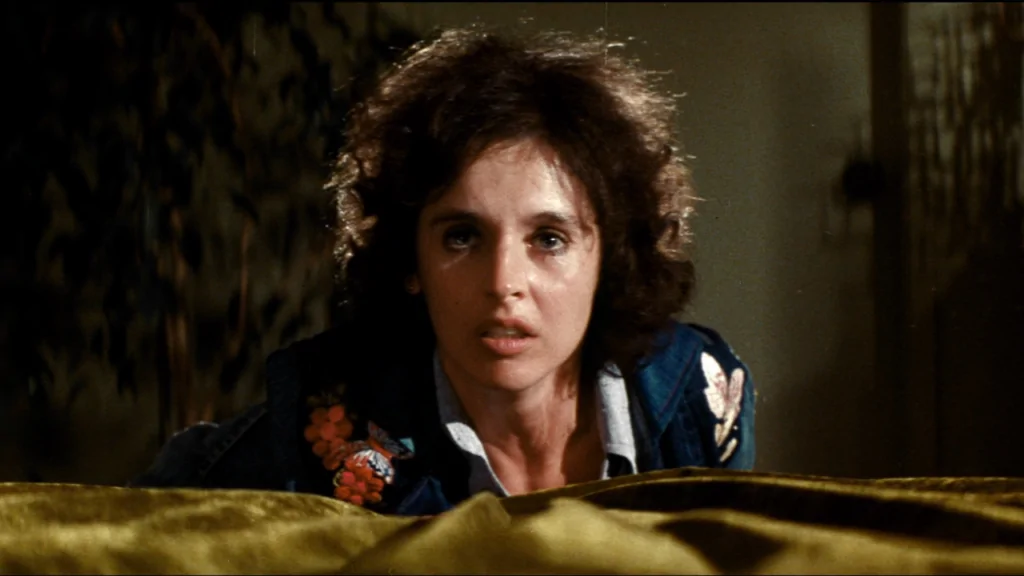
In the late 1950s, Perkins was working as a model when George Stevens saw her picture and decided she should play the lead role in his upcoming adaptation of The Diary of Anne Frank. She was reluctant to attend the screen test, not least because she had never done any acting before. “[W]hen Mr. Stevens chose me—that is clear to me now, knowing that he wasn’t going to be teaching me how to be an actress—it would either be instinctive or nothing at all,” Perkins said in a 2007 interview. That instinctiveness, offset against her elven beauty, gave her all the makings of a movie star – or would have, if it had been a decade or so later.

Instead of being a darling of New Hollywood in the 1970s, she found herself chafing against the confines of the studio system, refusing roles while under contract. “Millie did not fit in,” Stevens is claimed to have later said, “She was 10 years too early.” Though she and her neighbor Jack Nicholson were about the same age, by the time they were co-starring in Monte Hellman’s 1966 westerns The Shooting and Ride in the Whirlwind, their careers were set to go in opposite trajectories.
The Witch Who Came from the Sea feels, on screen, like a corrective: a chance for her to act her heart out in a boundary-pushing film made outside the Hollywood system. But in reality, it couldn’t have been further from a passion project. Perkins’s then-husband, screenwriter Robert Thom, was ill. He wrote The Witch Who Came from the Sea because he thought it was a script that would sell, and he put the money toward his medical bills.
Perkins agreed to star for the same reason. She was embarrassed to appear in what she considered a softcore movie, and didn’t tell her family or friends about the role. Both Thom and Perkins seemed to see it as a generic and sleazy entry in the disreputable rape-revenge genre, dozens of which were made in the ‘70s and ‘80s.
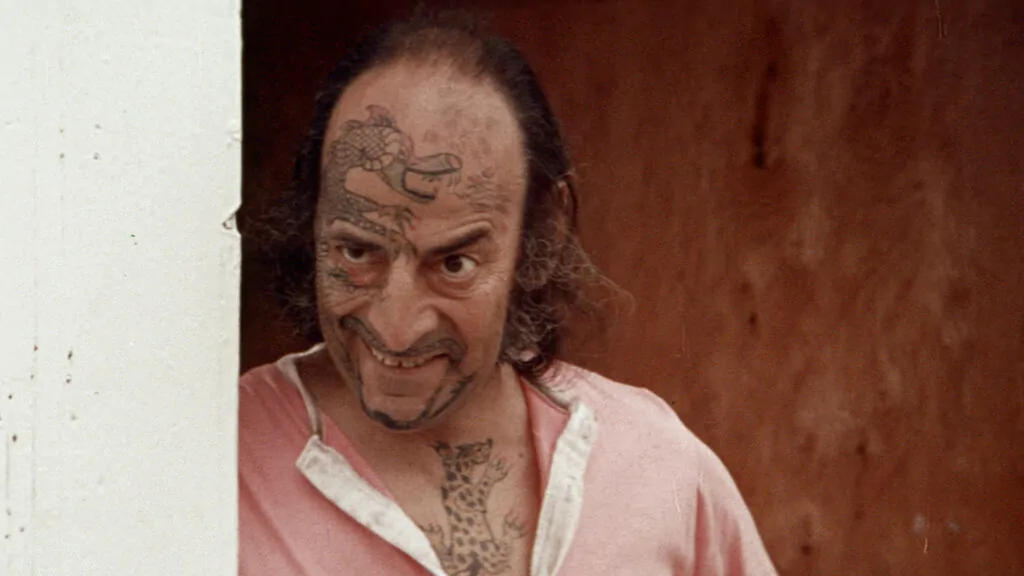
Though The Witch Who Came from the Sea contains all the necessary elements of a rape-revenge movie – its protagonist is raped and, later, kills and castrates men – it doesn’t really feel like one. A big part of why is that it disrupts the cathartic fantasy of rape-revenge movies like I Spit on Your Grave or Ms. 45: Molly’s fractured, traumatized psyche ensures that the rape and the revenge never really connect. It reflects how trauma resists linear narrative framing.
“The lived experience of sexual assault is not remembered in a neat, consistent, scientific parcel… in a clear linear story,” playwright Suzie Miller writes in Prima Facie. Molly’s violence against men is related to, even caused by, her father’s sexual abuse, but that relationship is for the audience to intuit, not one Molly consciously processes.
Molly can’t have intentions as neat and coherent as vengeance when she attacks a man and screams about how her father died for love, her voice becoming otherworldly. Like Twin Peaks: Fire Walk with Me, nearly two decades later, The Witch Who Came from the Sea links the breakdown of narrative linearity and realist aesthetics to its protagonist’s experience of sexual violence, which is depicted with upsetting frankness and deep empathy. We see photo-negative images of Molly sailing, and I remember it the way I remember nightmares: at once distressingly urgent and impossible to pin down with any clarity.
Perkins may have done the movie for the money, but she doesn’t phone it in for a single frame. She plays Molly with the vulnerability and grandeur of the best of Hamlets. I think of Greek tragedy, of kabuki, of Samuel Beckett plays where partially-embodied women talk without ceasing. “Perkins’ performance balances on a knife’s blade,” April Wolfe writes for Film Comment, comparing her performance to Anthony Perkins as Norman Bates in Psycho: “Both characters display a broken innocence, so that one may abhor their acts, even as one wishes to protect them.”
But where Norman’s abhorrent acts are cordoned off into a distinct part of himself, Millie Perkins doesn’t give Molly that kind of on-off switch. She is always both Norman and Mother. On any axis, she is, unflinchingly, both. As David Foster Wallace wrote about Fire Walk with Me, that bothness “require[s] of us an empathetic confrontation with the exact same muddy bothness in ourselves and our intimates that makes the real world of moral selves so tense and uncomfortable.”
That difficult reality of bothness is surely why Perkins’s performance as Molly also reminds me of a kind of performance you see from non-actors: when anybody from Josh Safdie to John Waters essentially find a guy and make a movie around what they’re like naturally. But Perkins was, as director Matt Cimber gushed during production, a “real actress” – one so instinctive, so authentic, so good, that it doesn’t even look like acting.
