
Last Updated on September 16, 2025 by Angel Melanson
The Long Walk has limped and stumbled towards adaptation for decades. Along the way, filmmakers fell by the wayside: George A. Romero, Frank Darabont, André Øvredal were each linked to an adaptation of Stephen King’s 1979 novella, before Francis Lawrence finally strode over the finish line.
Lawrence has form in adapting stories about kids pitted in lethal competition, having directed all but the first instalment of The Hunger Games. Any worries that the glossy dystopia of his previous work may soften the stark brutality of King’s story are soon put to bed, when, less than twenty minutes into The Long Walk a teenage boy develops a cramp.
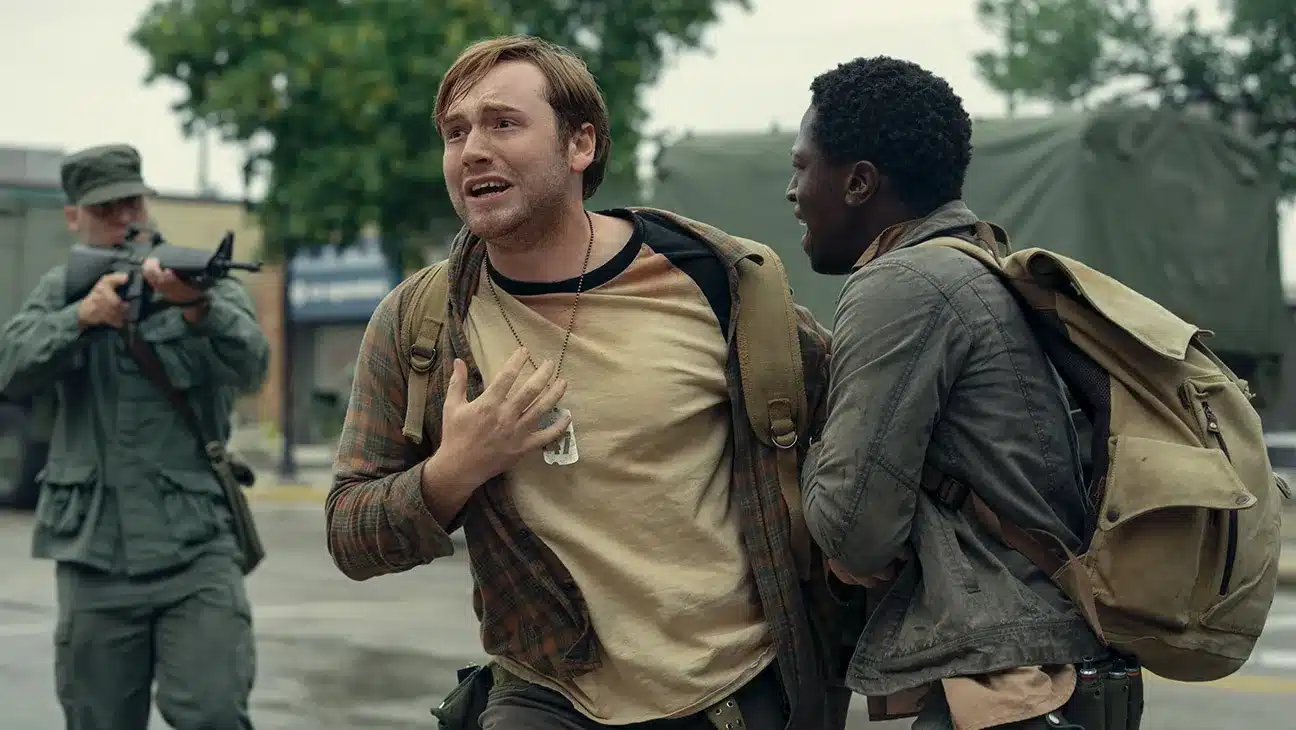
His pace slows and a first warning is called from the men with guns walking or riding armored vehicles alongside. Some of his competitors turn to help, urging him to keep walking, but as the pain grips and he falls further behind, a very authentic, very un-YA panic creases the boy’s face. He falls to the asphalt and bleats for mercy. Two further warnings are announced, a moment’s pause full of pleading, and then a single bullet from an assault rifle rips the boy’s face apart.
The camera doesn’t flinch from any of it and the viewer is left in zero doubt that Francis Lawrence means business. This is not The Hunger Games.

The premise of The Long Walk is simple and terrifying. In a near-future United States, a fascist authority distracts the population from crippling economic conditions with the grim spectacle of The Long Walk—an endless marathon, in which fifty young men must march until only one remains. If they fall below a steady pace of three miles-per-hour, they suffer the fate of the cramping boy. Despite being cast against the wide open spaces of rural America, it’s a hideously claustrophobic idea, the drama confined to conversations between the boys, protagonist Ray Garraty’s internal struggle, and only ruptured by rare moments of pathos and the sound of gunfire.
Written in the late ’60s, King’s source novella is shadowed by the Vietnam War. It’s there in the lottery (read: draft) that each boy enters for his place in the Walk. It’s there in the exhausted faces of young men, the push-and-pull between survival and camaraderie, and the paralyzing horror of watching new friends die meaningless deaths.
Lawrence (and writer, JT Mollner) retain the weight of this martial allegory—even emphasizing it more deeply, in a conversation between the boys about how the lottery offers only a charade of choice—but they also update the story to reflect new traumas. There is the threat of the gun barrel pointed in teenage faces, and the landscape that rolls steadily past is scarred with industrial and environmental damage, just as the faces of the scarce onlookers are pitted by poverty. Above it all looms the threat of the fascist fist, portrayed by Mark Hamill’s authoritarian Major, in a brilliant piece of counter-casting. From atop a rolling tank, he barks and growls a familiar diatribe about the glory of The Walk, and the boys’ responsibility to sacrifice their bodies and lives in support of the nation. If Hamill’s performance sometimes verges into pantomime villain, that’s in keeping with a character who, like all dictators, must be a showman as well as a brute. That said, his presence in one pivotal flashback does seem to suggest that he is the only figure of malign authority in the entire country. It’s a slightly silly decision, working hard to create personal animus, but mostly serving to shrink the movie’s otherwise deft world-building.
As fun as Hamill’s Major is to hate, it’s the walkers who carry the emotional burden, and they do so with rare grace. The young cast feels like a gathering of next-gen talent, offering sharply contrasting responses to their shared ordeal. Charlie Plummer’s Barkovitch provides malice and madness; Sinners’ Tut Nyuot brings humble grace to the role of Baker, and it’s truly distressing to watch Ben Wang’s breezy charm collapse into howling desperation as Hank Olsen.
Cooper Hoffman and David Jonsson take the central pairing of Garraty and Pete McVries, and their relationship is the hinge around which Mollner’s script turns. They are complementary opposites, but not in the way that first impressions suggest. Hoffman’s Garraty appears a wide-eyed farmboy, but the Walk cracks him open, revealing a cynical heart. Jonsson—in a career-cementing performance—proves a more soulful creature than his scars and skepticism imply. It’s McVries who enjoys the best of the script’s philosophical lyricism and if, on occasion, the character seems a little too sagelike for even the most hard-bitten teenager, Jonsson pushes through with charisma to spare.
The movie takes unavoidable liberties with King’s elusive ending, and is either dispiritingly powerful or regrettably nihilistic depending on viewers’ tastes. I found it the weakest part of an otherwise shockingly good, and shockingly grim adaptation. With so much pain on the journey—from Judy Greer’s Hereditary-level meltdown as Garraty’s mother, to the screaming of a dying boy that “I did it wrong”—a more hopeful terminus feels warranted. Nonetheless, The Long Walk is a major success, and one of the best King adaptations in decades. Even in its quietest moments, the movie keeps up a panic-inducing momentum, and when required to, it lifts its legs and runs.