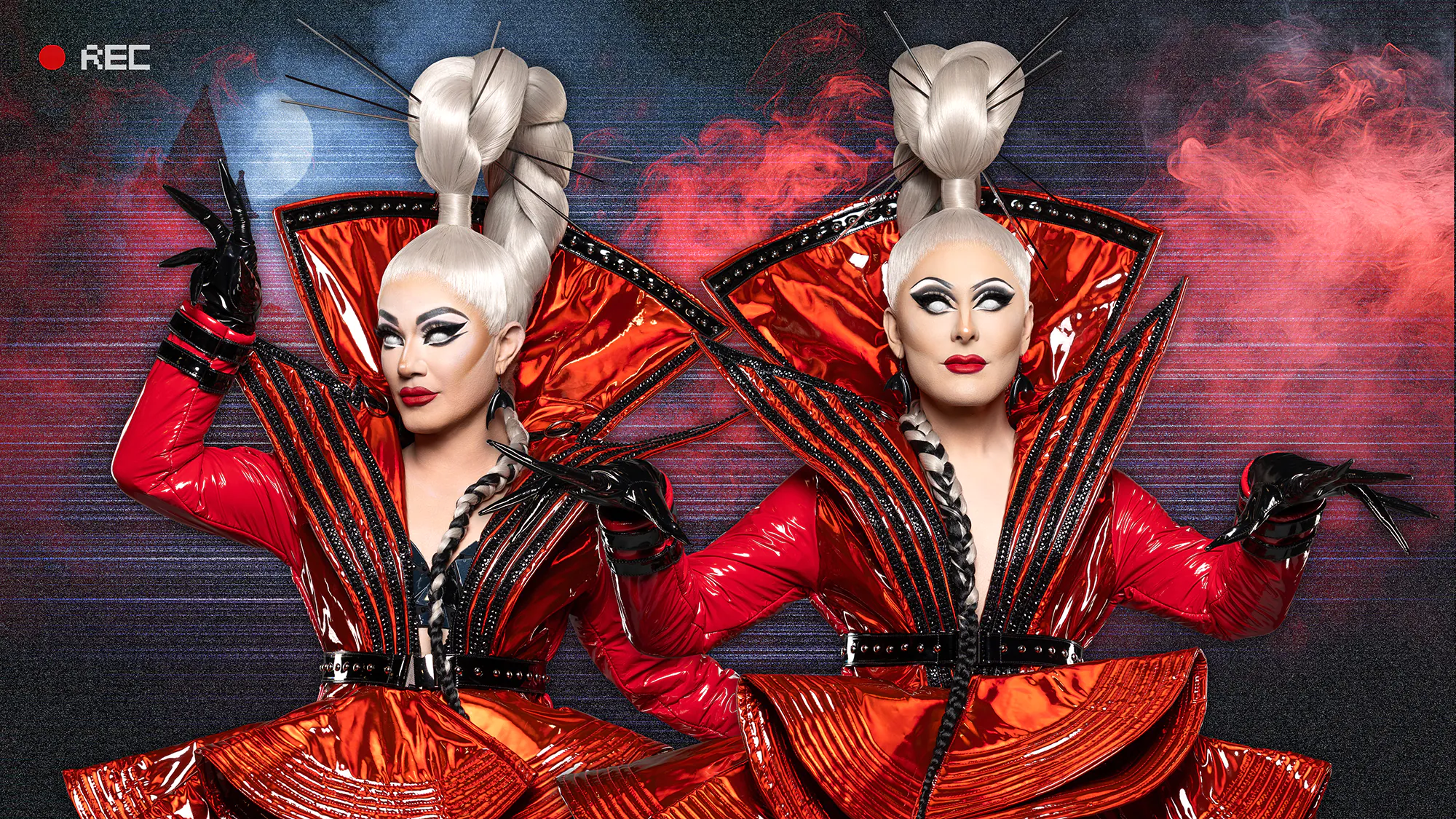
For the Boulet Brothers, drag has never been about playing it safe. Since launching The Boulet Brothers’ Dragula, Dracmorda and Swanthula have built a world where the grotesque is glamorous, and the outcasts get their moment in the spotlight. “We really just get off on creating fiction for people to live in,” Dracmorda says of the creative philosophy behind the series. “We wanted to make the show. We knew we wanted to get into reality TV, and we decided that we just really loved this event that we did and thought it would make a great reality TV show.”
The original event was a live pageant celebrating the uncelebrated: a deliberately tongue-in-cheek search for the neighborhood’s ugliest person, with “ugly” understood as a compliment. Rather than pitch the concept to a network and hope for the best, the pair invested their own money in a pilot season, determined to demonstrate that an audience existed for their particular brand of monstrous entertainment.
They were right. What began as an extension of their nightlife world became a television platform for drag that embraces horror, filth, glamour, and alternative performance without sanding down its roughest edges. Now approaching its tenth anniversary with Season 7, the new season promises a volatile mix of drama, boundary-pushing looks, and horror-inspired spectacle.
Over the last decade, the show’s evolution has unfolded alongside a dramatic shift in how the public perceives drag. The art form has become more visible and commercially successful, yes, but queer nightlife spaces continue to disappear, and anti-LGBTQ+ rhetoric increasingly targets drag performers and transgender people.

For Swanthula, that contradiction is both frightening and galvanizing. “It’s scary and kind of disgusting,” she says. “It reminds us that what we have achieved and what we have created is … it shouldn’t be taken for granted because, as you said, we can slide back and absolutely have.”
Still, she finds hope in people pushing back against political attacks on queer communities. Visibility matters, she argues, especially when the opposition works so aggressively to limit it. “Now more than ever, it’s important to be upfront and center and loud and taking up space and visible and just defying the negative propaganda and the targeting of our community,” she says.

For the Boulet Brothers, that visibility also means expanding the public’s understanding of what drag actually is. Dracmorda points to the trans performers and drag kings who shaped the duo’s early experiences. Their understanding of drag was never limited to one kind of performer or presentation. The art form they encountered in New York nightlife was broader, stranger, and more politically charged than what mainstream television often showcased.
“It just feels good to show people that there’s more to drag than what they have been fed on TV,” she says. “You do not need to be a man to do drag or male presenting.” Dracmorda credits RuPaul’s Drag Race with helping drag become a multimillion-dollar business, creating opportunities and financial rewards that were much harder to come by in earlier eras. But she also believes mainstream success has come at the cost of artistic compromise.
“In order for Drag Race to be successful, they had to take the art form and water it down to the most digestible content for middle America,” she says. Swanthula sees the distinction less as a competition between shows than a difference in artistic perspective. She explains that Drag Race reflects RuPaul’s own experiences with beauty, performance, music, and fashion. The Boulet Brothers’ Dragula, by contrast, draws on a world shaped by club culture, rave scenes, fetish communities, and the people who have always existed outside conventional boundaries.

“The drag that I saw coming out and coming into myself was very experimental,” Swanthula says. “It was across the board, it was dark, it was sexual, it was loud, it was political, it was dead wrong, and it’s what I loved about it.” That history is central to the show’s identity. Rather than asking its performers to fit a predetermined image of drag, Dragula makes room for everything that resists easy categorization. “We’re going to reflect the dark, the ugly, the good and the bad,” Swanthula says. “And I think people felt that raw realness.”
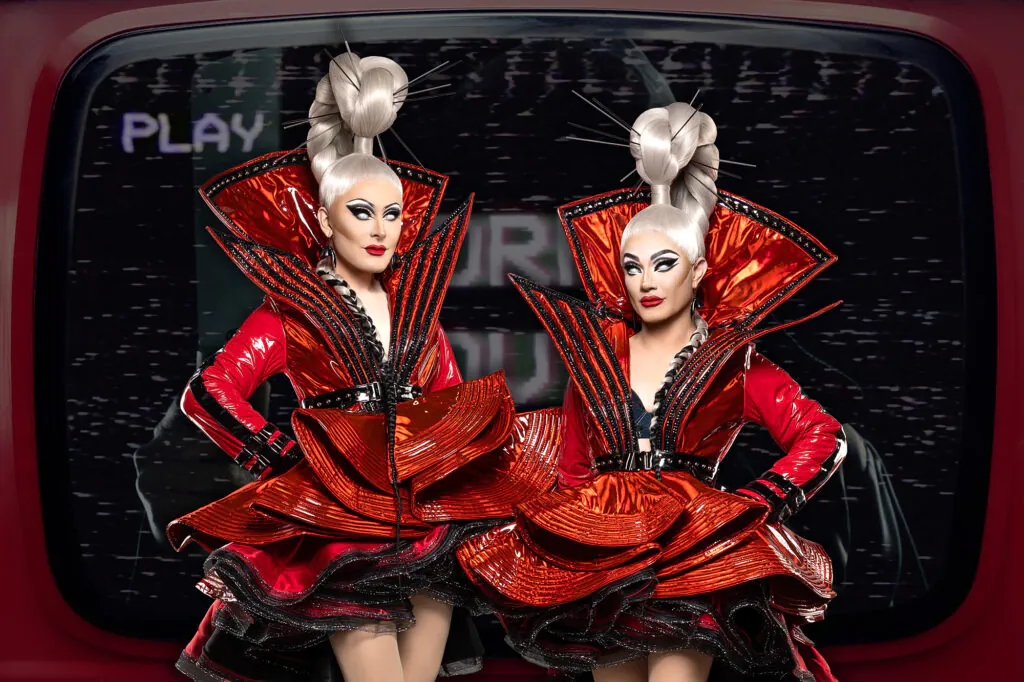
That commitment to experimentation extends beyond the competition itself. This season, the Boulet Brothers are leaning further into scripted storytelling, using the show to pursue their filmmaking ambitions. “All of the death scenes this season are shot-for-shot recreations of famous ’80s and ’90s horror movie kills,” Dracmorda reveals. The horror elements also reinforce what distinguishes the series from more conventional competition shows: its willingness to treat genre filmmaking, practical effects, and creature design as integral parts of the drag experience rather than decorative extras.
“I think seasons one and two had a very certain flavor to it because these artists were raw unknowns,” Dracmorda says. “I think this year is a total return to form in that regard.” Following the previous Titans season, the new installment offers a contrast in both energy and casting. The Boulet Brothers are excited to introduce performers who bring an unpredictable edge to the competition.
The season's guest appearances further connect Dragula to the wider horror world. Some guests are longtime friends of the hosts; others are people whose enthusiasm for the show has led to unexpected collaborations. Among the standouts for Dracmorda is Rose McGowan, whose work and public persona have long fascinated the host. McGowan's connection to filmmaker Darren Stein, with whom she worked on Jawbreaker, made the appearance especially fitting. They also single out Lloyd Kaufman of Troma Entertainment, whose irreverent, transgressive approach to filmmaking makes him a natural fit for the show's sensibilities. “He was like, ‘Yes, oh my God, I’m a super fan. I want to do it,’” Dracmorda says, recalling how enthusiastically Kaufman agreed to participate.
David Dastmalchian, a close friend of the Boulet Brothers, is another returning favorite. Swanthula, meanwhile, is particularly pleased to have Doug Jones join the lineup. Though not a drag artist, Jones has spent much of his career transforming himself into elaborate creatures and monsters, often enduring hours in costume and makeup. “He absolutely knows exactly what it means to be in a costume all night or for 12 hours a day,” Swanthula says. “It was just great to have him. It was very natural, super easy, and a great guy.”
The guest list reflects the overlap between the worlds that have always informed Dragula: horror cinema, creature performance, underground queer culture, and the art of becoming something other than yourself. For the Boulet Brothers, those connections are personal. Both grew up reading FANGORIA, whose coverage of horror makeup and practical effects helped shape their imaginations.
Appearing on the magazine's (incredibly sold-out) cover remains a career highlight, Dracmorda says, and a genuinely validating moment. Swanthula already has her sights set on a return. “In 2027, we’re ready for our next cover,” she says.
Watch the premiere episode of The Boulet Brothers' Dragula Season 7 on October 27 on Shudder! In the meantime, catch up on the Emmy-nominated Boulet Brothers' Dragula Seasons 1-6, The Boulet Brothers' Dragula: Titans Season 1, and The Boulet Brothers' Dragula: Resurrection, streaming now on shudder.com & AMC+.