Last Updated on November 4, 2025 by Angel Melanson
There are certain landmarks in horror that change everything. Jaws made us afraid to go in the water and simultaneously created the modern Hollywood blockbuster. John Carpenter’s Halloween made suburbia dangerous and set the stage for the entire slasher boom. Scream reinvented the genre in the mid-’90s through self-awareness and meta humor. And in the 2000s, Saw forced audiences to question how much we could actually handle.
But between all those milestones, there was something else. Something that changed horror just as much, maybe even more, and never really gets the credit it deserves. And it didn’t happen in theaters. It happened on primetime network television.
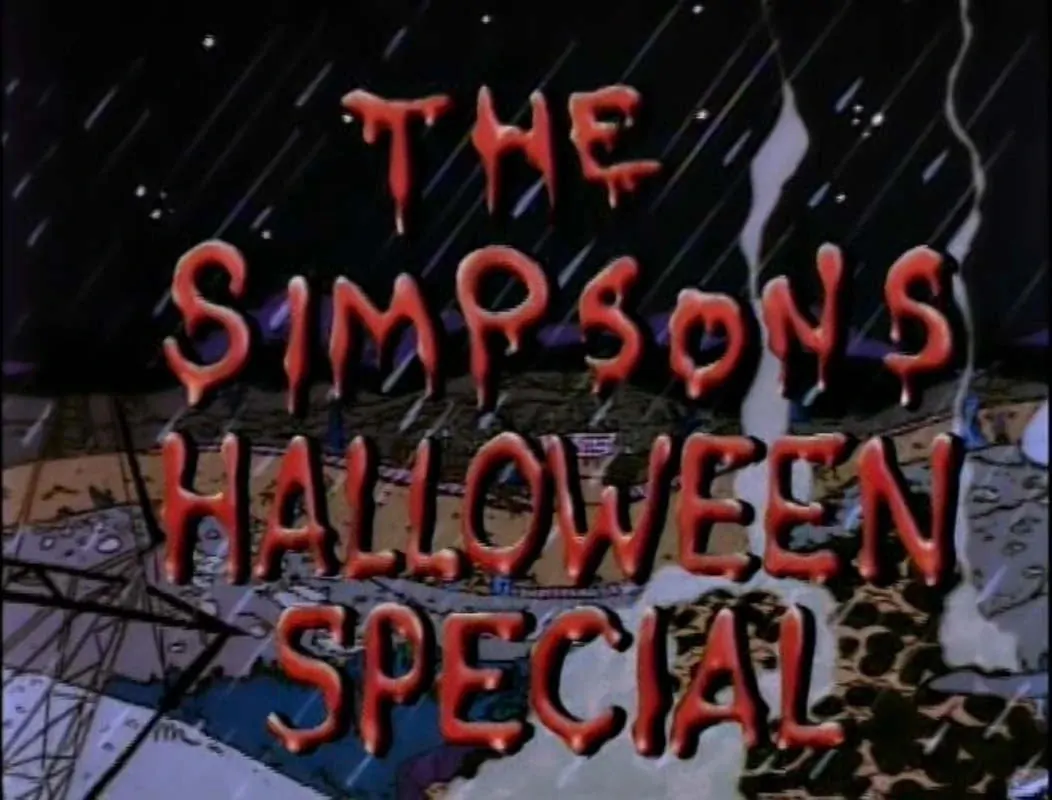
It was on October 25th, 1990, when a family from Springfield, once accused of being the “downfall of Western civilization,” decided to take a break from their usual half hour of chaos and air something entirely different: a haunted house story, a sci-fi alien abduction, and a dramatic reading of Edgar Allan Poe’s “The Raven.” They did all of this on a Thursday at 9pm (8pm Central), on a network that wasn’t supposed to survive, at a time when TV still clutched its pearls at the idea of even saying the word “hell.” They broke all the rules and at the same time created new ones.
None of this was supposed to happen. But it did. And thirty-five years later, The Simpsons Halloween Special still feels revolutionary.
Why This Shouldn’t Have Happened
Television in 1990 was sanitized comfort food. The Cold War was ending; the Gulf War was just getting started; network programming leaned into family unity and moral clarity. Wholesome sitcoms like Full House, Family Matters and Cheers ruled the hour, once euphemistically called “family viewing.” The FCC’s decency expectations lingered even after the formal “family hour” policy faded; blood, realistic death, or damnation before 9 p.m. could mean angry affiliates and skittish advertisers.
The climate produced truly odd artifacts. In 1986, CBS kept The Twilight Zone’s 1964 episode “The Encounter” out of syndication over “disturbing racial overtones” and violence. A 22-minute, black-and-white morality tale was deemed too provocative for daytime reruns. And then four years later, Fox aired a cartoon with bleeding walls and demonic possession.
Fox’s status as the scrappy fourth network mattered, too. The Simpsons was its unruly breakout hit, and executives understood that trying to declaw it would kill the magic. The result: more latitude than any sitcom should reasonably expect.
The Cartoon Loophole
The secret weapon wasn’t just satire. It was animation.
Psychologists call it aesthetic distance: our brains treat drawn violence and death as symbolic rather than literal. The same gag that would read as graphic in live action becomes comedic in ink. Scott McCloud’s “masking effect” explains the empathy trick: the simpler the face, the easier we project ourselves onto it. Springfield’s big eyes and rounded silhouettes let The Simpsons go darker while feeling strangely universal.
The FCC guidelines and advertiser sensibilities were written with live action in mind. Cartoons lived in a gray zone: “fantasy,” not “realistic depiction.” Bugs Bunny can dynamite Daffy. So Homer can be electrocuted or possessed and still make you laugh. The show exploited the ambiguity and used humor as a pressure valve. Animation, here, is a Trojan horse; it slips horror and critique past the gate.

“We Warned You”: A Meta Inheritance
The Halloween Special was equal parts creativity and love letter to the horror genre, and that’s evident right from the opening frame. The episode opens with Marge delivering a deadpan warning. It’s a direct echo of Edward Van Sloan’s curtain-speech before Frankenstein (1931): a “word of friendly warning” that the film might shock or horrify. Back in 1931, Universal used it as reputational armor against censors, while accidentally priming audiences to be more afraid (shoutout to expectancy bias and anticipatory arousal). Simpsons co-creator James L. Brooks revived the device for two reasons: meta-humor aimed at pearl-clutchers, and plausible deniability for a nervous network. Like the 1931 foreword, the disclaimer doesn’t calm the viewer; it programs them. And through the magic of parody and the soothing voice of Marge Simpsons, in retrospect it feels like the show is not only doing a satire of this warning, but also providing rebellious satirizing commentary on the strict FCC guidelines and folks who were uptight about this nuclear family who resided on Evergreen Terrace.
Genesis: How the Special Came Together
The writers’ room loved EC Comics and The Twilight Zone, so they framed the special as an anthology with Bart and Lisa swapping tales in the treehouse straight out of a Crypt Keeper playbook. It wasn’t “Treehouse of Horror” yet, even though they were telling their horror stories in the treehouse. The original title card read The Simpsons Halloween Special. Then they went all in, and the result was the following:

“Bad Dream House” (written by John Swartzwelder)
The Simpsons buy a suspiciously cheap colonial. Voices urge murder. The house bleeds. According to the DVD commentary, director Wes Archer and animation director David Silverman studied Poltergeist storyboards, using green/magenta glows and moving shadows to mimic live-action camerawork in 2-D. The dining-room vortex was layered with multiple transparent cels for a primitive motion blur; the bleeding walls were hand-painted watercolor streaks photographed on a separate layer. Fox’s Standards flagged the blood; producers argued, “It’s a cartoon.” The result: note dropped. Along with The Simpsons' writers' room microphone.
It’s Amityville’s “new homeowner’s nightmare” meets Poltergeist’s portal mythology, inverted by Swartzwelder’s sensibility: in Amityville, evil consumes innocence; in Springfield, chaos defeats evil. The final gag of the house stating, “I can’t stand living with the Simpsons,” is a thesis statement: even the supernatural can’t out-dysfunction this family.

“Hungry Are the Damned” (written by Jay Kogen & Wallace Wolodarsky)
A love letter to The 1962 Twilight Zone episode “To Serve Man,” in which the alien Kanamits promised plenty and the big twist revealed their book was a cookbook. Kogen and Wolodarsky keep the skeleton but swap the Cold War solemnity for late century irony. Enter Kang and Kodos, fluorescent pulp throwbacks designed in the spirit of EC’s Weird Science and Weird Fantasy (think Al Feldstein/Wally Wood: domed helmets, single leering eye, ooze). The lighting on the ship, sickly greens and purples, is deliberate EC pastiche. And the red lighting cues invoke Argento/giallo feels.
Where Serling delivered mankind’s doom through trust, The Simpsons delivers alien disappointment through cynicism. Lisa’s hilarious triple dust cover-reveal of How to Cook for Humans / How to Cook Forty Humans / How to Cook for Forty Humans is a perfect meta-Serling gag. It was a twist on the twist ending that managed to simultaneously parody and pay homage to the original source.

“The Raven” (adapted by Sam Simon; directed by David Silverman; narrated by James Earl Jones)
The prestige crown jewel of the half-hour special and the biggest risk of the entire episode. Matt Groening worried it was “too pretentious”; James L. Brooks argued it would be the heart. Silverman staged it like a mini silent film: chiaroscuro lighting, slow pans, hand-painted candle flicker overlays. James Earl Jones recorded the narration in one session, because of course he did; Dan Castellaneta added Homer’s interjections later, turning Poe’s meter into a duet between gravitas and goofiness.
The text is essentially verbatim. The humor isn’t mockery. It’s juxtaposition: Homer mourning “lost Lenore” while Bart, as the Raven, needles. Teachers immediately clocked the utility. For an entire generation, this wasn’t just their first introduction to Edgar Allan Poe, it was Edgar Allan Poe.
The Sound of Suburban Horror
The finer details of the horror homages filter all the way down to the music itself. Music, as we know, is as much a central character in horror as demonic dolls and slashers. This was composer Alf Clausen’s first Simpsons episode, and it nearly featured a real theremin (the classic 1950s B-movie instrument), but precision tuning clashed with the show’s timing. Under the gun, Clausen synthesized a “mock theremin” with detuned strings, slide whistles, and a pipe-organ patch. That wobbly glide, playful but uneasy, became the sonic signature for every Simpsons scare cue to follow. It’s musical irony: danger wrapped in whimsy. Clausen managed to be Hermann, Beltrami, Bishara, McCreary, Goblin and Carpenter all in one.
Pop-Culture Preservation (a.k.a. The Animated Horror Museum)
Before YouTube explainers and horror Twitter, the annual special functioned both as a syllabus for horror newbies and also a living, breathing archive to serve as a reintroduction to:
- Literary Horror: “The Raven” made Poe classroom-friendly. “The Island of Dr. Hibbert” (2002) revived H. G. Wells’s Moreau with Springfield citizens being spliced into beastmen, a neon cautionary tale about scientific hubris.
- Cinematic Horror: “The Shinning” sent newcomers to Kubrick; “Nightmare on Evergreen Terrace” let kids understand Freddy’s grammar; “King Homer” re-mythologized King Kong; “Easy-Bake Coven” reframed witch panics like The Crucible for the mainstream.
- TV Horror: Beyond “To Serve Man,” the series translated Serling’s ethics for the '90s:
- “The Bart Zone” riffs “It’s a Good Life.” Omnipotent child as tyranny (power without conscience becomes childhood without consequences).
- “The Genesis Tub” echoes “The Little People.” Godhood as a trap (Lisa becomes captive to the micro-civilization that worships her).
- “Homer³” mirrors “Little Girl Lost.” A tear in the living room wall becomes a doorway to incomprehensible geometry (rendered as then-jaw-dropping CG), undercut by the gag of Homer wandering into live-action Los Angeles.
The effect is preservation through parody, parody that stays true to the source material. The specials didn’t just reference horror; they kept it alive, refreshing the archive every October. For the coming of age audience in the '90s (like myself), it was this safe introduction to stuff like The Shining or A Nightmare on Elm Street.
And through it all, The Simpsons also taught us what horror can do beyond the scares: it can make us laugh, think and remember.
Legacy: Family-Friendly Anthology Horror
One weird experiment became a ritual. The ratings were enormous by any era’s standard (tens of millions of viewers in 1990). More importantly, the show normalized the Halloween episode as a creative laboratory. And other sitcoms, from Boy Meets World to The Office to Community to Brooklyn Nine-Nine and many others, followed suit by treating October as a license to break tone and canon.
That very tonal elasticity of a hard laugh followed by a flinch ripples into the likes of Scream, Shaun of the Dead and What We Do in the Shadows. It paved the way for shows like Are You Afraid of the Dark, Eerie ,Indiana and even Buffy the Vampire Slayer. Meanwhile, Treehouse minted icons of its own: Kang and Kodos as perennial emcees of mischief, Devil Flanders as the most polite Lucifer in pop culture, and “Citizen Kang” serving as evergreen political satire.
And to this day, these specials remain an index of our anxieties: nuclear dread, Y2K, surveillance, pandemics, AI, etc, all filtered through humor and the body armor of animation. In a world that gatekept genre, the series democratized it. In a TV landscape that once told you the monsters had to wait until after the nightly news, The Simpsons said hold my (Duff) beer.
Nevermore (And Again)
When James Earl Jones’ distinct voice full of gravitas spoke the word “Nevermore,” in retrospect it seems he was doing more than simply reciting Edgar Allan Poe. Because from that moment on in 1990, nevermore would primetime television be the same. Nevermore would horror references live in obscurity.
The beautiful thing about this is that The Simpsons didn’t set out to change television with their Halloween special. They simply set out to do something weird. But by sneaking ghosts, aliens, and Poe into family hour, they made space for horror in daylight and made satire a civic service. And at the heart of all of that is this genuine love for horror and storytelling. That’s why this works. That’s why it lasts. Anything truly game-changing doesn’t set out to be so; it's really a matter of coming from a genuine place and, if it's in the cards, then the title of gamechanger is bestowed on you. Thus is the case with “The Simpsons' Halloween Special” and the subsequent “Treehouse of Horror” specials that have been going strong for the last 35 years.
Horror is an ever-evolving genre. Sometimes the benchmarks are easy to spot, but sometimes all you see are the effects of impactful events without ever seeing the source. But when you really look at the trajectory of horror and television from 1990 onwards and trace back those steps, you’ll see that all roads lead you right back to Springfield… in whatever state Springfield happens to be. It’s only fitting that a show known for predicting the future would also be a key contributor in changing horror and TV as we knew it.
Want to know more? Listen to Jon's That Was Pretty Scary episode about The Simpsons Halloween Special, out today! That Was Pretty Scary is a hub for all things scary fueled by the love of horror. New episodes are released Wednesday wherever you get your podcasts.
Hosted and produced by Jon Lee Brody.
Executive Producers: Freddie Prinze Jr. and Alexis Cardoza