
Editor's Note: This was originally published for FANGORIA on August 2, 2002, and we're proud to share it as part of The Gingold Files.
M. Night Shyamalan has said that he’s not a genre director (which is why you won’t see him talking to Fango), but whether he likes it or not, he is one—just an atypical kind. In Signs, as in his breakout film The Sixth Sense, he creates a horror film that is less about scaring people than it is about people being scared. In other words, Shyamalan seems less concerned with frightening the audience than he is with frightening his characters and then examining how they behave.
Which is not to say that Signs isn’t a scary experience; the last act whips up palpable tension and a couple of genuine seat-jumpers. Here, however, as elsewhere in the movie, Shyamalan does more with less; he generates gasps with the smallest of onscreen gestures by generating a mood of creepy anticipation beforehand. The quiet chill of this film is a welcome relief in another summer of overkill; there’s more emotion in a simple scene of Mel Gibson trying to see under a door behind which something may be lurking than in all of the three bazillion special FX George Lucas tosses at us during the climax of the latest Star Wars.
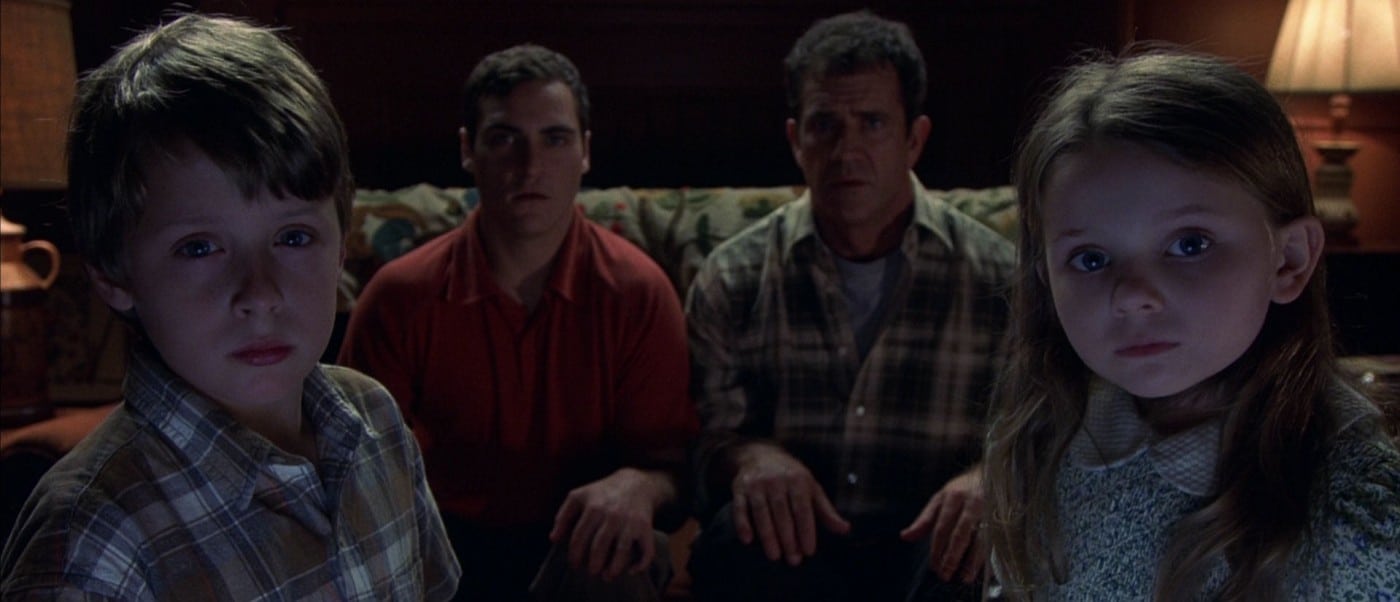
Shyamalan announces his intention to ground his bizarre events in reality in his very first shot. We see a bucolic cornfield in morning sunlight, and then the image begins to distort. Extraterrestrial influence? Nope, the camera is just pulling back, viewing the tableau from behind the old, rippled window glass in a Pennsylvania farmhouse. The house is occupied by Graham Hess (Gibson), a former priest who has lost his faith, his brother Merrill (Joaquin Phoenix) and Graham’s two children, Morgan (Rory Culkin) and Bo (Abigail Breslin). The absence of a mother in the household and Graham’s renunciation of his religious duties point to at-first unspoken traumas in the family’s past, which come to light as the Hesses deal with a more immediate concern: Crop circles have appeared in the cornfield, portending what Morgan quickly comes to believe is alien invasion. Graham, who no more believes in the extraterrestrial than he now does in the spiritual, has doubts—even in the face of further “signs”…
More I will not say about the plot, since the film is best experienced knowing only what the ads and trailers have already revealed. What can be said, and what helps the movie work, is that it eschews war-of-the-worlds clichés to focus on how this one specific family deals with events that may have global consequences, and how the experience forces them to confront internal problems and emotions they would otherwise not express. Shyamalan and the actors create a believable onscreen family, with the director once again demonstrating his gift for depicting the dynamic between parents and children (or surrogate children, in the case of Sixth Sense).
And like Bruce Willis in Sixth Sense, Gibson here submerges his cocky action-hero persona to compellingly present a man whose conflicts are internal, who doubts himself but will ultimately draw on every resource he has to protect the children in his care. Phoenix, whose Merrill has past disappointments of his own to deal with, matches Gibson step for step, and Culkin and Breslin are very fine as the Hess children. (The only casting misstep is Shyamalan’s own appearance in a small but pivotal role; not that he’s especially bad, but his presence is a distraction that disrupts the film’s carefully crafted reality.)
The result demonstrates the age-old truism: You get scared for the characters because you identify with and feel for them, not because the director is throwing every weapon in his CGI arsenal at them. The FX he does utilize are terrific, and the movie on the whole is technically first-rate, with kudos to Tak Fujimoto’s photography and James Newton Howard’s Herrmann-tinged score.
Some might feel that Shyamalan wears his and his characters’ emotions too much on his sleeve, and certainly there are scenes here that walk the knife edge between heartfelt and overwrought. Shyamalan’s accomplishment, however, is to allow the viewer to accept these moments in the emotional context of the movie, thanks to the complete assurance he displays in his own material. He clearly believes in his story and characters, which makes it easier for an audience to believe in them too. One of Signs’ ultimate messages is that there are no accidents, and that rings pretty persuasively when presented by a filmmaker with such confidence in what he’s doing.