

Last Updated on March 16, 2024 by Matt Donato
Rodo Sayagues is a man of many nightmares as Fede Álvarez’s co-writing partner on Evil Dead and Don’t Breathe, but it’s baby bird’s time to fly. Don’t Breathe 2 marks Sayagues’ directorial debut, born from a narrative that has many original fans pondering “hows” and “whys.” You may remember Norman Nordstrom as the maniac with a sticky turkey baster from Don’t Breathe, now the protagonist of Don’t Breathe 2. Again, “protagonist.” Don’t read that as “hero,” which we’ll dive into shortly. Suffice it to say, Sayagues’ duties as screenwriter and director were no doubt cranked up to another difficulty level in terms of the character exploration taking place–one that centers on a monster given a second act.
I sat down with Sayagues to chat about Don’t Breathe 2 and the trials of filming an intimate, action-packed survival thriller under COVID-19 regulations. We discuss the idea of bringing back Norman Nordstrom in the sequel’s capacity, the difference between a “protagonist” and a “hero,” and how Jean-Claude Van Damme works his influences into Don’t Breathe 2. As Sayagues says, what’s the fun of filmmaking if there’s no challenge? It takes a certain kind of courage to swing so hard on your first feature.
Fangoria: Don’t Breathe could exist as a standalone, but you and Fede Álvarez chose to test sequel waters—what was so special about Don’t Breathe that attracted you to a continuation?
Rodo: Before Don't Breathe we did Evil Dead in 2013, which I co-wrote with Fede and he directed, and that was our first movie—but Evil Dead was something that we inherited from Sam Raimi. We had the privilege, but it wasn't our own story. Well, It was in a way because Sam let us play as much as we wanted with his material, but Don’t Breathe is our first original. That alone is very special to a filmmaker. It doesn't happen too often in Hollywood. In this industry, it's all remakes or existing IPs. Making Don’t Breathe and seeing how well that movie was received by audiences was very special for us.
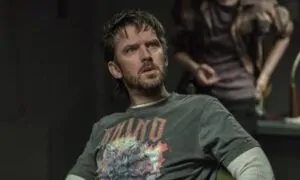
The story in Don’t Breathe was not finished. In the first movie, there are two parties, the blind man and Rocky (Jane Levy). They get away with their crimes, both of them. They strike a deal. Rocky flees with the money, so that leaves the movie in a certain balance—but these two people get away with their actions, especially Stephen Lang's Norman Nordstrom.
We thought the most exciting thread to follow was exploring how the life of Norman Nordstrom would continue. You have a psychopath—how is his life going to play out after Don’t Breathe? Is he going to behave the same? Is he going to start feeling any remorse? Is he ever going to understand what he did? Or is Norman Nordstrom going to live his life oblivious to the pain and hurt he has caused many people? Is his past ever going to catch up? Is he ever going to be punished? There are so many questions about how Norman Nordstrom's life would continue in the years to come after Don’t Breathe and we believed it was worth exploring that story.
Fangoria: There are other ways the sequel could have gone—you could have taken the easier “Norman chases Rocky” path—but you did not take the easy route. Norman is the villain of Don’t Breathe; how do you turn a villain into a protagonist?
Rodo: If the idea was to examine Norman Nordstrom, you have to put him in the front seat to take a closer look. That's the way to do it. The problem is that sometimes people confuse the idea of being a protagonist with being a hero. Hollywood has pushed this “protagonist equals hero” idea so much that you instantly connect the two, but that's not true at all. Over the past 4,000 years of storytelling, you can tell the villain's story from his perspective. That doesn't mean you have to either identify with him or root for him.

You're witnessing the story of Norman Nordstrom. That was the point. Let's explore this character; there are so many layers because he's not just a bad guy that wants to conquer the world like a fairytale villain. He's very nuanced. We made sure in Don’t Breathe to let you know why he did the things he did. I don't share his methods or approve of anything, but I look at him, and I understand that's a guy who’s been wounded by a failed system. Norman felt that he needed to take justice into his own hands. It's all means to an end. Norman chose this path of misery and pain, isolation, loneliness. He went down a spiral of violence and ended up spreading that everywhere.
Yes, it’s challenging. It’s harder, but that's what we’re enthusiastic about—if it's not challenging, it's not worth anything. It's a lot more fun when there’s an obstacle to overcome.
Fangoria: I like how Don’t Breathe 2 is about monsters fighting amongst themselves—it feels very seedy and like 80s action or exploitation. Were there particular films you had in mind when creating Don’t Breathe 2?
Rodo: Well, there are two sides to that question. My conscious mind can recognize, “Okay, there's this movie that I'm going to reference or look into for inspiration.” Then there's my subconscious mind, plagued with movies from the 80s—lower budget, bad flicks from the 80s—that lurk in the back of my thoughts, and they escape through a crack.
When we were prepping Don’t Breathe 2, I ended up watching Jean-Claude Van Damme’s Cyborg. I told my DP, “You know what? This set we built and the lighting reminds me of Cyborg.” I was like, “That wasn't conscious at all, it just burst through.” When I watch the movie now, I see what you're talking about—all these bad guys that look like they exited a time machine from the 80s, the way they're dressed and behave. It's rooted so deep within us as creators. I embrace those instances.
Fangoria: Oh, I made a note how Don’t Breathe 2 feels like something Schwarzenegger or Stallone or Van Damme would have starred in back then—it has an inherent action star feel.
Rodo: I don't know how old you are, but those guys were my heroes growing up. When we locked the idea for Don’t Breathe 2 we thought, “Has this or something similar been done before?” The first title that came to mind was The Terminator. In the first Terminator, Arnold is a clear villain who is very scary. Now, we all know Arnold and his sweetness—but when The Terminator came out, he was scary, really terrifying. Then in Terminator 2: Judgement Day, he becomes the character we all know today. James Cameron did that. He flipped the narrative, changing perspectives.
There's a difference. In T2—even though it's the same actor—it's not the same character because, in the beginning, he says, “I look like the robot that came before me, but I'm a different robot.” In a way, we thought, “Look, if James Cameron did that, then yeah, we can too.” It's a good road to follow.
Fangoria: Was there more choreography preparation in this sequel with Stephen Lang since Don’t Breathe 2 is more action-oriented? How does he find the character of a blind veteran with almost superhuman abilities?
Rodo: Stephen is an exceptional actor with a lot of experience, and on top of that, he's incredibly hardworking. He dedicated a lot of time to prepare for Don’t Breathe 2. At a physical level, Stephen always stays in really tremendous shape, works out three hours a day, and follows a strict diet. Whether he's shooting a movie or not—he's always ready. For Don’t Breathe 2, Stephen spent a whole month visiting the Northeastern Association for the Blind in Albany. He researched to understand and integrate how visually impaired persons move around a world that is not made for them. Stephen spent a lot of time there acquiring knowledge. So when he came to the set, he had a million ideas.
In terms of the action sequences, he's always ready for that type of challenge. He wants to do as much himself as possible rather than using stunt doubles. Most of the fighting is him. He gets tough. I had to work more with the other actors, letting them know Stephen will push them hard.
Fangoria: Madelyn Grace is a trooper in this film given the trauma her character endures—how was her demeanor on set after those nasty scenes, and what impressed you most about her performance?
Rodo: She was so ready for Don’t Breathe 2 even though she was 11 years old. Madelyn has chops; she's been acting in school and theater lessons since she's five. She knows all the ropes; she surprised me every day during production.
We made sure to create an environment around Madelyn that would make her feel that it's all a game, which is what filmmaking is. If you're on a movie set, it's all a game, and everybody's usually having fun, so we emphasized that around her especially. She was playing; she was enjoying; she was always the one that wanted to go further. When we were done on a particular day, she was like, “Can we do this again tomorrow? Can we go for another two or three hours more?” She's so energetic.
When you see the final product and a shot with Madelyn, it’s cut with something nasty that she's “witnessing” or something that was not on set at the time. It's all make-believe. Her mother was present, her teacher as well. It's my first time directing a kid actor, so I came in curious about how the dynamic of that was going to work and very careful because she's a child. How do you navigate that relationship? This whole system is wired in a way that makes it great for children. She was having more fun than any of us, being honest.
Fangoria: This is your directorial debut—what’s the best piece of advice you received coming into the production, and who gave it to you?
Rodo: I was very fortunate to have two mentors—Sam Raimi on one side and Fede Álvarez on the other side, so imagine the privilege. How many first-time directors can say that? I had Sam Raimi and Fede Alvarez available, especially Fede; he's just one phone call away. All I can say is those guys were there for me all the time, and Fede helped so much throughout the whole process. Even in post-production, Fede came in and had a million ideas that elevated the movie. To list what advice they gave me would be an impossible task.
Fangoria: So let me ask this then—was there an instance on set where you looked inward and impressed yourself? Like, “Wow, I can’t believe I pulled this off?”
Rodo: Actually, yes! At a certain point, we were shooting, and it's very stressful for us; the clock is always ticking. Something was not working that seemed impossible. Everything pointed in the direction that this scene was just not going to happen. Everyone around was looking at me with faces like, “Dude, not going to happen. This is a disaster. We failed.”
I was about to collapse. I went to the bathroom. I started having that monologue with myself, “What are we going to do? What am I waiting for?” I know the answer. “I'm waiting for someone else to solve this for me.” That's what I'm waiting for, but I'm the director. I'm the one who has to click into the mindset of, “It is possible.” My job is to shift the perspective and make everyone believe the impossible is possible, even when you feel it's not.
I came back to set, and I said, “Hey, now it's going to work.” Everybody looked at me like, “Are you crazy?” I was like, “No, no, no, trust me; it's going to work.” I understand I have no idea how this will work, but it's my job to say that it will. You know what? Funny enough, the take worked. I remember going back to the hotel that night; I'm thinking, “Wow. That was a magic trick.” In actuality, I realized, “You know what? It's my job to lead in those terms. To make everyone believe that what we're trying to achieve is possible.”
Fangoria: Self-doubt is a huge thing, same here. How often have I told myself I can’t do something not because I tried but because I prematurely convinced myself it was impossible?
Rodo: Exactly. Most of the time, you're waiting for someone else to come up with a solution, but I think the epiphany that I had is that because of the position where I'm at, that someone else is me. I have to be the guy who comes with a solution, so let's do it.
Fangoria: Now, this was a pandemic production, so I want to ask—was the screenplay finished pre-COVID? If so, were there adaptations that had to be made to adhere to safety guidelines?
Rodo: No, it didn't hurt the story at any level. It just changed the way that we worked because there were a lot of restrictions and protocols. We had to get those nasty, uncomfortable PCR tests every other day, so precautions like that.
On theme with what we were just talking about, trying to find the flip side to everything that looks not good or negative? I realized that the restrictions helped us focus on what we were doing. It was more conducive for the tasks we had ahead. Usually, you're shooting a movie, and during the weekends, people would take short trips here and there; we would have visitors on set. Everyone gets distracted easily. After three months of working on the same project, you want to relax a little bit, so you plan a getaway, or bring friends, or invite your family.
In this case, we had to be in lockdown. Shooting Don’t Breathe 2 and nothing else made us concentrate a lot more on what we had to do. The actors were locked down from the hotel to the set, set to the hotel, and nothing else. It helped us dive deeper into the world that we were creating, into the creative space that needs to happen for us to make a movie.
Fangoria: You and Fede already knocked one remake out of the park (Evil Dead), and you’ve got The Texas Chainsaw Massacre on the way, but I’m wondering—if you had your pick of any horror film or franchise, what would you bring the Rodo/Fede treatment to next?
Rodo: For me, this is the way I see it now. I realize working on an existing IP or doing your original movie, at the end of the day, it's the same thing. What matters most? Is the story worth your time? Do you believe that it's a story worth telling and putting out there into the world? It doesn't matter whether it comes from me or it comes from someone else because that's just an ego thing at the end of the day. Where it comes from, it's secondary.
When Fede and I write a movie, it's a collaboration. He brings his ideas, I bring my ideas, and we create a script. It's no different than if I would adapt a book written a hundred years ago because that would be a collaboration with that writer. There's a time difference there, but at the end of the day, it's the same experience. It's a person bringing their ideas, their points of view, and me working on top of that, adding my ideas before something new comes to life. The only difference is that if that person is dead, I cannot exchange ideas, but it's co-writing at the end of the day. It's a story. If I love the story, I'll do it—simple answer.
Fangoria: So it sounds like your advice to anyone approaching a remake is to make sure it collaborates with the source material first and foremost?
Rodo: There you go. It’s what we did with Evil Dead—we were just lucky enough that the creator was right next to us.
Don't Breathe 2 will be in theaters August 13… which also happens to be a Friday.
