
Editor's Note: This was originally published for FANGORIA on September 27, 2009, and we're proud to share it as part of The Gingold Files.
One of the motivations for writer/director/producer Donald P. Borchers to do the Children of the Corn remake that just aired on Syfy was to create an adaptation that was more faithful to Stephen King’s chilling short story than the one he produced back in 1984. But the movie’s DVD (coming from Anchor Bay) reveals another reason: This film is a Statement as well.
In an on-camera interview, Borchers proclaims that he wanted this interpretation of King’s tale of a youthful rural cult to be a parable about religious extremism and the current crisis in the Middle East. This is no doubt why the new Children (following a 1963-set prologue) takes place in 1975, so that protagonist Burt (David Anders) can be a Vietnam veteran, a key source of the tension between him and wife Vicky (Kandyse McClure) during their drive through the Nebraska farmlands. (The fact that they’re interracially married, which might be expected to have also caused some problems in middle America in those days, is never addressed.) There’s lots of forced, on-the-nose dialogue regarding Burt’s Nam experiences, and when he’s later being pursued by the killer kids through the cornfields, Borchers actually throws a bunch of Viet Cong, machine-gun fire and tracer bullets into the sequence.
You can probably surmise at this point that the 2009 Children is not an improvement on the 1984 version, which certainly left room for it: That film featured two of the dumbest protagonists in horror history, wasted veteran actor R.G. Armstrong as a cliché-spouting (“It’s just the wind!”) rube and, sorry, but John Franklin’s squeaky-voiced turn as corn cult leader Isaac always struck me as more goofy than scary. The redux stays truer to King by making its central couple a dysfunctional one, but Vicky’s constant haranguing of Burt gets really old really fast, which doesn’t exactly help maintain sympathy for her. Nor does the fact that she seems incapable of seeing the young stalkers even when they’re strolling or running one at a time past their car. At least the original Burt’s dialogue howler, after he runs down a young boy who proves to have had his throat slashed (“He was already dead when he stumbled out into the road”), has been improved to “He was as good as dead when I hit him”—but Children ’09 tops it when Burt later asks the little cultists, “Why don’t you put that in your God and smoke it?”

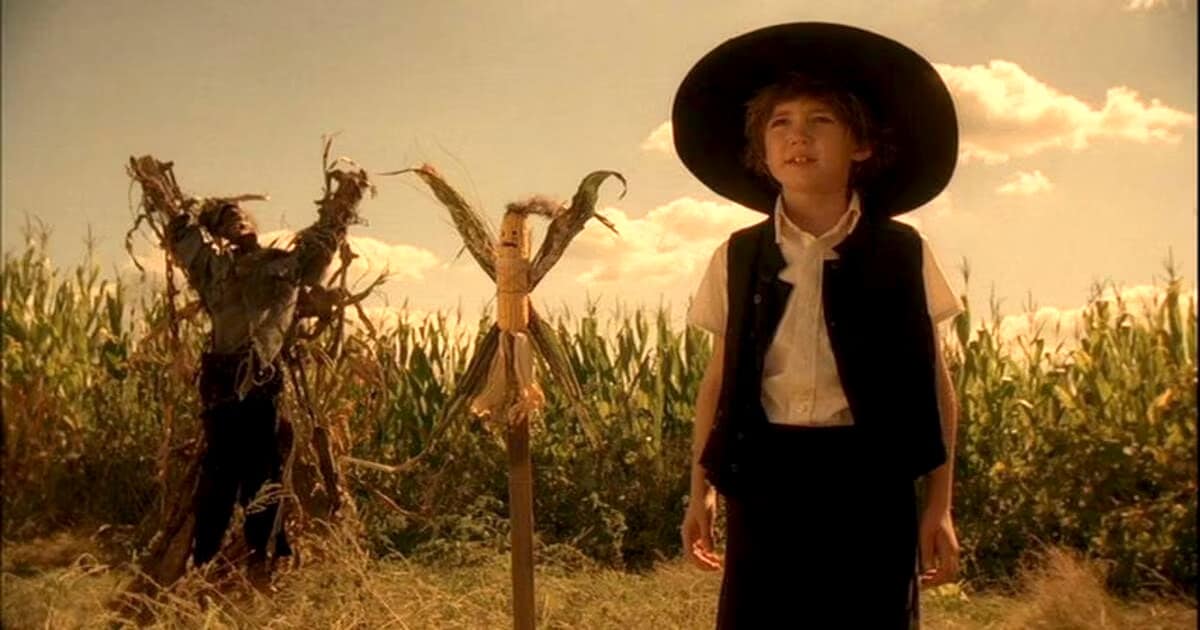
Like the ’84 feature, this one defuses the tension and mystery of King’s story by revealing the kids’ evil right up front, though Borchers doesn’t bother to actually show us their massacre of the adults in his opening scene, just the stabbing of a pig. His Children of the Corn are cast more age-appropriately than their big-screen predecessors, but the new Isaac (Preston Bailey, who plays Cody on Dexter) comes off as more petulant than possessed of an unholy spirit. He also wears an oversized hat that, when he’s photographed from behind, makes him look a bit like Spaceballs’ Dark Helmet. While Borchers retains King’s ending this time around, the climactic action is intercut with a ridiculously gratuitous sex scene between two of the older teenaged Children—it’s the “time of fertilization,” you see—and when He Who Walks Behind the Rows finally makes His presence known, we’re never even given a look at Him.
The “uncut and uncensored” version contained on the DVD doesn’t add much gore to the one shown on Syfy—the extra explicitness is more evident in that bout of fornication—and it looks and sounds sharp enough in the widescreen transfer. The movie is accompanied by the 45-minute “Rough Cuts: Remaking Children of the Corn,” divided into four parts. “New Directions” is where Borchers announces his intentions to make this film a political allegory, and to improve on the “Hollywoodized” original (whose writer and director he gallantly fails to name, acting as if he was its sole creative force), which King disapproved of. One has to wonder what the Maine man will think of this interpretation, on which he shares a writing credit with Borchers—who admits that King declined to read his new script, a revision of the author’s initial ’84 draft.
“Cast of the Corn” sees Anders discussing details of Burt’s backstory and McClure addressing elements of the social climate of the ’70s, which sound interesting, and it’s a shame they’re not more evident in the movie itself. In “To Live and Die in Gatlin,” production designer Andrew Hussey and Alan Tuskes, on-set supervisor for Robert Kurtzman’s makeup FX company, share interesting details about the challenges of shooting in real cornfields and creating appliances for then-uncast young characters, respectively. “Fly on the Wall” is a collection of on-set footage from a few key moments—though the best behind-the-scenes bit appears in “To Live and Die,” when the juvenile actors are seen returning their weapons to a prop box at the end of the day’s shooting. Too bad that, on screen, these kiddie killers have nothing on the terror tots of the recent The Children or Orphan’s Esther (played by Isabelle Fuhrman, who’s on hand here too, but only as an “Additional Voice”; bet the filmmakers are kicking themselves over that one now). Both of those movies also DVDebut next month, and either one is a better bet than this Corn ball.