
Editor's Note: This was originally published for FANGORIA on October 14, 2002, and we're proud to share it as part of The Gingold Files.
Horror films, in one sense, can be more specifically defined based on how much information the audience is given. Alfred Hitchcock once described the famous example of a bomb going off in a crowded room; if the viewers don’t know beforehand that it’s there, that’s a simple shock, but if they do, that’s suspense. (If both the audience and the characters know it’s there, that’s a slasher sequel, but I’m getting off track.) Below, which is generally well-crafted and well-acted, isn’t entirely satisfying because it plays too coy with key information; it’s like a room where the audience thinks a bomb might be there, but isn’t really sure.
At the end of Below, scriptwriter/director David Twohy’s follow-up to his justly successful Pitch Black, one character asks another how he would explain what has happened to them, and he replies that he doesn’t know. And anyone watching can only nod in recognition. Adapting a previous screenplay called Proteus (by Requiem for a Dream’s Darren Aronofsky, who stayed on as producer, and Lucas Sussman), about a monster on a submarine, Twohy reconfigured the tale as a subtler mood piece, in which the crew of the U.S.S. Tiger Shark is plagued by inexplicable events that may or may not be supernatural in origin. There’s nothing wrong with sustaining this type of uncertainty, but such a story does require some kind of payoff, and Twohy tries to have it both ways right up until the end. Are the sailors being haunted by a ghost, or can the mechanical oddities and hallucinations be chalked up to accidents and oxygen deprivation?

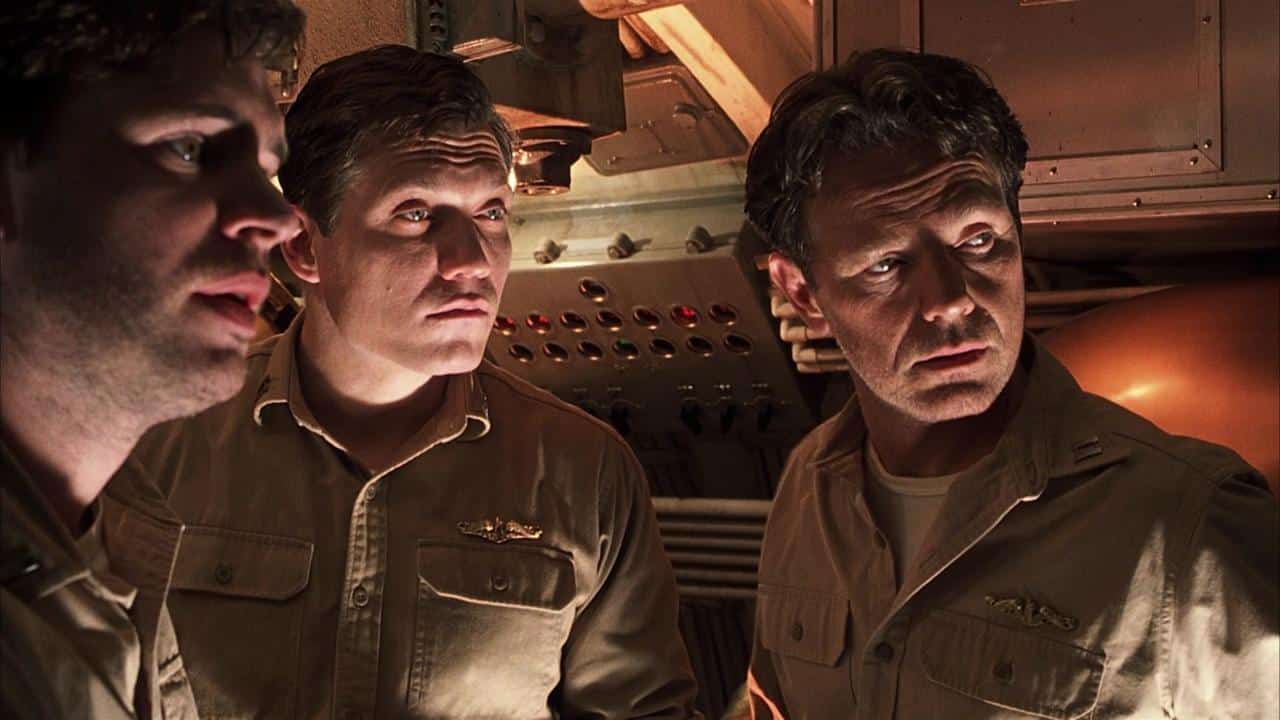
Twohy’s point seems to be not whether they ever find out what is afflicting them, but how they react under the literal and figurative pressure. As such, the movie does sustain a decent amount of tension, thanks in part to an impressive physical production and a generally strong cast. Bruce Greenwood is Lt. Brice, acting commander of the Tiger Shark, which picks up a trio of survivors after their hospital ship is sunk. But not all on board are happy to see the newcomers: One is a German, not a welcome passenger in the thick of WWII, and the other is a nurse, Claire Paige (Olivia Williams). Women are seen as bad luck aboard submarines, and sure enough, things start to go wrong soon after her arrival. A record plays by itself; strange voices are heard; ghostly faces are seen. If that’s not bad enough, the crew also has to evade the ever-present threat of Nazi ships above them.
A submarine is a great setting (claustrophobia + no escape) for a horror film, and Twohy does a lot with it, managing to find a way to convey the cramped atmosphere without knocking off Das Boot (the model all sub pictures since have followed). He also comes up with at least one great setpiece that no such film, as far as I’m aware, has yet used: A depth charge hits the front of the Tiger Shark but doesn’t explode, and the crew waits in fear as it bounces its way down the length of the sub, threatening to go off at each hit. There’s also a tense setpiece in which a few sailors must venture outside the sub and then inside the hull to fix an oil leak. Moments like these, based on realistic scenarios, work better than anything involving the paranormal phenomena, since Twohy’s approach dictates that the latter add up to little more than teases.

Still, thanks to the good cast, we believe that their characters believe something spectral is going on. While no one performance stands out, that’s because they form a tight-knit ensemble that is convincing as a group of men stuck together (and ultimately falling apart) under oppressive circumstances. Matt Davis, as the seaman who emerges as the story’s hero, and Williams elicit the necessary sympathy, while genre fans will enjoy seeing familiar faces like Jason Flemyng (Bruiser) and Nick Chinlund (The X Files) among the supporting cast. Twohy has also marshalled the movie’s technical elements well; like Pitch Black, this is a modestly budgeted production that looks and sounds like an A-picture.
Pitch Black, however, had a clearly defined threat, with the great gimmick that its nocturnal monsters were at their most efficient when it was the least possible to see them. A variation on that idea appears to have been the guiding principle behind Below, as well—that the most frightening things are those that can’t be fully discerned. But there’s a difference between being mysterious and simply being evasive, and as far as the horror content is concerned, it results in a nagging feeling of frustration when Below is over.