
Last Updated on March 16, 2024 by David Obuchowski
PART 4: LATE SUNDAY AFTERNOON DEPRESSION
In the previous installment, it’s revealed why and how close the film came to not being, and how it was saved. Karl Geary (who played Renfield) explained how he came to be involved in the project, having never acted before, revealing a connection between himself and the author, who recalls how a move to New York was like waking up from the dead.
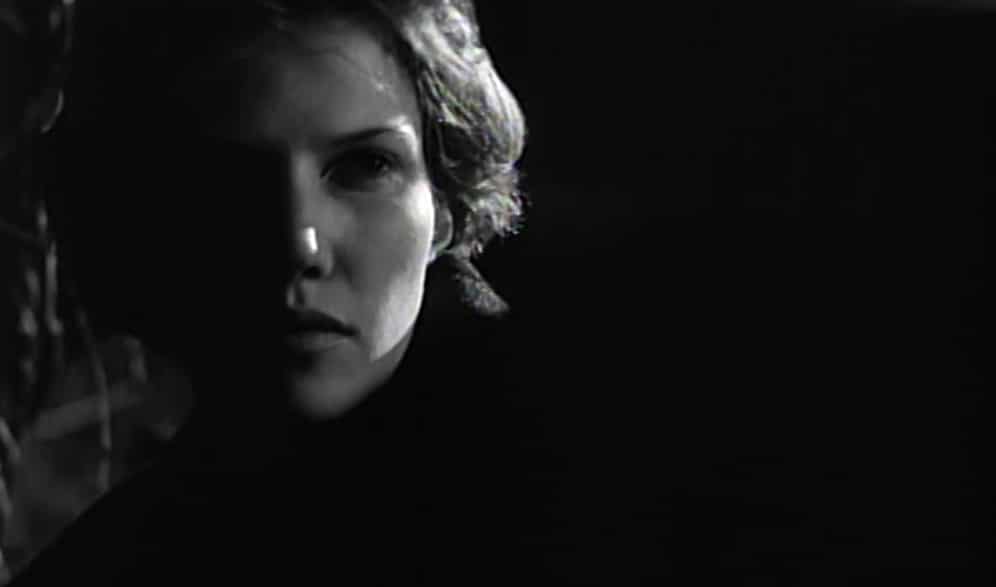
Nadja doesn’t really see herself as a vampire. She sees herself as a woman with a lifelong curse that she must live with and fight against. This is how I view my own lack of self-confidence, my crippling self-doubt. It’s been there since I was young, when I wasn’t even certain of who I was or who I was supposed to be.
I was cast early on as an athlete. I played the part but I hated athletics. And so I was angry, though I lacked the courage to truly rebel. Mine was a passive rage, and consequently, I grew withdrawn, got middling grades; I smoked and drank, seeking some different feelings and sensations.
Then right around the time I saw Nadja, I tried to break the curse. I quit baseball and threw myself into endless hours of work at a video store where I lied about my age just to get the job. Worked 32 hours per week while I was going to high school.
When I wasn’t at work, I was playing in a punk band, trying (and failing) to express my confusion and rage through meaningless words about girls and things like that. I was a mess, but it was still an improvement.
But I couldn’t spend all my time screaming into a mic, banging on a guitar; couldn’t spend all my time among the VHS tapes.
Sundays were the worst. Sundays, when the day grew late and school loomed for me, and work for my parents. It would have been better to go to sleep at 3pm and wake up on Monday morning and march off to another grinding week than mark the hours that stretched on endlessly in the dying light of Sundays.
My friends didn’t get it. There were great shows on TV on Sunday evenings. Big, delicious meals were served on Sundays. Sure, it was a bummer that school was the next day, but Sundays were half the weekend. Sunday afternoons and evenings were a quarter of the weekend. So how could I hate Sundays?
I dreaded Sundays.
***
Every once in a while, you hear a lyric, or read a passage in a book, or watch some moment in a movie, and it touches you in a way that makes you feel as if someone, maybe for the first time, understands something about you in a way no one else does. At least, that’s how it feels when you’re a teenager.
There’s one of those moments for me in Nadja. And when it happened in the theater back in August of 1995, it felt as if maybe the entire film had been made and shipped to the Angelika for one reason, and one reason only: so that I would see it. Me.
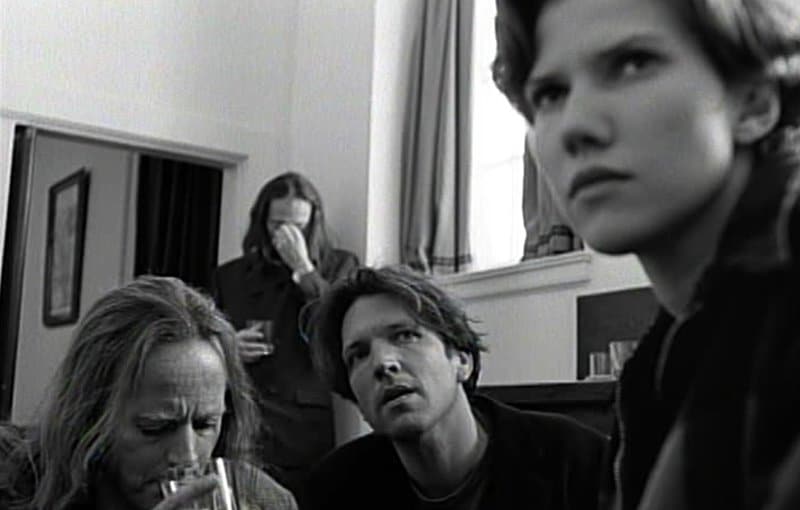
After her tryst with Nadja, Lucy is behaving strangely. She’s detached. She’s gloomy. She’s preoccupied. Her husband, Jim, is worried. His uncle, Van Helsing, suspects something supernatural is afoot, and he asks him how she’s been acting lately.
“She says she loves me. She says she can't imagine living without me. But she's been spending too much time alone lately,” Jim says thoughtfully. Then, he adds: “She keeps getting that late Sunday afternoon depression every day.”
Late Sunday afternoon depression.
When I heard those four words, I nearly stood up and cried THANK YOU! But I didn’t. Rather, I took them, and tucked them inside my chest. Anyone who saw the film heard those four words, but they didn’t hear them like I did. It was like a secret, hidden in plain sight. A secret whispered from the screen to my soul.
I would go on to make a few ridiculous (and terrible) short films in college. Those always included the credit: Late Sunday Afternoon Depression Production Company. (Not a real company.) I would have a few small musical projects and would self-release them on tape or CD under a fictional label called Late Sunday Afternoon Depression Records. And after college, I made an effort at running a zine distributed in Austin, Chicago, New York and a few other places. The name of the zine? Late Sunday Afternoon Depression, of course.
Early on in my communication with Galaxy for this essay, I texted her a photo of four old copies of the zine and I asked her if she recognized the title of the publication.
“Yes, from the line in Nadja. I think I wrote that line,” she texted me. “Actually, now that I remember, it was a short story I wrote that Michael read.”
Michael confirmed this when he’d replied to a set of questions I’d emailed him about the film. “As Galaxy must have told you, the Sunday afternoon depression line came from her.”
***
As Galaxy recalls, Nadja was made when she was an undergraduate at Barnard, where she was studying creative writing. (Filming, she recalls, “definitely coincided with a Christmas break or something.”)
To make a little money in college, Galaxy occasionally appeared as an extra in films. Her first part, she says, was in the 1991 remake of A Kiss Before Dying. But, as she told me, “I think [it] was edited out… I was like a girl on the street, like, a heroin addict or something… it was weird.” (IMDb lists her as playing the role of Susie). Shortly thereafter, Woody Allen and his crew showed up at Barnard to shoot Husbands and Wives.
“I auditioned to be an extra,” she says. But instead, “he gave me kind of like an elevated role.” She was given lines, though they were edited out. Still, she’s definitely in the movie, playing one of Woody Allen’s former lovers in a single, lingering shot.
Despite the lack of lines, she was now in an actual Woody Allen film. And so that made her, technically, an actor. She wasn’t working toward that as a career by any means, but she was happy to do it for employment. Meanwhile, she had other employment that was actually relevant to her aspirations: she was a contributor to Details magazine and was an intern at Interview magazine, which published a short profile of her along with an excerpt of her story, “Vinegar Hill,” and her photograph.
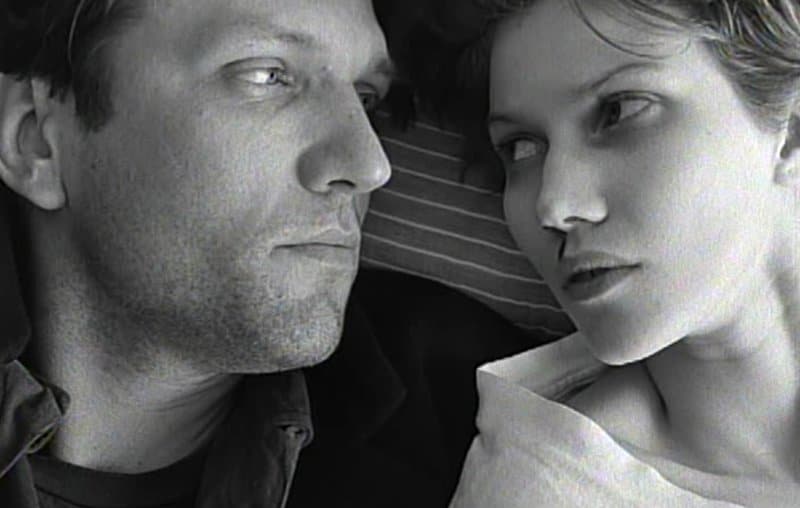
“I saw a photograph of Galaxy in Interview magazine, where she was presented as a writer, not an actress,” Michael Almereyda wrote to me. “I told [producer] Amy Hobby, ‘This is what Lucy should look like.’ When we shared this with Billy Hopkins, the casting director, he let us know that Galaxy was an actress as well as a writer, and he encouraged me to meet with her.”
So Galaxy came in to meet with Michael, and also provided more samples of her writing.
“She shared pages of various kinds of writing – sketches, mostly,” he wrote to me. Among them, word-for-word, was “her short speech when Jim is lamenting her condition: ‘Monday I ate half a bagel, hot tea, and a can of coke. Tuesday I ate two diet cokes and a piece of pizza. Today I had a bag of M&Ms, but I didn’t eat the yellow ones.’”
In fact, her audition, Galaxy told me, was her reading these lines. Put another way: her audition was reading her own work.
Between how she looked and the things she said, Galaxy got the role because, really, the role had been hers all along.
***
“I was left with an incredible, beautiful image of this person,” Elina Löwensohn tells me when I mention Galaxy. She’s absolutely thrilled to learn I’ve made contact with her.
“What I loved about her,” she says, “[is that] she had this talent of somehow expressing whatever she was thinking in the moment. Like, with no barrier type of thing. It was poetic and not at all. Some people express their anger or negativity. It’s not about that. It’s almost as if her thoughts were coming out as she was thinking them. It was a certain way of thinking and expressing herself and I found that incredible because I don’t think I’ve met anyone else quite like that, with that sort of personality.”
Her personality, she says, more than made up for her lack of acting experience or training. “She was acting for the first time. There is a different quality of sensitivity and not necessarily the same presence of work like someone who has gone to school, even though we were all young. It was my second feature so I wasn’t so experienced, but I had done some theater and it’s a different way of approaching and incarnating a character. But, besides that, it was really her, the quality of the person that she was,” Elina observes.
Martin Donovan remembers Galaxy well. “That’s the genius of Michael, that he would cast her. He’s amazing that way… The way that he put that movie together, and he’s done it with some of his other films, is this casting that is so unusual that it makes it into something more than just a casting choice,” Martin explains.
“Galaxy brought this thing,” he says. “The fact that she’s not an actress made it so interesting. She had this incredible presence and that look she had. That androgynous look was so appealing and wonderful.” Then he asks, “God, should I retract that? I hope she won’t take offense to that. I don’t know. I mean it as a compliment. Just gorgeous. As I sit here thinking about it, all I can remember is her, the contrast of her hair and her skin with the black and white. The way the light found her. Her hair. And then Elina, the contrast there was just beautiful. Of course Elina is stunning in a contradictory, complementary way. Those two. Now I’m rambling,” he says.
But Galaxy’s character, Lucy, was never intended to make such an impact. In the original script, Jared Harris tells me excitedly, “Her character’s supposed to die! Lucy dies!”
“Glad to know Jared has such a sharp memory. It’s true, Lucy was initially killed off,” Michael Almereyda confirms over email.
I ask Jared if he knows why Lucy was kept alive. “It’s quite hard sometimes to figure out what Michael’s thought process was,” he answers. “He didn’t share a lot of that with you. He definitely was from the French New Wave auteur theory of filmmaking. I’m not sure why. I think he just wanted,” he ponders it for a moment, then says simply, “he didn’t want to send Galaxy packing.”
Indeed, Michael explains, “Soon after casting Galaxy I realized it would be cruel and unnecessary to dispatch the character; more compelling and hopeful to keep her alive.”
When I’d learned this, I had already interviewed Galaxy for about six hours over three separate phone calls. But she had never mentioned her role being expanded. So I immediately follow up with her. Was she aware of that, I ask? “No, I wasn’t aware. I didn’t know that!” she says, genuinely surprised. And then she asks, “When was [Lucy] supposed to die?!”
I tell her how, from what I understood, it was meant to be early on. “That’s good to know,” she chuckles. Then says, “I’m glad [Michael] didn’t kill off my character. It would have made Nadja more unlikable if she was killing people.”
I point out that, in fact, she does kill people. She kills a man at the very start of the film (practically the first scene) and then it’s implied that she kills a couple of mechanics working in their garage later in the movie, as she’s fleeing Van Helsing and his crew.
“Well,” Galaxy says, “Maybe she’s nicer to girls.”
But the truth is more that the Lucy character was supposed to be more of a plot device. In Bram Stoker’s 1897 novel Dracula, the character of Lucy is killed earlier on by Count Dracula, and her death is one of the maior motivators for the principal characters to hunt down and kill the vampire.
Similarly, Lucy’s death in Nadja would have motivated her husband Jim to go on a vampire hunt with his uncle Van Helsing. But then Michael had the realization that the story was richer with Lucy kept alive, in a brain fog, in a liminal space between life and death, yearning for Nadja herself, but clinging to her mortality.
But beyond the writing, it was Galaxy herself. She was simply too interesting to kill. She was just too good an actor.
***
This did not go unnoticed in the industry. Because of Nadja, Galaxy got a manager and an agent. All at once, there was a whole new road ahead for her, should she choose to take it.
But Galaxy wasn’t looking to move to LA, nor was she looking to abandon her dreams of being a writer. Still, she was, at least, willing to see what other interesting work she might get as an actor.
“But I would go on some random auditions, which were often really depressing. Most of them were really badly written,” she told me. And nothing is so frustrating to a good writer as seeing poorly written stuff get made.
“I don't know,” she tells me, “I was thinking about it yesterday, and, I think, like, five out of seven [auditions] were prostitute roles or something like that.”
“Are you kidding me?” I laugh.
“No, I'm not kidding,” she says. “I remember clearly, there were so many movies where it was, like, a drug addict prostitute girl in the street or a call girl or an escort, and yeah. And I was like, wow. I'm like, I'm actually not…”
Here, Galaxy pauses and stammers a bit, not because she doesn’t know what to say, but because she knows exactly what she wants to say, even if she’s not entirely certain of how to say it.
She checks herself because she doesn’t want to offend anyone: “Look, it seems condescending, it seems like – I don't even know the right words,” she tells me, but then she does something I’ll come to observe again and again with her – in the midst of her searching, stammering, self-correcting, she is actually drafting and re-drafting, revising in real time. And now, she’s found it: Auditioning for these roles, she says with sudden clarity, “it’s like you're trying to please someone by belittling yourself.”
And ultimately, these roles, these auditions, this work, it was not for her. “I was a hard-working college student who wanted to be a writer,” she concludes.
***
NYU agreed, accepting her into their Creative Writing MFA program. So, too, did the New York Times, which awarded her a full scholarship and stipend so she could complete the program and teach.
Five years after Nadja was creating a buzz at film festivals around the world, Galaxy’s first novel, By The Shore, was published.
The New York Times described it as an “exceptional book [that] captures perfectly the hopes and hurts of childhood.” Publisher's Weekly noted Galaxy's “seemingly effortless touch,” and called the novel “remarkable and moving.” The San Francisco Chronicle lauded it as “breathtaking” and “note-perfect from beginning to end.”
I, too, faced my demons and read it.
By The Shore is an absolutely brilliant book. So is the followup novel, Tiger, Tiger. Both are poignant and funny and sad stories with rich imagery and magnificent dialogue. Her young adult novel, The Last Princess, shows that she can do suspense and adventure and action as masterfully as she can do nuanced, subtle, character-driven “adult” literature. And I’m truly surprised things haven’t come full circle and we haven’t seen any of her books turned into films.
What I’m certainly not surprised about is that Galaxy Craze turned out to be the one who wrote the four words that would resonate with me more than any other combination of four words in literature, film, or anything else: late Sunday afternoon depression.
***
If there’s a traditionally correct way to become a writer, Galaxy did it. She got her BA and her MFA and she took on valuable internships relevant to her aspirations.
Not me. I got it wrong from the start. Picked the wrong major. Turns out I should have been a Rhetoric major, where I could have studied Creative Writing. Stupid me, I was an English major. In high school, all the classes where we wrote and read stuff were English classes. It naturally followed, then, that I should be an English major.
Well, what the hell did I know about majors? All I knew when I’d gotten there was that I’d just wanted to write. Write. That’s all I knew. That’s all I desperately wanted. I didn’t spend time researching or exploring and analyzing. I just followed my gut and picked English as my major.
In the first half of my time at the University of Illinois Urbana Champaign, I’d loaded up on required courses and the “gen-ed” courses. So by the time I was midway through my junior year (which would have been late 1999, when By The Shore was captivating readers), all I really had to do was earn credits, and I could do that by taking any classes I wanted to.
And that was when I found out there were Creative Writing classes. My heart sank. What had I been missing? Eagerly and anxiously, I took them as electives. Most of my classmates were Rhetoric majors (like my girlfriend at the time), striving proudly on the correct path toward their goals of being writers. They regarded me as an outsider, and I guess I was.
One day, I wrote a story. I’d written stories before. I’d been writing stories since I was in junior high school. But this one day, I wrote a story in one sitting. It was about a college kid who tries to rush home in time to see his dog one last time before it’s put to sleep. He doesn’t make it in time, but the only thing people seem to really be concerned about is this silly t-shirt he’s wearing. Only now at 42 years old, do I realize what the story was really about. Not about a dog or a road trip or loss or anything like that. It was about not being taken seriously.
It got positive feedback from my classmates. Even my creative writing professor, Michael Madonick, said it was good, which was not a word he often used about any of our work. He encouraged me to submit to the University of Illinois Undergraduate Fiction Contest.
So then I read it to my then-girlfriend, who was already a good writer. I thought she’d be proud. Instead, when I got done, she stared at me for a moment, then said, “I’m the writer in this relationship, not you!”
I was awoken one Saturday morning not long after that by a telephone call from the head of the Creative Writing Department, informing me I’d won the contest. I was awarded a thousand-dollar check and was invited to a ceremony where I gave a reading.
Still stung, my girlfriend – the writer, the real writer – and I broke up shortly thereafter. And yet it took me months, if not a year, to get over the breakup. I’ve often wondered why, when we really didn’t get along and were so mismatched. But like many things in retrospect, it’s clear why I was heartbroken. I didn’t mind her spurning me as a romantic partner. Rather, I was heartbroken to be rejected by the only writer I knew, to be sent away as if I were a trespasser.
“Oh my God. That would actually be a really good short story,” Galaxy tells me.
She would know.
It seems like everyone I’ve spoken with from Nadja would know about good art, and the good life of a good artist. So that is why I was so surprised to learn about what became of Elina Löwensohn (Nadja herself) after Nadja...
Part Five: The Uncertain Future Of Nadja. The Voices In Our Heads. will be published tomorrow.