
Last Updated on May 4, 2026 by Angel Melanson
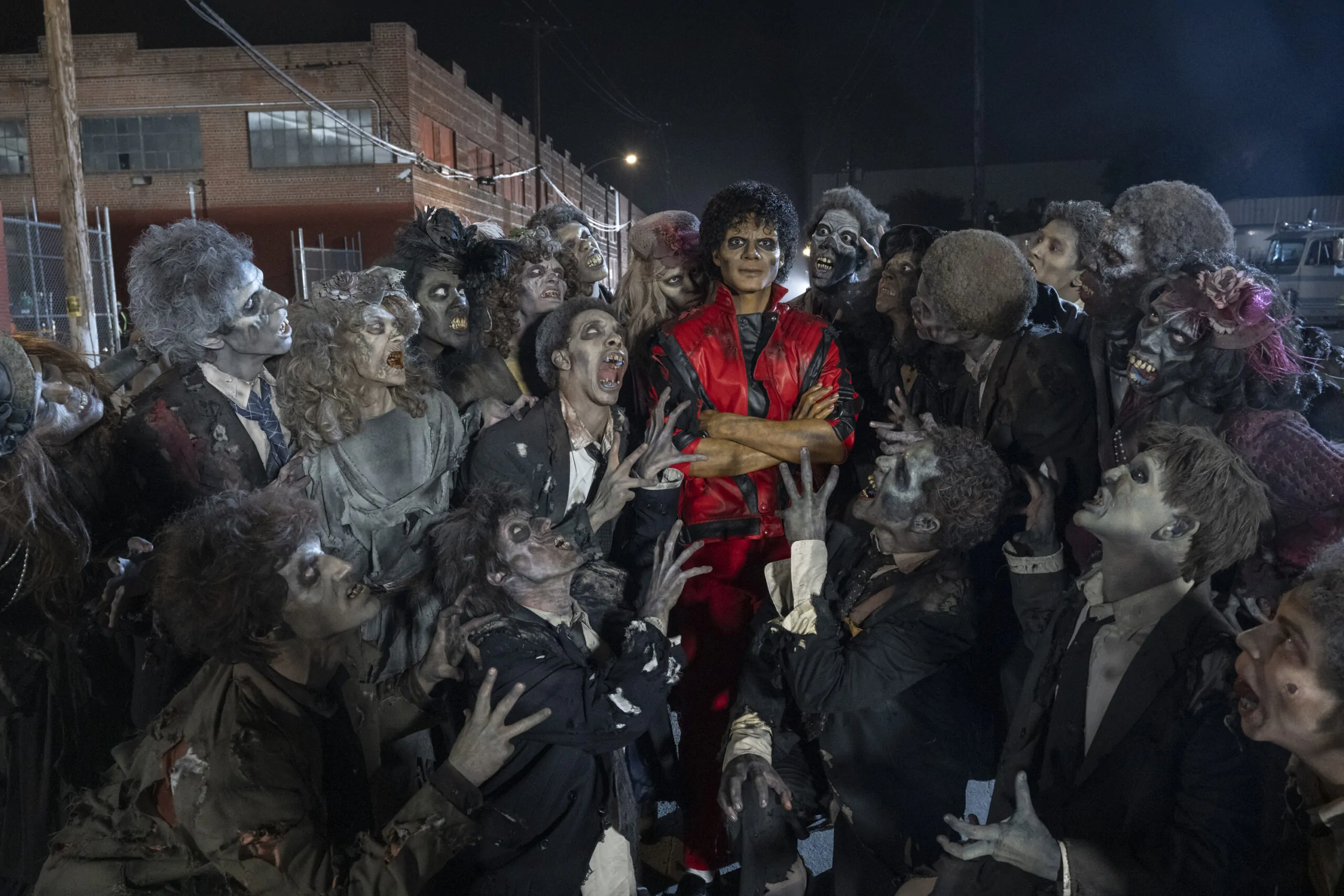
Among the many musical numbers recreated for Michael, the screen saga of Michael Jackson’s life currently in release, one that will strike a chord with genre fans is the Thriller video. For those who first caught it on MTV in December 1983, and saw the Making Michael Jackson’s “Thriller” documentary that became a best-selling VHS tape, it was a seminal achievement. Not only was it groundbreakingly longform, running 14 minutes, it was an all-ages showcase for the kind of zombie and monster makeup, created by legendary artist Rick Baker, that largely had been the province of R-rated movies.
For Michael, makeup designer Bill Corso was tasked with not just physically transforming Michael’s nephew Jaafar Jackson into the star, but recreating the Thriller ghouls for the lengthy setpiece dramatizing its production. Corso, himself a veteran of the art form and an Oscar winner for A Series of Unfortunate Events, has collaborated with Baker on films including Gremlins 2: The New Batch, How the Grinch Stole Christmas, and Planet of the Apes. Here, he speaks with FANGORIA about honoring one of Baker’s most enduring accomplishments.
Do you remember when you first saw Thriller, and its impact on you in your youth?

I absolutely remember. I was a sophomore in high school when Thriller came out, so I was right in the pocket [laughs]. And I was a wannabe special makeup effects guy. I was obsessed with makeup, I was obsessed with Rick Baker, and I had my own little studio space that my dad had put together for me. Before the video even came out, I had a giant poster my dad had scored for me of the Making Michael Jackson’s “Thriller” video box, like they would have had at video stores. So when the video came out, I was, like everybody else at that time, glued to MTV on my TV set. I remember sitting on my floor of my living room and just being gobsmacked. It was mind-blowing.
Thriller was one of the first productions to popularize zombies in the mainstream. We’d had the George A. Romero movies, but they were still kind of considered cult films. And this may have been the first venture in the true mass-market media that centered on the undead.
Absolutely. And remember, the Romero zombies at that point were just painted blue, with that cheesy bright red blood. In Thriller, they were a different-looking type of zombie. Rick took it one step further and did actual corpse-like makeups and skeletal-looking ghouls. He had all the artists in his studio do different types of zombies. So it was the first time we saw that cool level of zombie makeup. That took it to a whole other level.
And then, of course, you had the whole American Werewolf in London influence and the transformation, which was also amazing. You know, American Werewolf, which had come out just a couple of years earlier, was an R-rated movie. And Thriller brought that level of special effects to the masses.

Over the years, you’ve done plenty of both creature and character makeup, and Michael has both. Do you find there’s a different appeal and distinct challenges to each?
Well, creature stuff is fun because you can just go for it and go balls-out. It’s the opposite of subtle, and the more extreme and fun and fantastic you can get, the better it usually plays. Whereas with character makeup, you’re dealing with reality and very extreme subtlety sometimes. It’s adding a couple of eyebrow hairs, or a little depth to a wrinkle, or a mole. It’s a very different set of rules and sensibilities. And you’re doing it for a different type of project, realistic dramas where you don’t want the makeup to even be noticed. You’re just trying to help an actor transform into their role dramatically, as opposed to a fantastical character where you’re kind of showing off. You’re saying, “Here, look at me!” They’re very opposite ends of the spectrum.
One of the things I love about this business is that we get to go from one end to the other sometimes. I’m such a big fan of old-school makeup, where a makeup artist would do The Wizard of Oz and then they’d do Gone With the Wind. Or they’d do Island of Lost Souls, and then they would go off and do The Good Earth. That’s what’s exciting to me: It’s always different.
And honestly, Michael was the bucket-list dream movie I didn’t even know I wanted or I needed. I was such a huge Thriller fan when I was a kid, and it was such a pivotal moment in my life, as a wannabe makeup artist, seeing that making-of documentary. It was the first time we’d ever seen behind the scenes of makeup like that. I mean, they would have TV specials about the making of Star Wars and they would show them putting on the rubber masks, but you never saw prosthetic makeup being applied. And there was Rick Baker, arguably the greatest of all time, painting and putting on the appliances, and taking them off and doing a life cast on Michael. That was a huge moment for me and my whole generation of makeup guys who wanted to do that. It was like rocket fuel added to an already burning flame. So the fact that I got to help design and create all the different looks for the characters in Michael—and I obviously had an amazing group of people working with me—was a dream come true. It encompasses everything I’ve ever done, which is the best.
When you designed the Thriller zombies, how closely did you stick to those in the original video? Did you have any license or desire to go afield from that in any way?
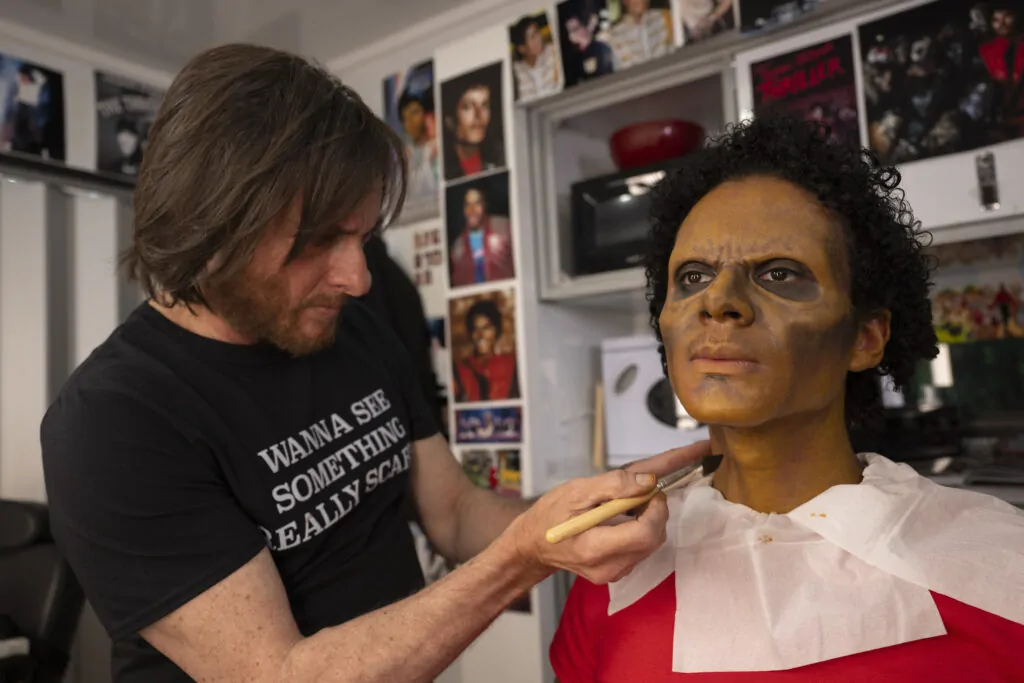
Well, look, I’m a purist. I mean, how many Star Wars movies have we seen where they’ve tried to reinvent Yoda or Chewbacca? I was so specific that we were matching reality, even with Michael himself. Every day he worked, whatever time of year scene we were shooting, we would plaster the makeup room with photos from that era. And Jaafar changed his look so drastically throughout the day, throughout the scenes, we would be bouncing back and forth with different looks, different eyebrows, hair, skin complexion, nose, chin, whatever.
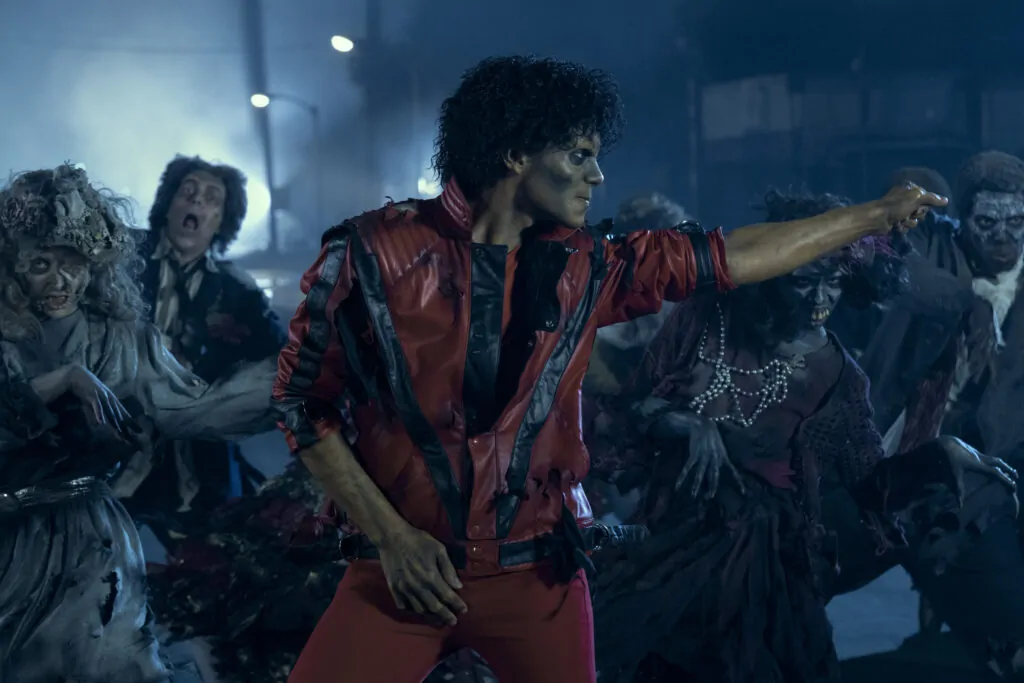
So for the Thriller scene, it was very important that we respected the original. It’s so good. I mean, you can’t mess with perfection. And I was very explicit to the team that we were going to do it exactly the way they did it back then, which was traditional foam rubber appliances. They were white, not pre-colored. Everybody got to use greasepaint, done as close to the original way as possible, because I wanted to have that same exact look. There was no hi-tech silicone, airbrushing, all the things we do nowadays. That entire sequence was done the way it was in 1983.
Were there any particular challenges in doing the makeups for people who were going to be very active and dancing and moving around a lot in the makeup?
Well, there always is. You have to make concessions. The interesting thing with Jaafar Jackson was that he, like his uncle, sweated profusely from his face, which is inherently a great makeup remover. Nowadays, we use silicone appliances, which are incredibly realistic and don’t require a lot of paint, but they don’t breathe. And for a year before we started shooting, Jaafar would dance at the Hayvenhurst house, Michael’s old house; he had the whole place to himself, and he would set up a dance studio and rehearse. I would go over and put makeups on him and just watch them disintegrate as he danced [laughs], trying to figure out ways to be able to maintain it for when we shot.
And it was my good buddy, makeup artist Mike Marino, who just threw out one day, “Why don’t you just do old-fashioned foam rubber? Because we know foam rubber stays on.” It’s porous, so it absorbs sweat. The silicone, on the other hand, would just bubble up; it would look like leprosy. So I tried foam rubber, and sure enough, that stayed on. The greasepaint didn’t break down like all the new modern materials. So every time Michael dances in the movie, I did a very traditional foam rubber makeup with greasepaint, and that held up.
When you were casting the people playing the zombies, did you try to match the dancers who had been in the Thriller video — the same genders and shapes and sizes?
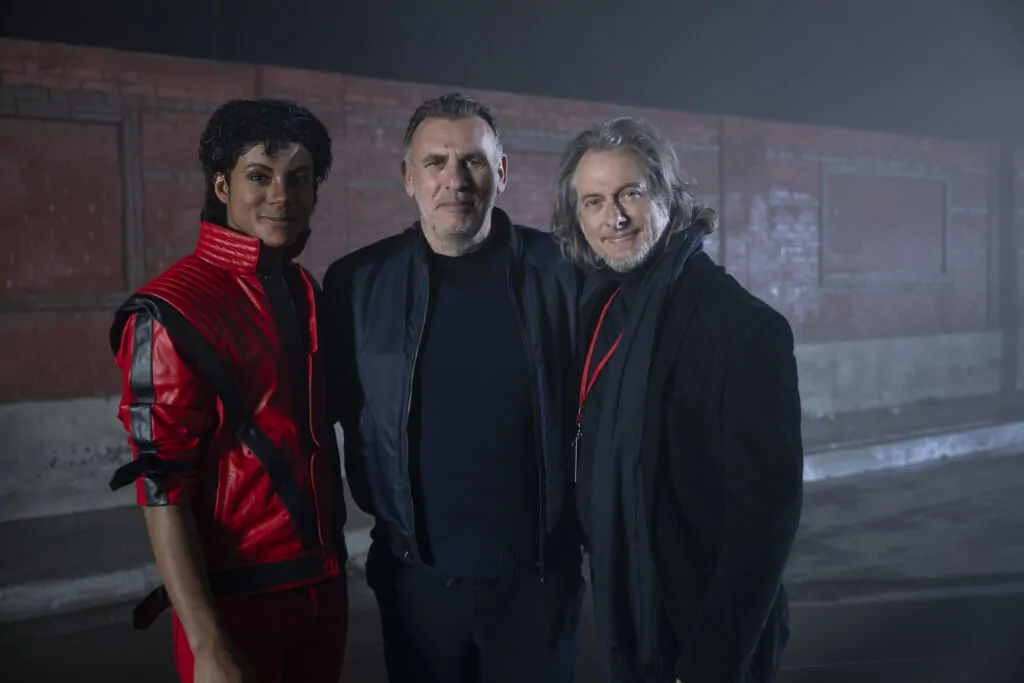
Well, I’m not a casting agent, luckily. The studio and the director, Antoine Fuqua, and Graham King, our producer — their explicit directive to me at the very beginning of the movie was to try my best to match everything. And I guarantee they gave that directive to everybody. I’m sure the casting agents got the same thing, and they had photos of the original dancers. And they and the choreographers, Rich and Tone [Talauega], who were Michael’s actual choreographers for his last few videos and one of his last tours, were very involved in picking the dancers, and trying to be as specific and respectful of the original as possible.
My co-prosthetic designer on the movie, Christien Tinsley, and I went to the 4K restored Thriller video and screen-grabbed every single zombie. Some of them were very hard to get, because there were 25 dancers, and some of them were just in the background; you never see them very well. But we tried to get the best photo references possible. The appliances were sculpted and designed to match each one of those zombies, and we did it exactly the same way Rick did it. I talked to him about it; he was a very sweet, off-book consultant. He told me, “We did four or five different makeups, and everybody just cycled through them. They all used those generic appliances, and made them up differently. So that’s what we did.
Michael was such an amazing group project, reliving a period of time that was so exciting for all of us. The nights we shot Thriller, I invited Rick to come to the set, which was such a full-circle moment. He brought his whole family, including his daughters, who were not born when Thriller was made, and it was a trip for him. He said, “This is honestly the closest to being in a time machine that you could ever be.” Because we shot on the actual street, the actual location all night long for two nights, just the way they did.
What are you working on right now?
There are some projects that I’m talking about. I had dinner with a director in New York about something really fun with Mr. Jim Carrey, who I’ve been with for 25, 30 years now. So we’ll see.
This interview was edited for length and clarity.
