
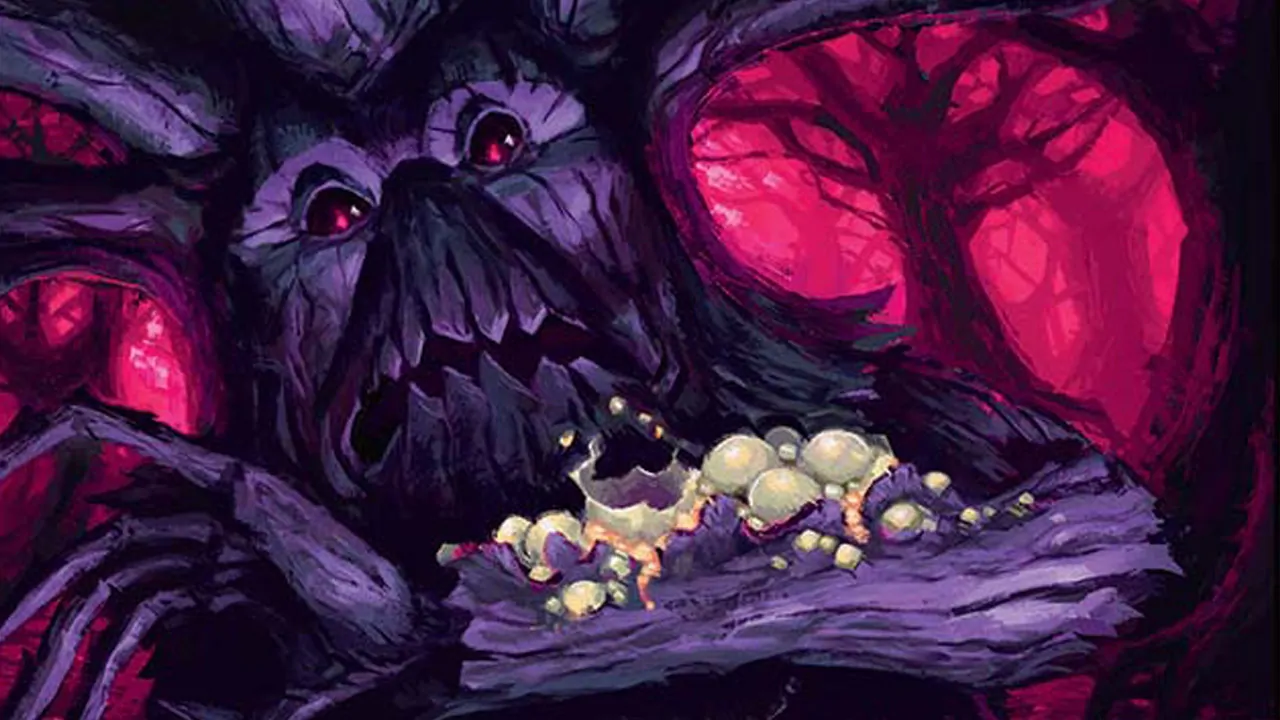
Wizards of the Coast released their first Magic: The Gathering set of the year, Lorwyn Eclipsed, in January, and it is a return to the plane of Lorwyn. With Lorwyn Eclipsed, players aren't just on the bright and sunny Lorwyn plane but also the dark and more sinister plane of Shadowmoor, which features some more horror-inspired monsters and bizarre creatures.
The set is definitely set in a fantasy world, but as is often the case in the genre, there are hints of horror — like Shelob in The Lord of the Rings, or even the practical monsters by Jim Henson in Labyrinth and The Dark Crystal.
We chatted with Neale LaPlante Johnson, the Senior Narrative Designer, and Deborah Garcia, the Art Director, who helped bring Lowryn Eclipsed to life, and how they infused elements of horror into the latest Magic: The Gathering set.
Fairy tales and fantasy tend to blend elements of the horror genre. In the new Lorwyn Eclipsed set, there is a split between day and night, and the night cards have a more sinister side. How did you infuse horror into the new set for Magic: The Gathering?
Deborah Garcia: Shadowmoor is the darker reflection of Lorwyn, so we wanted to utilize its imagery to contrast with Lorwyn. However sunny and bright Lorwyn is, Shadowmoor is equally as dangerous and ominous, but aspirationally so! We wanted to convey that Shadowmoor is still worth visiting if you value high risk for high reward.
The very environment is a trial, with dangerous elementals based on fear and aggression. I loved any opportunity to build on harmful design language, like emphasizing the lengths Kithkin will go to in order to trap and guard their homes—spikes, traps, poison, you name it. We also emphasized pairs of cards where there is a Lorwyn and Shadowmoor version, and you can see the darker reflection more clearly. Every denizen of Lorwyn has their darker half!
Neale LaPlante Johnson: A lot of the horror comes from this looming sense of dread—knowing that another world exists beyond your comprehension. For someone in Lorwyn, not only is Shadowmoor potentially more terrifying, but it also represents the transmutation of your identity. And the same is true of someone from Shadowmoor.
The physical horrors might be more on the Shadowmoor side, but the true terror is not knowing what changes you might undergo if you were to become your Lorwyn or Shadowmoor self. There’s also the existence of eclipsed realms, which represent a total death of identity. Trying to merge Lorwyn and Shadowmoor results in a place that is both and neither—a contradiction with only one logical endpoint: total annihilation.
What excites you and the team about adding horror elements into what seems, on the surface, a whimsical fantasy setting?
DG: It’s so fun to design for those darker elements! We, of course, have many of those Shadowmoor designs established from the original blocks, but where we could, we pushed for more. For example, I wanted to further distinguish how the Shadowmoor boggarts established their warrens.
They’re crude weavers, and their homes look like jagged, spikey nests, and build gibbets to ward off enemies. What I find exciting about playing with these elements is playing into the chaos of the plane. Boggarts and faeries are not masterminds of well-planned mischief, but they are experts in impulsive mayhem. Designing for their craziness is all in good fun!

NLJ: Audiences crave depth, so it's always important to hint at something that causes tension in our worlds. The horror of Shadowmoor makes the brightness of Lorwyn feel more relieving and safe. The comfort of Lorwyn makes Shadowmoor feel more dangerous. And in some ways, experiencing evil and dark themes in Lorwyn, such as the brutality of the elves, is made even more startling because it is unexpected.
It is so much fun to create moments when players are uncertain and open to surprises. Horror is all about tension and subverting expectations, creating scenarios that leave you constantly feeling uncomfortable.
Are there any horror or fantasy movies/books that you used as reference when building out Lorwyn Eclipsed?
DG: A big influence and creative touchpoint for me was the dark fantasy films popular in the ‘80s, largely media that made use of practical effects, tactile material, deliberate stagecraft, animatronics, and puppetry. I always loved how those films communicated texture and fabrication.
I believed that a thing was real because it looked like it could be picked up and felt like it could be made, and I could make it, too. Especially if that thing looked alive! A door that could talk, or a mountain that could awaken. I really liked the idea of plants that could giggle or growl or bite at you as you brave the dark, enchanted forest, or a creature with sharp teeth and tangled fur that snuck its way into your bag.
NLJ: I like to take inspiration from a lot of dark fantasy media, specifically other games, where I can. I love the idea of decay and rot, especially the eldritch horror. So much of Magic’s identity is about casting awesome spells, but Lorwyn Eclipsed provided a huge opportunity to get cerebral and focus on what goes on in someone’s head.
I also love the vibe of ‘80s fantasy and horror media, where effects weren’t so flashy and every set piece and scene carried real weight. John Carpenter specifically has done so much in creating horror that is both visually brutal and invites us to explore the psyche behind both the victims and the killers.
At FANGORIA, we love unique monsters and bizarre creatures. Can you talk about any of the new ones that were created for this world?
DG: I love monsters, too! I’d love to talk about Eirdu and Isilu, our two elemental gods. They were specifically created for this set, each representing Lorwyn and Shadowmoor, respectively. Our concept artists faced the challenge of creating magnificent creatures that embodied day and night and held majesty over their own domains.
While beautiful and strange, they are also, in their own way, unsettling. Isilu, the god of Shadowmoor, has a very cool, creepy silhouette that suits its Shadowmoor realm very well. You should always take the opportunity to peek into its open, gaping neck!
NLJ: My favorite “monster” I got to work on is on the card “Providence of Night”. I’m always struck by the media when our human characters confront beings that seem to exist on an entirely different plane of experience. It confronts them in ways that call into question their importance, making the narrative feel like just part of a larger tapestry where they are a minor player.
In the piece, you can see these two elves looking over the horizon at this gargantuan creature as it grasps the moon. You can put yourself in the place of those observers and ask, “How can they possibly take in this scene and still remain unchanged?”
Are there any cards or world-building in Lorwyn Eclipsed that you think fans of the horror genre will like?
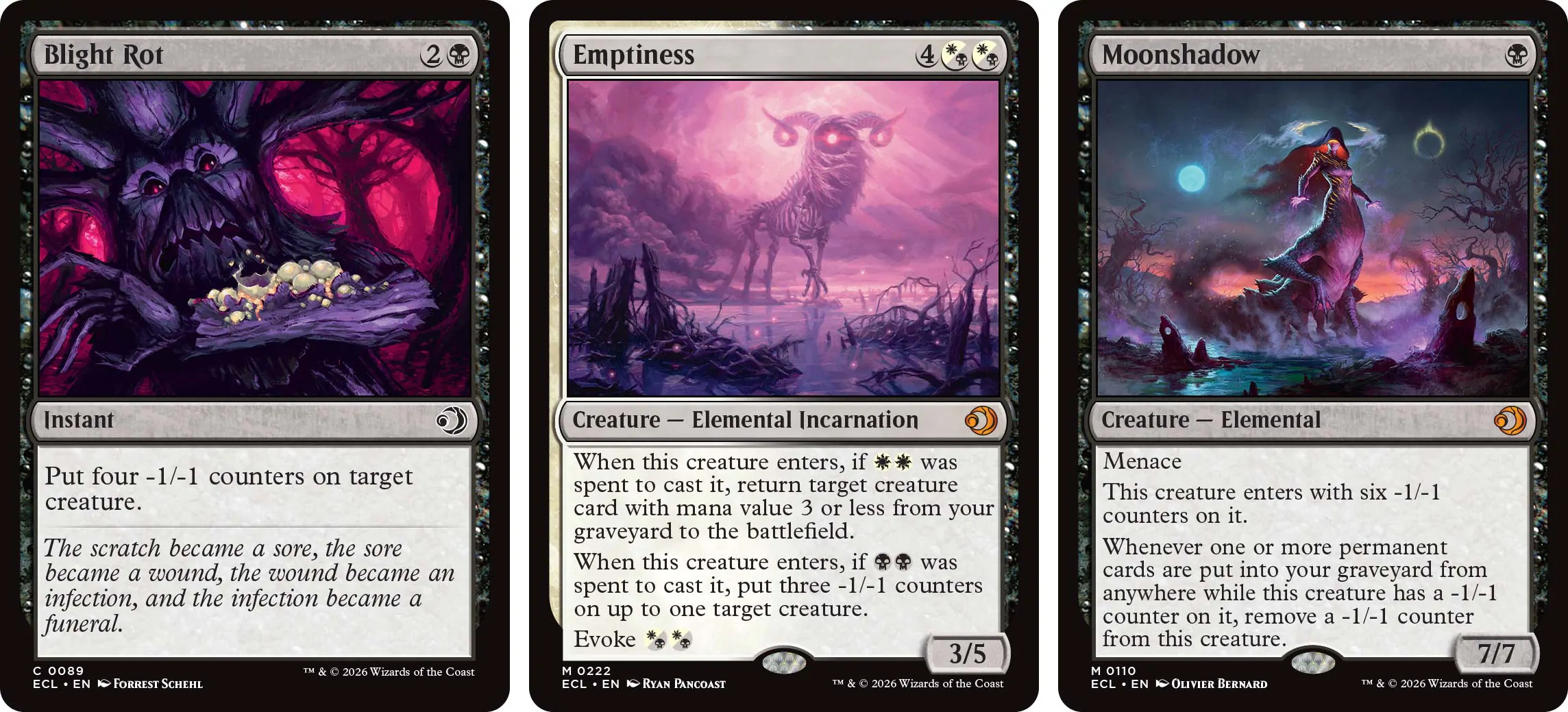
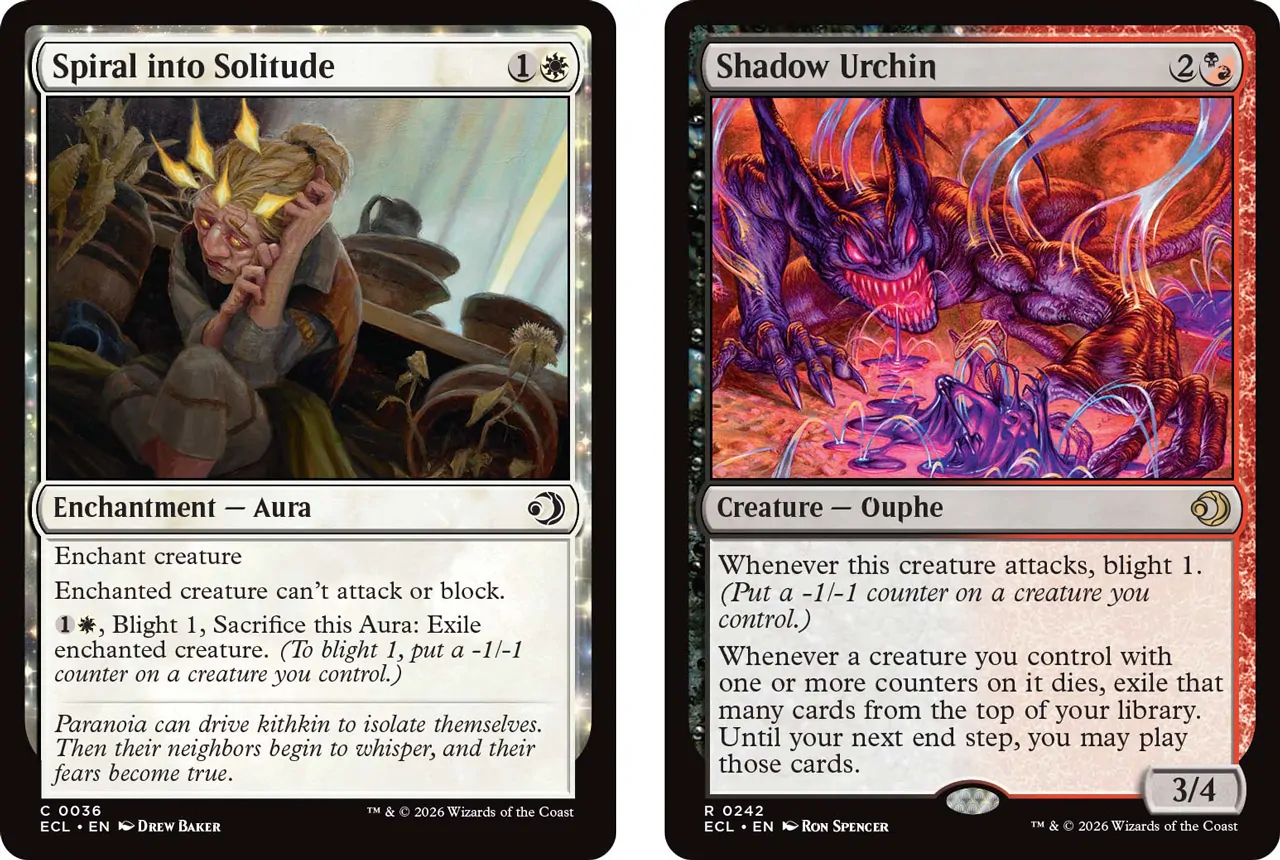
DG: If you like some gnarly body horror, you might like cards like “Blight Rot” or “Shadow Urchin”. Our elementals are amalgamations of natural forms and emotions, and on the Shadowmoor side, they can get very unsettling. Check out “Moonshadow” or “Emptiness”, and imagine those giant elementals on the edge of the horizon, walking slowly towards you.
NLJ: One of the big ones here would be “Emptiness,” an incredible piece that just screams, “STAY AWAY!” Moonshadow is another that just invites questions and gives no answers. That type of mystery is so enticing. One of my favorites is Spiral into Solitude, which depicts a kithkin whose own kin have turned against them.
The kithkin are connected by the thoughtweft, which allows them to share emotions and thoughts with one another. But if you become unwelcome, you are subject to the constant judgment and harassment of your entire village. It is like a living hell where your whole world unravels, and you’re left choosing between toxic connections or isolation.
Not so much about the new set, but are there any horror movies that have inspired you and your work with Magic: The Gathering and at Wizards of the Coast?
DG: My love for practical effects and fabrication also extends to horror films, which I feel perfectly overlap with fantasy. Many horror films that use prosthetics, textiles, animatronics, puppeteers, and physical labor are major artistic inspirations for me.
I can appreciate, too, where horror overlaps with folklore, and during the development of Lorwyn Eclipsed, I drew on as many examples of dark folklore in media as I could find for inspiration. The unsettling depths of ancient folklore go hand in hand with horror in a way that felt perfect for what I needed.
NLJ: In terms of movies, anything ‘80s and utilizing practical effects. In terms of more modern films, I tend to gravitate towards the work of Robert Eggers because of his ability to transport us to a time and place, as well as his deft understanding of how human culture and historical periods have their own sense of horror. Understanding how someone’s way of life can inform what they consider taboo and horrific helps me understand how to build horror in our fantasy settings.
