
As a disabled woman, I’ve never seen myself represented much on-screen. But if there’s one genre that feels to get closest to my experience it’s the horror genre. Horror has always been hospitable to the outcast and the unconventional. Those deemed aesthetically different from others may be monstrous, but in some movies (like Freaks and Frankenstein) it is humanity that is revealed as the real monster.
Horror is also the genre to illustrate the experiences of disabled women. Disabled women, historically, have tread a bloody road, from victim to final girl. Women in horror have to use their ingenuity to survive. But with disability it’s different. Disabled women in horror can’t just be creative, they have to adapt their limitations to the situation. On top of that, movies with disabled women at the forefront, open up the door to discussions of ableism and misogyny, as is the case with director Mike Flanagan’s Hush (2016).
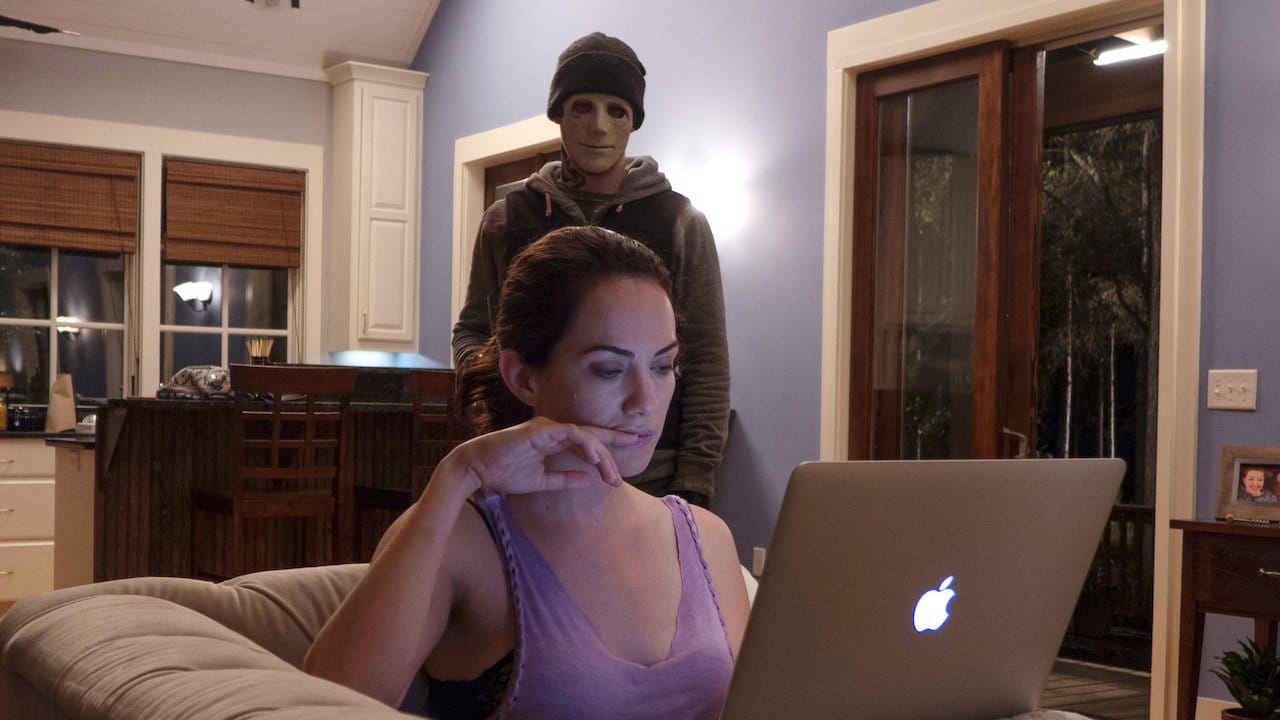
Hush is the story of Deaf writer Maddie (Kate Siegel) who has retreated into a self-imposed isolation in a remote cabin in the woods to finish her latest book. When a masked killer, The Man (John Gallagher, Jr.), arrives, Maddie must figure out a way to survive.
Hush is part of a grand tradition of Deaf and disabled heroines where the usually male killer believes they’re easy pickings because of their disability. We see this in features like 1967’s Wait Until Dark, wherein Alan Arkin’s character, Roat, terrorizes the blind Susy (Audrey Hepburn). In that film, Roat’s actions are outlandish – going so far as to wear costumes even after realizing Susy is blind – that they almost come off as a comical exploration of ableism. But unlike Hush, Wait Until Dark takes a perverse pleasure in watching Hepburn in panicked positions.
Not so Hush, wherein Maddie is required to use her intelligence, her ingenuity, and her deafness, in order to subvert The Man’s (and, by proxy, the audience) expectations of what she’s capable of. Maddie is highly independent, a successful author, and has a home adapted to her lifestyle. The audience watches her communicate via text, and she has smoke alarms with lights and an alarm loud enough to cause vibrations. This becomes an important plot device used later.
The film isn’t a perfect depiction of deafness or disability (though, honestly, no movie is). It’s revealed that Madd was deafened at the age of thirteen after a bout of bacterial meningitis. This is a standard technique in disabled films, wherein making the character disabled after years of being non-disabled, can allow for an audience to bond and an non-disabled performer (like Siegel) to play the part.
In a previous interview with Flanagan and Siegel, the decision also had a narrative purpose in making Maddie more of an outsider, not just to her friends but also outside of the Deaf community. It’s only through surviving the night that the hope is that Maddie herself no longer sees her deafness as a burden. However, the content of the story and how it calls out ableism and sexism is something that is not discussed enough in movies about disabled people, and comes through clearest in horror. (Guillermo del Toro’s The Shape of Water is another great example.)
The Man fetishizes Maddie’s deafness, toying with her through the movie, almost as if he’s turned on by how defenseless she is. There’s nothing romantic here, however. Maddie’s deafness is only an additional means to torture her for The Man. The fact that the killer lacks a name, referred to exclusively by his gender, also points back on the idea that he misogynistically believes he’s superior to her. There’s a throughline that can be traced between him and del Toro’s villain, Michael Shannon’s Agent Strickland, in The Shape of Water. Both men connect their disabled/Deaf victim’s sexuality to their disability, and want to use violence in a quasi-sexual manner. The Man tells Maddie at one point he wants to “hear [her] scream,” equating noise with submission.

Maddie runs through her options, expressed verbally by a subconscious version of herself: “He’s bigger, stronger, and faster…And he has the advantage: He can hear you.” Maddie, though, finds strength and superiority in her Deafness, realizing that The Man takes for granted his own abilities. In a move akin to Wait Until Dark – wherein Susy knocks out all the lights in the house to make Roat as blind as she is – Maddie turns the adaptations in her house into weapons, using the strobe effects in her fire alarm to disorient The Man. The two eventually end up wrapped in physical combat and Maddie is able to overcome him by stabbing The Man with a corkscrew. Hush ends with Maddie contemplating her own survival with her cat. Maddie isn’t a hero because she’s a Deaf woman who defied the odds. She’s a woman who bested a man who perceived her as weak.
Every time I revisit Hush I think of the various disabled women in horror that have crafted this fascinating world of playing with expectations, from Maddie to wheelchair user Nica Pierce (Fiona Dourif) in the Chucky films, to Audrey Hepburn in Wait Until Dark and Kiera Allen (one of the few disabled actresses playing a disabled character) in Run. These women aren’t perfect, but they’re self-sufficient badasses. And until Hollywood is ready to catch up and create more opportunities for disabled actors, these women of horror are some of the best we have.