It’s a liberating feeling when you learn that you are, in fact, right when everyone else insists that you’re wrong. The topic of debate doesn’t matter much. Maybe strangers on social media called you a panic-mongering alarmist for suggesting that the confirmation of one Brett Kavanaugh signaled the future death of Roe v. Wade.
Maybe your friends swear up and down that The Shining’s exteriors were filmed at the Omni Mount Washington Resort (they were not) instead of the Timberline Lodge (they were). Carrying micro-computers in our pockets wherever we go has proven a curse in the last decade, but being able to fact-check on a dime is a nice perk.
But the luxury of Too Much Damn Information All The Damn Time™ can’t provide us with the vindication we crave and richly deserve. Finding the data, the stats, the quotes, the citations that demonstrate without a shadow of doubt our correctness isn’t enough to ratify our point of view. Casper Kelly’s latest deranged nightmare, Buddy, strictly speaking, isn’t about that.
Its primary concerns lie in the perils of what can be passed off as children’s entertainment in the digital age–Vlad & Niki, Stacy Toys, and Pinkfong, I’m looking at you. But nestled within that particular cultural critique is a secondary, sociopolitical one as well, wrapped up in the dynamics of the very post-2016 term we call “gaslighting.”
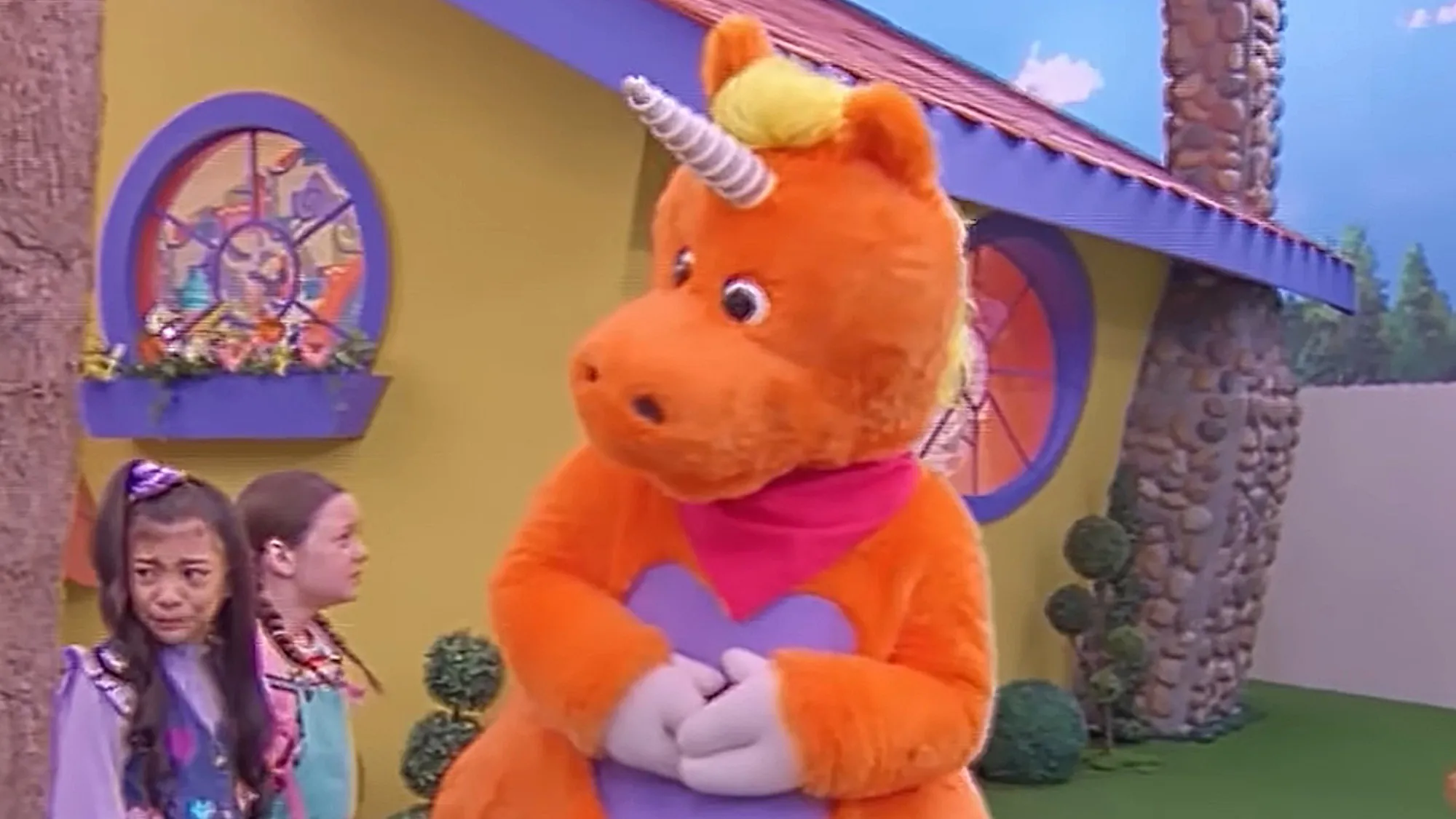
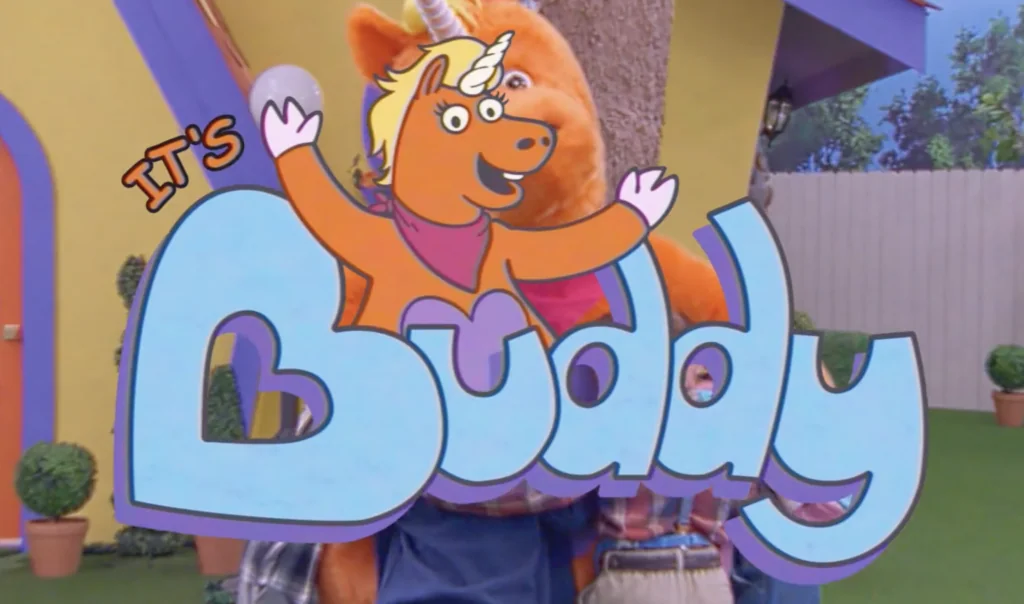
Kelly’s title invokes the villain of the piece, a chonky unicorn mascot with orange fur and a tuft of hair on his head that’s the same shade as the worst spaghetti your local grocery chain can legally sell. We begin in Too Many Cooks mode: no preamble, no establishing dialogue, just a series of vignettes made in the style of kids' shows like Barney & Friends.
Each clip ends on a more sinister note than the last, starting with the disappearance of a child actor from the show-within-the-movie’s cast, which Freddy (Delaney Quinn), our kid protagonist, picks up on immediately. Before long, it’s children versus a monster, as Buddy is pretty clearly not just a man in a plush suit playing a part. They escape, save for Wade (Caleb “CJ” Williams), whom Kelly codes as co-lead only to slay him abruptly.
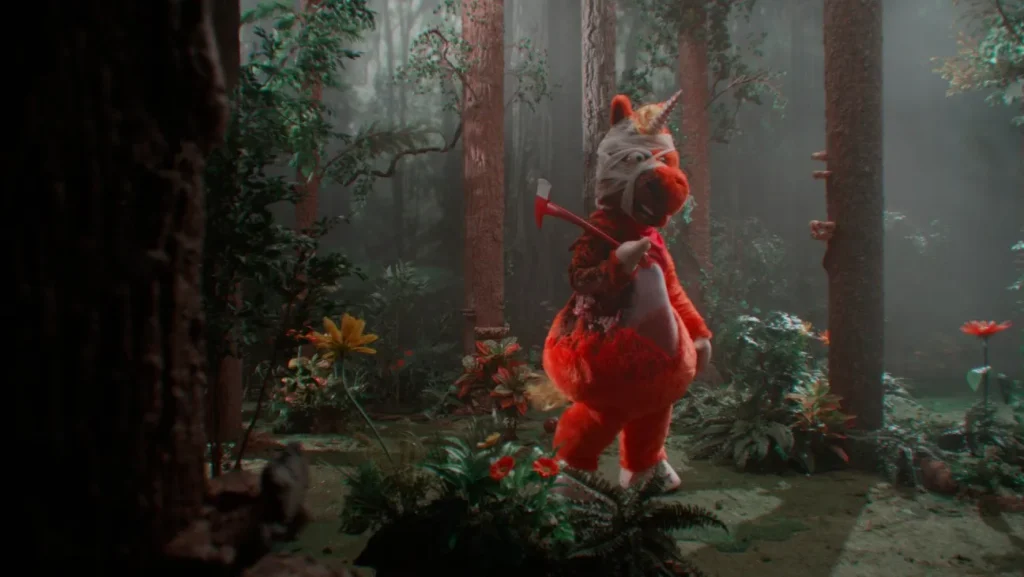
Outside the bounds of the faux-show’s “set,” Buddy looks an awful lot like a movie; Kelly switches to 1.85: 1 from the 4:3 aspect ratio used in the television segments. Here, we’re introduced to Grace (Cristin Milioti), a working suburban mom of three two boys, Derek (Bryson Jonsteele) and Timothy (Seamus Flynn), and married to Ben (Topher Grace).
They seem like a nice, normal lot, until Grace screams bloody murder over dinner while staring intently at an empty chair at the kitchen table; she’s struck by the sudden notion that she and Ben actually have, or had, a third child. Ben dramatically fails his “good partnership” test by writing her off as crazy. (There’s a lot to appreciate in Buddy, but watching Grace play an incurious and doltish prick is a treat.)

From here, the film splits into dual narratives. In one, Freddy and her surviving friends, Oliver (Tristan Borders) and Hannah (Madison Skyy Polan), trek through the deep, dark woods surrounding Buddy’s turf, seeking “Diamond City” for refuge. In the other, Grace hangs onto her sanity and her deep-rooted belief that she did have a daughter, and Ben be damned, she’s going to prove it.
She doesn’t have to try very hard at that, of course, as Buddy reaches out through her flat-screen TV, yanks her into his realm, and casts her as the replacement for the nurse met in the film’s opening act. (Buddy kills her, with Freddy as a horrified, unseen witness.) In a way, this solves a lot of Grace’s problems. As soon as she shows up in Buddy World, she promptly develops full-on amnesia–Buddy’s tactic for keeping the other adults on his show, whom he’s presumably kidnapped from our reality, docile.
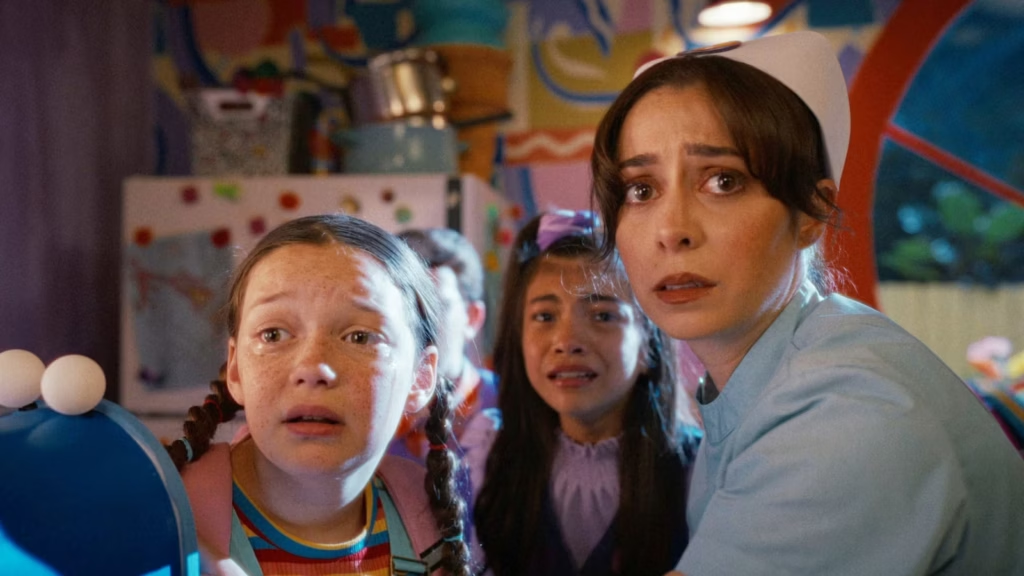
Maybe the movie could end there, and evil could prevail, but evil tends to underestimate the bond between kids and their parents. There is the potential for some awfully cheesy “only a mother’s love” clichés here–the idea that it takes a mom to undo whatever pervy sorcery Buddy wields to snatch folks from their lives and make them forget those lives, or that the connection between mother and daughter is stronger than any otherworldly powers can imagine.
But Buddy is about neither of these. It’s about two women shaking off the effects of gaslighting, whether pacification or torment, and reclaiming their lived experiences from a stand-in for America’s bulbous Dear Leader.
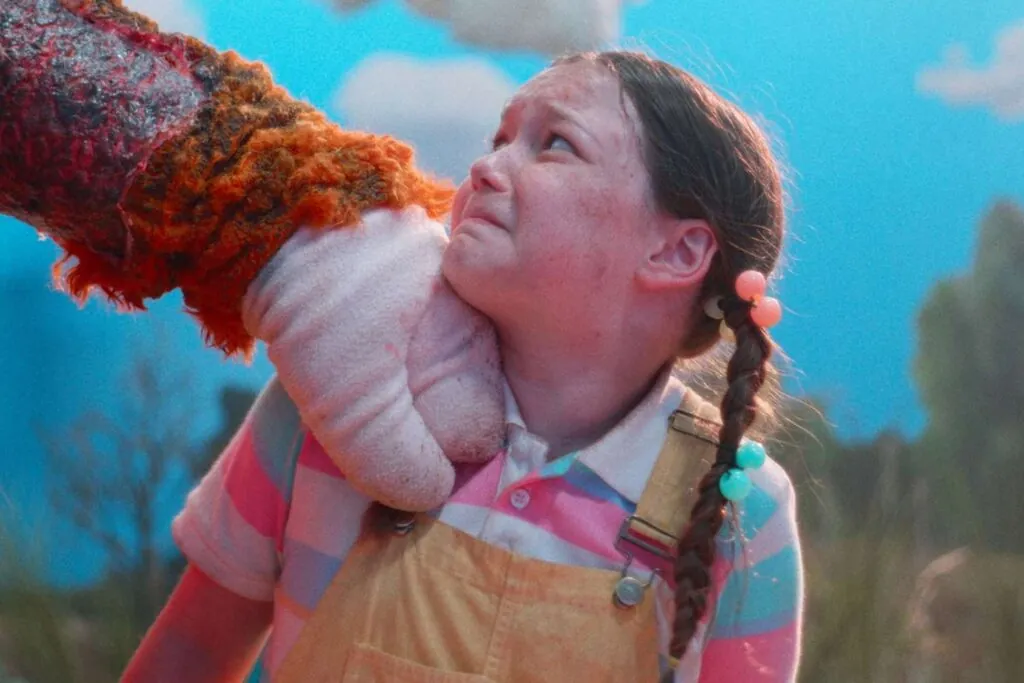
The relationship between Buddy’s aesthetic choices and plot choices points to the days when “gaslighting” became integrated into the mainstream American lexicon (just after the 2017 election of ol’ Donny Johnny, Women’s March and the viral proliferation of the #MeToo hashtag).
It’s hard to buy that this is all by happy accident, and that Kelly had no political sentiment caroming about in his head while writing the film’s script with Jamie King, though perhaps what is represented by Buddy as a movie monster is simply Kelly’s subconscious snarl of disgust towards the past and present administrations for, among many other crimes, stripping away women’s rights and protections while demanding their unquestioning compliance.
Ben probably voted for Kamala and Hilary; he reads like a liberal milquetoast. But he’s nonetheless prone to the same dynamics of disbelief promoted by America’s right-wing operators, and so uses blunt-force dialectic tactics to shut Grace up and down when she expresses her anxiety over their supposed third kiddo. He refuses to listen; it’s easier to question her mental well-being.
In fairness, Grace’s fear is a tough pill to swallow. But if we’re being really fair, then Ben’s response to her emotional distress — dismissive at first, then antipathetic, and eventually outraged —is appalling no matter how frightening it is for him to absorb it. Do better, men Ben. What Kelly folds into Buddy’s plot through Grace’s headbutting with Ben, though, is her interior need for validation, and this detail elevates her motivations above maternal tropes regarding self-sacrifice.
[Spoiler Alert]
Grace does die in the end, once she shakes off the effects of Buddy’s spell and recognizes Freddy as her child (her Freddybeans) and vice versa; her death constitutes a classic act of self-sacrifice. But Buddy inverts that act’s typical dynamic. Horror movie parents tend not to believe their kids when they cry “monster.”
Here, the parent isn’t believed by their own coparent, no less. Take Friday the 13th Part VI: Jason Lives as an example, where hard-nosed sheriff Mike Garris (David Kagen) spends the narrative refuting claims of Jason Voorhees’ (C.J. Graham) return. When Garris sees Jason with his own eyes, he, like Grace, dies attempting to save his daughter Megan (Jennifer Cooke), and hands the Crystal Lake killer one of the most extensive beatdowns anyone manages to give him in the series.
Garris acts on instinct, as any parent would, and maybe also out of guilt for not listening to Megan in the first place. Would Jason Lives’ plot go any differently if he had? Perhaps. Perhaps not. It’s the listening that matters, though, more so than the outcome. Grace likewise acts on instinct, fighting to protect Freddy and her fellow captive children. But she’s fighting for herself, too.
“I found you,” she rasps with her last breath, a telling parting thought. Equally as important to Grace as Freddy’s safety is her dignity. She isn’t having a breakdown after all. Ben just worked overtime making her feel like she was. Any parent would gladly give their life for their children as Grace does, but Buddy contextualizes the truth- her truth- as an ideal worth dying for, too.
Buddy is in theaters August 28.