

For a filmmaker setting out to reference and, in some instances, recreate clips that people long believed were real, there's a good amount of pressure to nail it on the FX side. It’s a challenge Faces of Death director and co-writer Daniel Goldhaber did not take lightly. Stopping shy of creating a snuff film, Goldhaber explained, “You're making a Faces of Death movie, you got to commit to the bit.”
Read our full Faces of Death review here.
And while each effect introduced its own unique level of difficulty to… execute, he was happy with how they ultimately turned out. Adding to that level of difficulty, the director said his favorite death sequence was shot in one take. “They were all hard in their own way, but I think they all came out well enough. I think I can actually say what I'm most impressed by in one of these is the one with the firing squad and the cops. We had one take, and that death is so convincing. The way his eyes go in different directions, I have no idea how he did it. Kurt is amazing. I love him so much, and he was really so great in the movie, but that death was extraordinary. That's my favorite.”
In a post-Scream world, there is no shortage of meta and self-referencing horror movies, operating at varying levels of effectiveness. The unique thing about Goldhaber and co-writer/producer Isa Mazzei’s take on Faces of Death is the very specific time capsule feeling of what it’s like to be alive at this particular point in time. The term “influencer” as a job title is a relatively new concept, and the movie captures the essence of what it means to be chronically online in a way that someone from twenty years ago likely couldn’t understand.

Who knows what the future holds, but this movie captures what it is to exist in the internet age and the landscape as it is currently. But Goldhaber doesn’t consider it a meta movie.
“I don't really think of it as being particularly meta, and I think that's only because it's a movie about Faces of Death. It's a movie about another piece of media. It's not, I think, ever really very self-aware. I think the only moment where it gets a little self-aware is when Arthur (Dacre Montgomery) talks about the fact that algorithms love remakes and just wants the audience to think a little bit about the fact that Arthur is a psychotic serial killer who's murdering people in an attempt to hijack the Faces of Death brand and name to generate attention for himself.

“Legendary is a giant corporation that bought the rights to remake Faces of Death. Maybe that's also something that's worth interrogating and thinking about, that's in itself kind of a perplexing choice to make. But I think that presents a very exciting opportunity as filmmakers to come in and say, okay, someone's making a movie about Faces of Death where it is today.
“How can we make a movie about that and do something that's scary and entertaining and bloody, but also that I think really has something on its mind about the nature of violent images and social media and human connection today?”
Barbie Ferrera’s character, Margot, is a fierce protagonist fighting against the familiar hysterical female trope. It’s an uphill battle, and the term “overreacting” is used repeatedly throughout the movie. But as the audience knows, Margot is not overreacting in the slightest. She’s smart, and she’s attempting to get help in any way she can think of. “I always think the strongest horror movies are those where your final girl is extremely intelligent. I'm never one who likes when a writer or director sends the poor vulnerable girl down to the basement, and you're like, ‘Don't go in the basement. That's so dumb,” Mazzei explained.
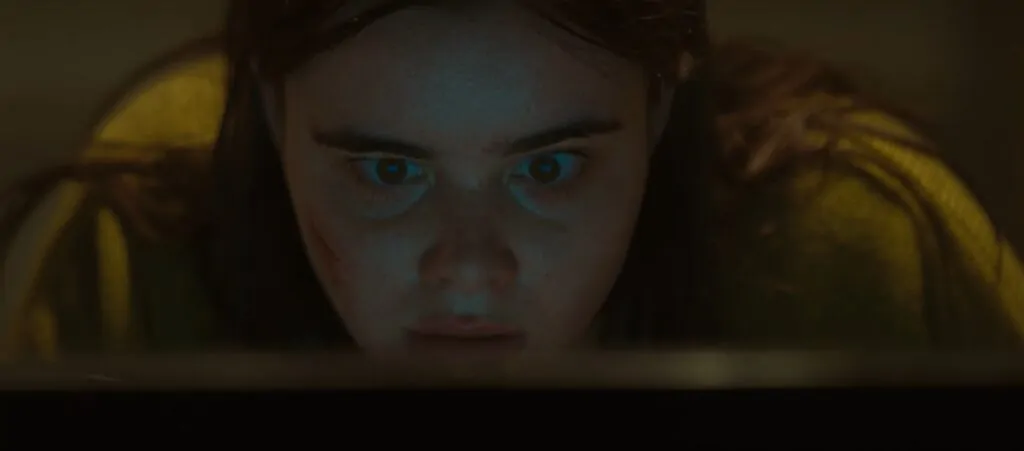
“How do you write a character who is incredibly intelligent, who's making all the choices that any woman I know would make, and still is not listened to and not believed? Barbie did such a great job of tracing Margot's arc as she slowly has this realization that she's kind of in this alone, and no one is there to help her. In a lot of ways, it's a story of disillusionment and kind of an awakening where she realizes that this system that she thought would not only give her maybe some sense of redemption for her past, but also some sense of safety and security in the world, is actually kind of perpetuating the problem. She's going to have to break from the system in order to take matters into her own hands.”
In a reality where breaking from systems and taking matters into our own hands seems increasingly to be where many find safety and security, Mazzei said writing this character was cathartic as hell. “It's my favorite character to write. I love it. I love the final scene. No spoilers, but that final scene, what Barbie brought in those visceral screams, is such a wonderful moment for me. Also, what happens right after the final moment where you realize it's kind of a Pyrrhic victory, and at what cost does this victory come? That is kind of thematically exactly what I want to point to, the thorniness of getting involved in these systems.”
Both Barbie and Dacre Montgomery let out some incredibly chilling, primal screams. It’s the kind you feel in your bones, and as I write this, I can replay them both in my head as if I’m watching it all over again. That’s no small feat, especially considering that on any given week, it’s likely I’m experiencing at least half a dozen horror movie screams.
“What's actually very funny is that both screams were improvised. When Dacre screams after Barbie, that was something we'd shot a couple of takes and he was like, ‘I want to try something on this take. I'm so angry at her, and I can't shoot at her, and I know I can't chase her anymore. I have to let the anger out at her.’ And he did this scream,” Goldhaber shared.
“I think we only did maybe two takes, max, of it, and that's honestly maybe my favorite shot in the film,” the director said. “It's just so specific and eerie. He has these different colored eyes, he looks like a Nazi, and he's in the suburbs. It's an image that I think only comes from this movie, and I'm very proud of that.
“When we were shooting the final fight scene, Barbie goes, ‘I think I need to scream back at him, I really feel like I want to give him a taste of his own medicine.’ What's really interesting is that is literally a call and response between them as actors. It's indicative of a great performance and the great instincts that they both have. They're actually really listening to each other, even across the days of shooting and finding ways to lock each other in battle across the movie. That's always really cool.”
Faces of Death is now in theaters, and on the subscriber-exclusive cover of FANGORIA #31. Read more in-depth Faces of Death coverage in our latest issue.
