
Video game adaptations are a notoriously tough beast to tame. Either a director alters the original text in such a way that it becomes all but unrecognizable (see: Paul W.S. Anderson’s nonsensical Resident Evil movies), or risks disrespecting it with an egregious misreading of what made the game so beloved in the first place (see: Christophe Gans’ disastrous Return to Silent Hill). The challenge increases tenfold when tasked with adapting a game that has no visible protagonist, contains no action, and takes place in a single, utterly nondescript location. It’s a wonder, then, that Genki Kawamura’s Exit 8 is a thrilling, existentially chilling piece of horror cinema that manages to stay faithful to its origins while also fleshing out its bare-bones source material.
Billed as a ‘walking simulator' – for non-gamers: that's exactly what it sounds like -, Kotake Create's The Exit 8 hit platforms in 2023, becoming a hit with fans of the ‘liminal horror’ trend popularized by The Backrooms (which itself has a big budget adaptation en route from NEON’s chief competitor A24.) Players are situated in a seemingly unremarkable unnamed Tokyo subway station, and tasked with one simple objective: leave. To do so, one must spot inaccuracies in their surroundings, referred to as ‘anomalies', which will help them escape the Escher-esque infinity loop that the station has become. Think of it as a spot-the-difference game from hell, if you will.

Wisely, rather than mimic the game's nausea-inducing first-person POV, Kawamura (perhaps best known to Western audiences as the author of the New York Times bestseller If Cats Disappeared from the World) puts a face to the game's unseen protagonist in the form of The Lost Man, an aimless, asthmatic everyman played by Kazunari Ninomoya (Letters from Iwo Jima). We meet The Lost Man during his soul-sucking subway commute, where, with headphones in and eyes cast down, he desperately maintains self-imposed isolation from his fellow, similarly indifferent passengers, ignoring those in need like the single mother and her crying baby being berated by an aggravated businessman. The Lost Man prefers instead to doomscroll and block out the trouble with Maurice Ravel's “Boléro”, the hypnotically monotonous melody interrupted by an incoming call from his girlfriend, who has just found out she is pregnant and is contemplating whether to keep it or not.
If the “Boléro” reference sounds a little on the nose, that's because it is. Exit 8 doesn't shy away from its heavy-handed themes of purgatorial monotony in the day-to-day grind, instead embracing them in universally applicable catharsis. “Going to work, doing the same thing over and over again,” exclaims one character around the film's midway point, “It's hell!” Sure, it may not be subtle, but one could argue that in our current capitalistic hellscape, we're way past the need for subtlety.
Visually, Exit 8 captures that malevolent mundanity with an impressively accurate rendering of the game, all stark overhead strip lighting and corporate poster advertisements which the Lost Man must use to establish whether he's in an anomaly loop or not. Cinematographer Keisuke Imamura’s long tracking takes perfectly capture the meandering, frustrating claustrophobia of the game, giving Ninomoya plenty of space to deliver a performance that's raw with palpitating paranoia and escalating anxiety.

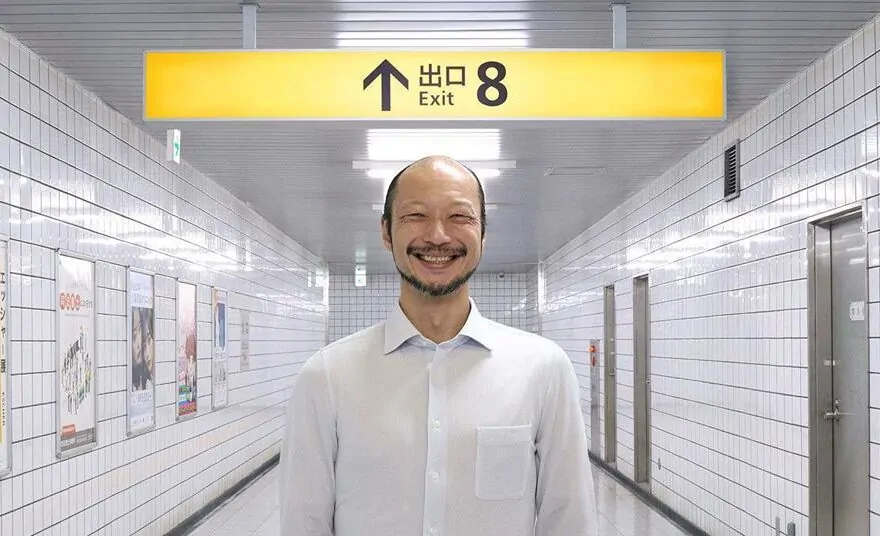
Ninomoya's supporting players are equally effective, with a particular highlights being Kotone Hasane as a psychotic schoolgirl and Yamato Kôchi as The Walking Man, one of very few characters seen onscreen in the game, and one whose blank-eyed stare and overextended smile has become synonymous with the uncanny scares of ‘Exit 8-likes' and Internet ARGS. While the Walking Man is little more than scenery in the source material, oftentimes appearing as an anomaly, Kawamura expands on both him and the lore of the mysterious subway station a little more in a welcome backstory, that shows us how victims can end up stuck in their own eternal loops.
However, it's in the ‘rules' of this bizarre Möbius subway strip that things get a little messy. Kotake Create's game gave players absolutely nothing in the way of world-building, meaning Kawamura had a totally blank canvas to paint on, and opts to craft an emotional core that pulls on the heartstrings with themes of responsibility, especially when the Lost Man meets The Boy (Naru Asanuma), a little lost wanderer who might just hold the key to escaping. Intentional or otherwise, there are a couple of eyebrow-raising implications suggested in Exit 8′ s ideas of parenthood and responsibility (not to mention a woman’s agency over her own pregnancy), but for the most part, Exit 8 sticks the landing by reminding us that no matter how hard we try to avoid the peril of our fellow passengers, we have a duty of care to those who need us. Avoiding those obligations will get you, like The Walking Man, nowhere.
Exit 8 hits theaters on April 10 via NEON.