
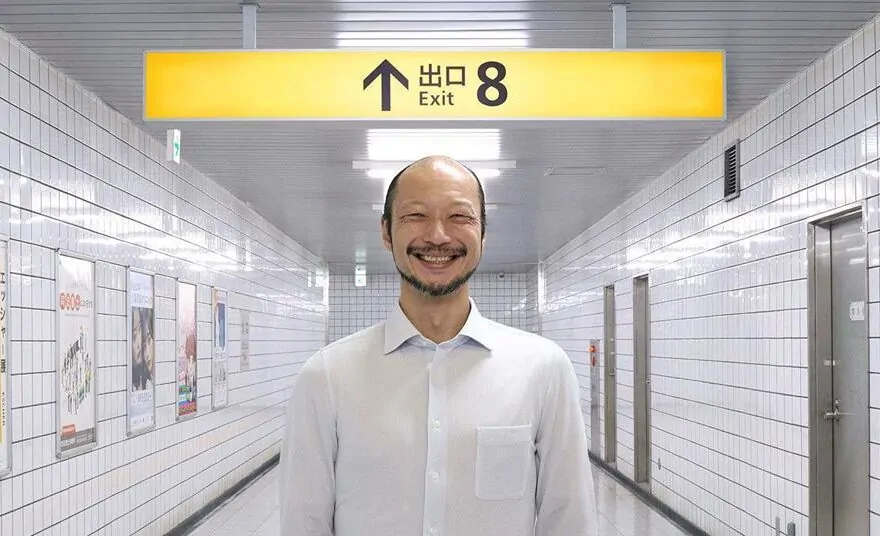
Looking around at the state of, well, everything right now, it's easy to believe we're living in some sort of purgatorial nightmare world. Thankfully, we have filmmakers on the front line delivering catharsis in the form of horror movies that accurately depict the anxiety and claustrophobia of life in the 2020s. That's exactly the case with Exit 8, Genki Kawamura's adaptation of Kotake Create's ‘walking simulator' game that was a hit back in 2023. Following its Cannes premiere, Exit 8 has racked up a hefty box office sum in its native Japan, with a U.S. theatrical release coming on April 10 via NEON, and in the U.K. on April 24 via Vertigo Releasing. Ahead of Exit 8‘s release, we sat down with Kawamura ahead of Exit 8‘s release this Friday to talk liminality and escaping the video game adaptation curse.
This interview was interpreted and translated by Michael McNamara.
The video game Exit 8 has no protagonist and no story, meaning you and writer Hirase Kentaro had a blank slate to work from – where did the inspiration for creating this new story come from?
Genki Kawamura: I played the game of The Exit 8 myself, but in addition to that I was watching a lot of livestreams of other people playing the game. Because the game is so simple, there were as many stories as there were players that I saw online. That’s what I used as the starting point. It served as a device to really see the inner self of how humans interact.

When you're adapting an existing property, I imagine you go in knowing that people will have strong feelings about it before they ever even experience what you've created. Do you feel that's more constricting or more freeing as a creator?
GK: Most game adaptations tend to fail [laughs] so actually this time we weren’t trying to adapt the game so much as my directive was to try and blur the lines between the video game and movie medium, and create a brand new moviegoing experience.
In Exit 8 and in your novel If Cats Disappeared from the World, you explore themes such as finding meaning in life and taking responsibility for one’s own happiness – can you expand more on about what interests you about these ideas as a creative?
GK: I find myself gravitating much more towards the inner emotions and what goes on inside the mind of a human rather than what’s happening on the exterior. So rather than disaster movies or monster movies, I tend to gravitate more towards exploring memories, guilt, regret – things that we carry with us every day. If those ideas and concepts manifest themselves into our world, what would that look like?
This story you’ve created obviously has very universally applicable themes, but do you feel Exit 8 tackles things about Japan and Japanese culture specifically that might not be obvious to Western audiences?
GK: I live in Tokyo, and during rush hour I take the packed train to work. What I notice and feel is that we’re collectively moving together, many people in these carriages, but it feels like we’re all looking at our smartphones. We’re selfish, in a way, so we don’t notice something like a crying baby – or we’ll look, but not actually look at what’s happening around us. On our smartphones too, we’ll scroll through images of war and violence on our timeline like nothing happens. I know we’re not directly responsible for the killing and the deaths that are happening on the other side of the screen, but I thought, if we took these elements of guilt and put it in this sanitized white corridor and manifested it into the world, what that would look like, and how terrifying would it be?
![The EVENT HORIZON Sequel Is ALIENS In Hell [Exclusive]](https://www.fangoria.com/wp-content/webp-express/webp-images/doc-root/wp-content/uploads/2026/03/EventHorizon-Inferno-CoverRBG-Cropped-2-300x169.jpg.webp)
Visually, watching Exit 8 really does nail that dizzying, claustrophobic feeling of being trapped in an endless subway station. What were the biggest challenges when it came to creating this seemingly continuous loop on set?
GK: There were two identical sets that we built, we essentially copy and pasted the exact same corridor twice. Because the cast and crew would get lost all the time, we had to name them. One corridor was called Hitchcock and one was called Kubrick. Having these two corridors allowed us to create these long takes that seem like one single shot, and it blurs the edit points so the audience really don’t know where you are in that shot. That poses a challenge for the actors. The Walking Man (Kōchi Yamato) actually had to walk through the corridor once, get on a bicycle, ride back to the beginning of the other corridor, catch his breath, and then start walking again. He had a very CG-like performance by the end.
We're seeing something of a liminal horror trend right now, with Exit 8 of course, but also with A24's Backrooms, other Japanese games like The Convenience Store. What is it about liminal horror that is so appealing to audiences right now, do you think?
GK: Liminal spaces offer an interesting device because we start to think more about memories. It’s like we’ve seen these places but we can’t recall exactly what it is, be it Exit 8 or Backrooms, the idea of being trapped in a space makes us look into our minds and project that onto our surroundings because the design of the space is so simple. That to me is something that’s truly scary, once your memories or these sins or small moments of guilt start to project themselves onto their surroundings – that’s the true horror.
You mentioned earlier about the low success rate of video game adaptations, but Exit 8 definitely breaks the bad streak. If you could adapt any other horror game into a film, which would you like to tackle?
GK: Actually are a few that I’m looking at, but I really can’t say more right now. When translating a horror video game into a film, there’s something I keep in mind. I spoke with (famed Japanese game designer and Nintendo director) Miyamoto Shigeru about ten years ago and he told me that when you make a great game, it’s not just about the player having fun while playing, which is obvious, but also the people watching the player play the game also having fun. When thinking about this in the context of a movie, at times I want the audience to feel like they are the player, but other times I want them to feel like viewers watching a livestream. It’s a snapshot of the phenomena happening across the game industry at large. I try to keep that in mind because it leads to a much better representation and adaptation.
Exit 8 opens in theaters on Friday, April 10 via NEON.