

Screenwriter Alex Garland has returned alongside director Danny Boyle to the world of 28 Days Later with the long-gestating sequel, 28 Years Later (read our review here). The third entry in the franchise explores the macro and micro ways in which society as a whole is affected when besieged by the “rage virus.” Since the release of the original film back in 2002, Garland has gone on to become a director in his own right, writing and directing works such as Ex Machina, Civil War, and even the limited series Devs.
From advancing technology to pandemics to political infighting, each of Garland's projects has taken an analytical approach to exploring how humanity reacts, as individuals and as a collective, to such new stimuli. While all of these works have tackled heady thematic material and given Garland room to explore the idiosyncrasies of the human condition that he is so drawn to, none have done so as succinctly and damningly as his 2018 film, Annihilation.
Annihilation is a science fiction horror film based on Jeff VanderMeer's novel of the same name that centers on the sudden appearance of something referred to as “The Shimmer.” Though labeled an environmental disaster zone in the swamps of Florida, The Shimmer is far more than that; a seemingly inexplicable and indefinable area of land that has been consumed by this purple-tinged material of cosmic implications. The first team sent in to investigate The Shimmer is led by Oscar Isaac's Kane and is comprised entirely of men. However, the mission goes haywire, leaving Kane incapacitated and the lone survivor.

In the wake of this, another mission is mounted in an attempt to garner answers about the origins, nature, and relative danger of The Shimmer. This mission includes Kane's wife, Lena, played by Natalie Portman. Upon venturing into The Shimmer, what Lena and her team discover is a state of not only decay but also one of incandescent beauty.
Within The Shimmer, it is as if every molecule is in active conversation with one another, each single entity becoming quite literally a part of a larger whole. Late in the film, this is equated to a prism, with one character saying, “The Shimmer is a prism, but it refracts everything. Not just light and radio waves… animal DNA, plant DNA, all DNA.”
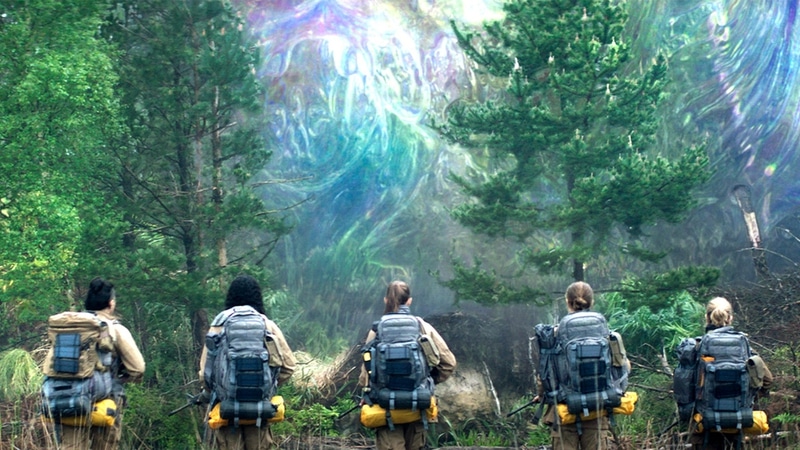
As a result, the longer the characters spend in The Shimmer, the more their own personal DNA is distorted and intermingled with the people and things around them. As a result, Garland's Annihilation grapples not only with massive themes such as nature versus nurture and the ways in which the things we surround ourselves with ultimately bleed into the essence of who we are as individuals but also with the existential and nebulous horror of what the true nature of self even is.
For as much as Annihilation is very much a dyed-in-the-wool work of science-fiction, Garland is very much utilizing the trappings and structure of the genre as a means to an end, to reach a place where he can explore more philosophical and theoretical queries than an audience might otherwise indulge. While elements such as the loss of self are narratively brought to the forefront by The Shimmer and its effects on the characters, these are thematic threads that have been woven throughout the film from the very beginning.

When audiences are first introduced to Natalie Portman's character, Lena, she is an accomplished professor who is still mourning the apparent loss of her husband. When Kane unexpectedly shows back up in their home, the interactions between them are tense, layered, and complex. This begins to scratch at something simmering in the back of the viewer's mind: something is not as it should be. Later in the film, audiences are shown via flashback that Lena had an affair and how that affected her marriage well before Kane ever disappeared into The Shimmer.
As a result, the experience of watching Annihilation in and of itself is an ever-evolving, intermingling viewing for the audience. On the first watch, you see Lena as she presents externally to the world. But on subsequent watches, you are unable to separate the Lena in the opening moments from the character in the flashbacks. In this way, the film's narrative and larger themes themselves are refracting upon and into one another.

Mahatma Gandhi famously said, “Happiness is when what you think, what you say, and what you do are in harmony.” Even though it isn't revealed until well into the film's runtime, Lena has already lost any true sense of self long before audiences meet her. She is not a character living in harmony, nor is she simply a wife grieving the apparent loss of her husband; she is someone mourning the person she believed herself to be.
As the female-comprised expedition into The Shimmer commences, Lena chooses to deliberately close herself off from the more social interactions of the rest of the group. She doesn't open up to them in any substantial way, even neglecting to tell them of her relationship with Kane, fearing it will incite fear or conflict. However, as the trek progresses, the characters go from single entities into a communal whole, both literally and metaphorically.
In a narrative sense, The Shimmer is literally blending the DNA of each of them into the next, with details such as a tattoo that one team member has on her arm being passed onto Lena's arm late in the film's run. But metaphorically, the characters also form interpersonal bonds with one another.

In a lesser film, this would have been portrayed as an objective good, as a healing experience for Lena. But under Garland's watch, it's a far more complex and multi-faceted issue. For as therapeutic as it is for Lena to share her grief and listen to the troubles of the others, it's also indicative of experiences that are changing Lena before the audience's very eyes.
With each passing second, Lena becomes less of the person she was and more of a person she is not yet aware of, with Garland ingeniously weaponizing the very idea of a protagonist's arc against the audience. She is embarking on a classically Joseph Campbell-ian “Hero's Journey,” but that means that the person who starts this journey may very well not be the person who ends it.
Annihilation is a film about both the beauty and horror of change. While in layman's terms, the word “annihilation” is synonymous with destruction, in particle physics, the term actually has a far more versatile meaning. There, annihilation is defined as the conversion of matter into energy or the process that occurs when a subatomic particle collides with its respective antiparticle. To this end, the term encompasses the extreme ends of the spectrum: life and death, destruction and creation, beauty and horror.
Alex Garland has said that in adapting Jeff VanderMeer's novel to the screen, he ultimately adapted his experience of reading the novel rather than the literal book itself. “The act of reading this book is quite like having a dream… I made an adaptation of the quality of experiencing it, as opposed to adapting the text of the book.”
In essence, Garland made a film about reading the source material and how the book challenged and ultimately changed him. And now, not only does Annihilation form this unyielding cycle in which audience members can never see Lena quite the same, with pieces of her ultimately changing from one viewing to the next, but it also ensnares the audience itself in a similar trap. Annihilation changed me, and that is both beautiful and terrifying.
