
Editor's Note: This was originally published for FANGORIA on October 2, 2002, and we're proud to share it as part of The Gingold Files.
Any franchise that goes on long enough runs the risk of falling victim to its own success, and that’s just what happens with Red Dragon. When The Silence of the Lambs opened 11 years ago, winning raves and big box office and Oscars, it set a template for the serial-killer genre that was used by countless films in the ensuing years. One diabolical murderer after another was tracked by one dogged, gifted sleuth after another, until it all seemed to run together into one long investigation punctuated by grisly murders. Whatever one can say about Hannibal (and much has been said), at least it took the Lecter saga in new directions, whether one feels they were successful or not. Red Dragon, on the other hand, for all its technical polish and some fine supporting performances, has the air of “been there, seen that.”
We have, of course, seen that before, as this is the second filmization of the Thomas Harris novel that Michael Mann previously adapted as Manhunter. Mann’s movie is a triumph of style, but not style over substance; the drama and terror of the situations is as riveting as the visuals. It was also one of the first (if not the first) films to explore the subject of “profiling,” with William L. Petersen memorably portraying FBI agent Will Graham, who submerges himself so deeply into the mindset of his quarry that he risks drowning in it. His characterization provides a compelling center for Manhunter, and that’s what the new Red Dragon lacks. As the 2002 Graham, Edward Norton simply seems too young (I say “seems” because he’s actually the same age Petersen was when he played the role), and Ted Tally’s script doesn’t explore the disturbing implications of a lawman identifying too strongly with a criminal. The new Graham doesn’t come off as obsessive, just particularly perceptive, and thus there’s nothing about the central plot that one hasn’t seen in a dozen previous procedural films, or can’t see every week on CSI (and I’m not just saying that because Petersen stars in that show).

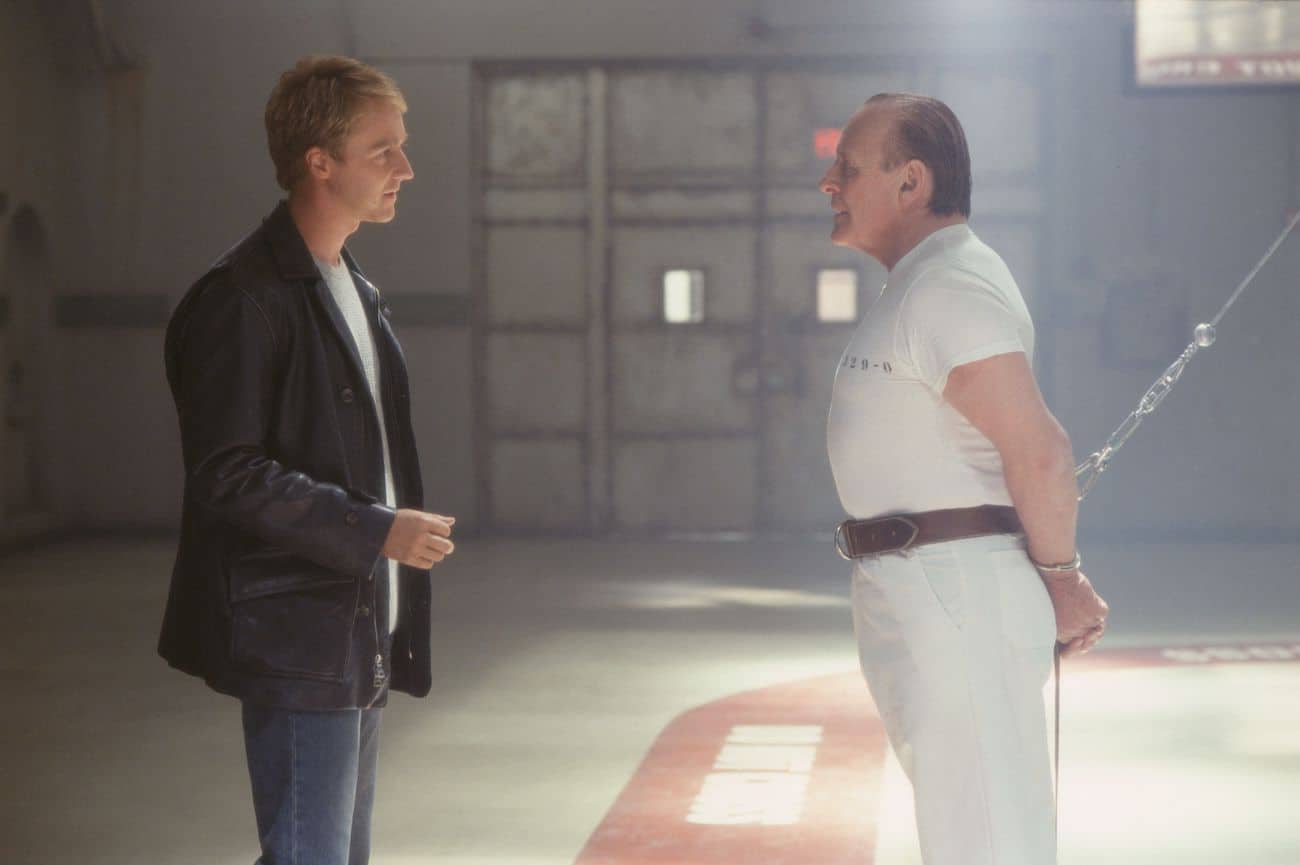
Red Dragon’s villains fare better. The Anthony Hopkins-vs.-Brian Cox debate will no doubt be fueled anew, and while the former’s work here won’t eclipse memories of the latter, Hopkins slips easily back into the skin of the Lecter we came to know and love to hate in Silence. The actor has stated that he wanted Lecter to be scary again this time, and while the character’s danger does come through, he’s just as often a figure of dark humor, retaining his way with a bon mot and an ironic delivery.
The recasting of Francis Dolarhyde, a.k.a. the Tooth Fairy, the family-slaying object of Graham’s pursuit, could have been more problematic. In the place of Manhunter’s tall, not conventionally handsome Tom Noonan (whose performance evoked both pity for his mental state and terror at his physical state), the new movie casts a buff, ravishing Ralph Fiennes (“disfigured” only with a small facial scar, and bearing a striking body tattoo) in the role. Fiennes’ good looks at first threaten to work against the part, but the actor proves more than able to disappear into the role, finding the black heart of the character and evoking both pathos and terror. And he plays well with others; Dolarhyde’s halting relationship with the blind Reba McClane (Emily Watson, doing fine, sensitive work) and terrorization of tabloid scribe Freddy Lounds (Philip Seymour Hoffman, vividly sleazy) carry an emotional charge that too much of the rest of the film lacks.
Part of that has to do with the choice of director, Rush Hour veteran Brett Ratner. It’s not that Ratner does a bad job, just that he’s done a competent, workmanlike but undistinguished one. His approach owes less to the stylization of Mann or Hannibal’s Ridley Scott than to the naturalistic flair of Silence’s Jonathan Demme, and while this feels appropriate (with returning production designer Kristi Zea providing visual continuity), it doesn’t feel terribly exciting. Given that this film is retreading familiar material (even, in some areas, for those unfamiliar with the book or previous movie), it required someone at the helm with real vision, someone with a palpable ambition beyond simply proving that he can direct more than slapstick comedy.

The result is a movie that has its moments, but as a whole doesn’t live up to the standards set by Manhunter and Silence. To be sure, those are tough acts to follow, but while Red Dragon may feel less “dated” and more faithful to Harris’ novel than Mann’s feature, there is something to be said for taking liberties with source material in the interest of the cinematic whole. For one thing, Mann did right by altering the ending for Manhunter; the climax as presented here, while it hews closely to the book, not only hinges on a thoroughly predictable plot twist but takes the action away from the setting in which it’s the most dramatic. Like a good deal of Red Dragon, this too-conventional windup does something inadvertently that the movie’s sneaky coda (which brings the film series full circle) does intentionally—it just makes one want to see Silence again.
