

Editor's Note: This was originally published for FANGORIA on September 28, 2006, and we're proud to share it as part of The Gingold Files.
These days, when one hears the phrase “independent zombie film,” it’s hard not to get a bit cynical and think it’s gonna be just one more George A. Romero fan turned moviemaker rehashing the mythos on a lower budget. Some of the homegrown ghoul features from the last decade or so have been good, many have not, but very few have attempted to truly rethink the formula, and present the undead as something other than pale and/or disfigured creeps staggering about and munching on human flesh. One of those few is Last Rites of the Dead, the new production from the gang who created Strange Things Happen at Sundown (writer/director Marc Fratto and producers Brandi Garfi, Frank Garfi and Andrew Dantonio), and as in that vampire/Mafia opus, they tackle an ambitious, wide-ranging narrative, and largely succeed. This is a zombie movie with a lot of differences—smart and scary and, best of all, genuinely dramatic.
At its center is a love story gone terribly, terribly wrong, showcasing a pair of fine performances. Heroine Angela (Gina Ramsden) is first seen locked up in her bathroom, hiding from her enraged, pistol-wielding boyfriend Josh (Joshua Nelson). In most walking-dead stories, a bullet in the head is the end of a zombie’s existence, but here it’s just the beginning of one. Angela winds up as one of the growing number of deceased who have begun returning to life for inexplicable reasons—not as mindless ghouls but as conscious, thinking folks, most of whom would like nothing better than to continue to make their way in society. The movie posits a world where the existence of the walking dead is treated as a fact of life—which is not to say that it’s accepted happily by all of the living.
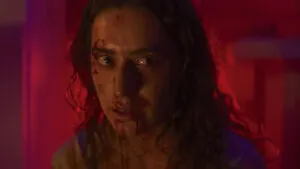
Specifically, Josh falls in with a couple of anti-zombie bigots who commit random assaults on undead individuals, which leads him to join a sort of living-supremacist movement devoted to preserving the breathing way of life. For her part, Angela is led by a former member of her zombie support group into a cult led by Good Mother Solstice, who encourages complete acceptance of one’s undead status—including giving in to the urge to eat human meat. The two collectives are clearly headed for a showdown, but writer/director Marc Fratto keeps the focus on Angela and Josh, who will have an inevitable reckoning of their own and are given compelling shadings along the way. As Angela fights the urge to become a flesheater and desperately tries to deny her new identity, Josh struggles with conflicting feelings of lingering love for the Angela who once was and his hatred for the “monster” she has become.
Last Rites of the Dead is one of those rare movies that’s a story about zombies, rather than a zombie story (if you catch my meaning), set in a fully imagined environment that looks like the here and now but has made plausible adjustments to the risen-dead scenario. While TV commercials hawk makeup products designed to allow zombies to pass for the living, “termination facilities” have been established for those resurrected individuals who want to return to the beyond. (It’s not enough to just shoot or stab ’em in the head; the brain has to be completely obliterated, and even a severed zombie head will still live separate from its body.) Beyond the allegory about prejudice, Fratto grounds the story in recognizable emotions in other ways, putting a genre spin on identifiable situations—as when Angela, wearing that “Look Alive” makeup, goes for a job interview at a company whose hiring policies don’t extend to walking corpses.
The film may take a sympathetic view of the undead, but it eschews an easy ghouls-good/humans-bad approach; there are heroes and villains in both camps. And while there’s plenty of bloodshed to go around (with strong makeup and FX by Demonic Pumpkins), Fratto doesn’t exploit the opportunity to wallow in splatter every time; he knows when to show the gory details of a cranium destruction or zombie feast and when not to, and a couple of the most effective death scenes are those where the act is only suggested.
The movie is not without problems, chief among them a final act that goes on too long and makes an odd shift in tone. After the realistic buildup and follow-through of the first 80 minutes or so, the action becomes more stylized and over-the-top, attempting to plunge both the characters and the audience into a hell on Earth of victimization and retribution. While some of the resulting mayhem is genuinely disturbing, the human touch falls by the wayside, and the action on the way to the confrontation the whole story has been leading to is played on an exaggerated level that undercuts the sympathy that has been built up for both participants. The story never completely loses its grip, but here’s a case where a horror movie might have been even more effective if it had actually held back a bit in its climactic moments.
Nonetheless, Last Rites of the Dead stands out in the grassroots horror scene, its creators demonstrating a keen sense of how to make the most of their limited means. Well-shot on high-end video and boasting a commendably consistent level of performance among its large cast, it also proves that the best way to honor a beloved subgenre is to take it out in new directions rather than just recycle the elements that made it so popular in the first place.
