
Editor's Note: This was originally published for FANGORIA on September 27, 2002, and we're proud to share it as part of The Gingold Files.
Das Experiment has one of the most painful-to-watch moments in recent cinema—a bloody bit that’s nonetheless not quite violent, but rather violence being deferred. More I won’t reveal, but it made the hardcore horror fan I saw the film with actually look away (and was strong enough for him to refer to this later as a bad thing).
Despite its occasional gory moments toward the end, however, Das Experiment is more concerned with psychological unease. Director Oliver Hirschbiegel, adapting the novel Black Box by Mario Giordano (who scripted with Christoph Darnstädt and Don Bohlinger), has fashioned a tense, claustrophobic study of what happens when people are handed the license to give in to their worst impulses. The idea that men locked into a faux prison would eventually give in to violence is not necessarily a surprising one, but in Hirschbiegel’s hands the devolution comes to seem inevitable rather than predictable.
He even gets away with one of the overseers of this psychological project insisting, in an early scene, that violence will not be tolerated without it seeming like a ridiculous or obvious bit of foreshadowing. None of the test subjects who have volunteered appear as if they’re going to violate that rule, at least at first. The film’s protagonist, cab driver Tarek (Moritz Bleibtreu), is simply in it for the money, and for another reason: A journalist fallen on hard times, he convinces an editor that the situation will make for an excellent story, and even has a tiny camera wired into his glasses. He gets one heck of a story, all right…
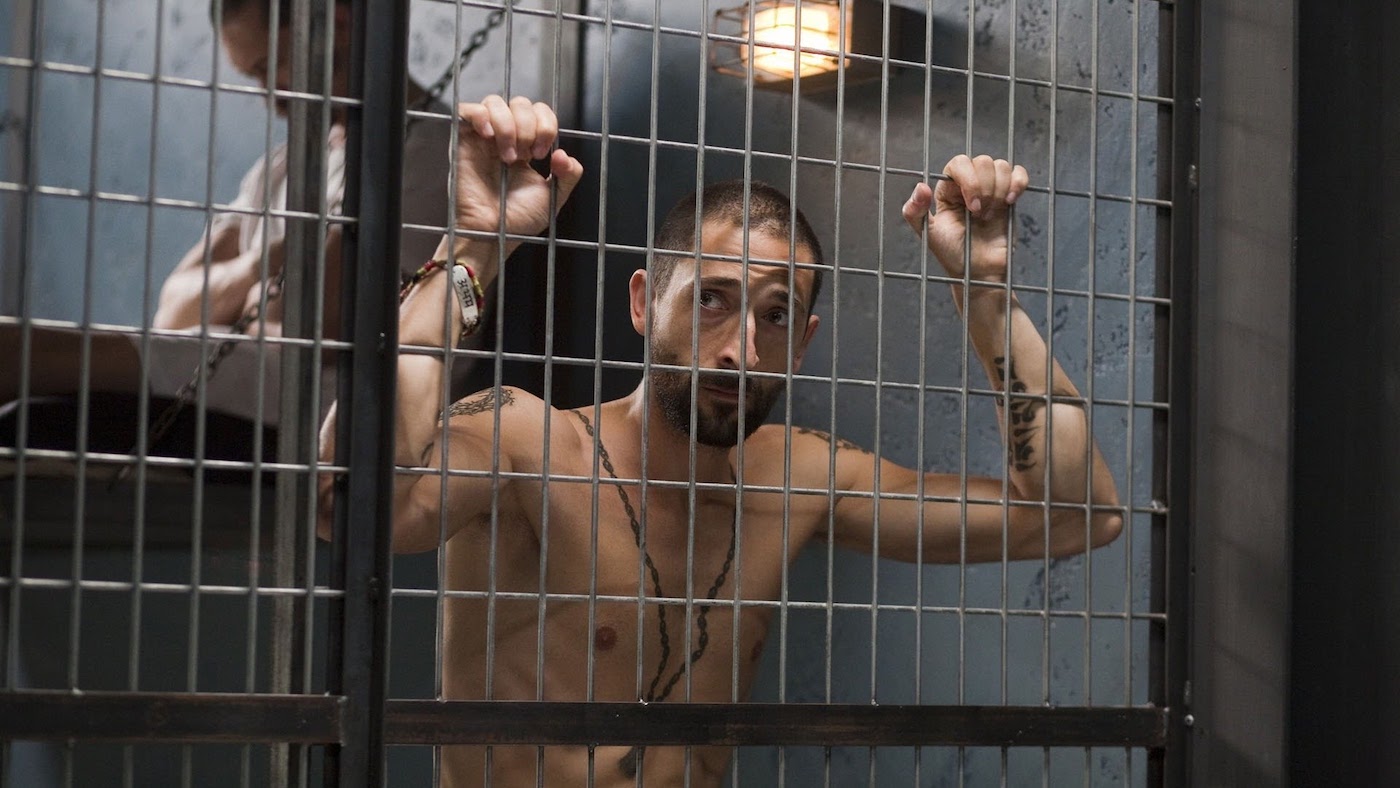
Half of the men are assigned to be “prisoners,” and the other half as “guards,” and it isn’t long before the latter group begin to let their power over the former get to their heads. What makes the movie work is its attention to character, a number of personality switches that are both dramatic and plausible and Hirschbiegel’s fine use of space, lighting and camera placement to accentuate the oppressiveness of the situation. One waits in anticipation to see how bad things will get, and by the end they become very bad indeed, yet Hirschbiegel resists any temptation to take the violence over the top.
The one element he’s not as successful with involves Dora (Maren Eggert), a young woman Tarek literally runs into the night before he is to begin the experiment, and who eventually becomes suspicious about its circumstances and tries to save Tarek from it. (It’s only a coincidence that this is Bleibtreu’s second recent film, after his career-boosting turn in Run Lola Run, that features a woman desperately racing to save his character from a dangerous situation.) Dora never quite shakes the impression that she’s a plot device, though it’s a measure of Hirschbiegel’s control over the tension that when she ends up in the middle of the experiment herself, it’s never certain that she’ll survive the experience.
Bleibtreu aside, Hirschbiegel aimed to cast actors who were largely unknown in Germany to make the scenario more credible for the audience, and certainly that will be the case for U.S. viewers. Bleibtreu serves as a strong anchor for the story and all of his fellow guinea pigs are believable, with Christian Berkel, as Tarek’s cellmate with an agenda of his own, and Justus von Dohnànyi, as the “guard” who undergoes the most extreme personality change, standing out in particular. And while the German setting gives the film’s themes of conformity and violence extra resonance, one needn’t make any metaphorical connections to appreciate the movie’s power. Das Experiment’s situation may be specific, but the emotions it both exploits and elicits are universal.