
Editor's Note: This was originally published for FANGORIA on September 24, 2008, and we're proud to share it as part of The Gingold Files.
It’s well-known to fans of Italian horror maestro Dario Argento that the director likes to get personally involved in his murder scenes, often donning black gloves himself to wield the weapons. But actress Coralina Cataldi-Tassoni, who has collaborated with Argento several times, reveals that while filming, he also demonstrates empathy—of a sort—with the on-camera victims. “He’ll basically imitate you, and follow what you’re doing,” she reveals. “Like, if he’s behind the monitor, and you’re making faces while you’re dying, he’ll make them with you. That’s a very interesting thing. So if I catch him out of the corner of my eye and see him doing that, then I know I’m doing a good job.”
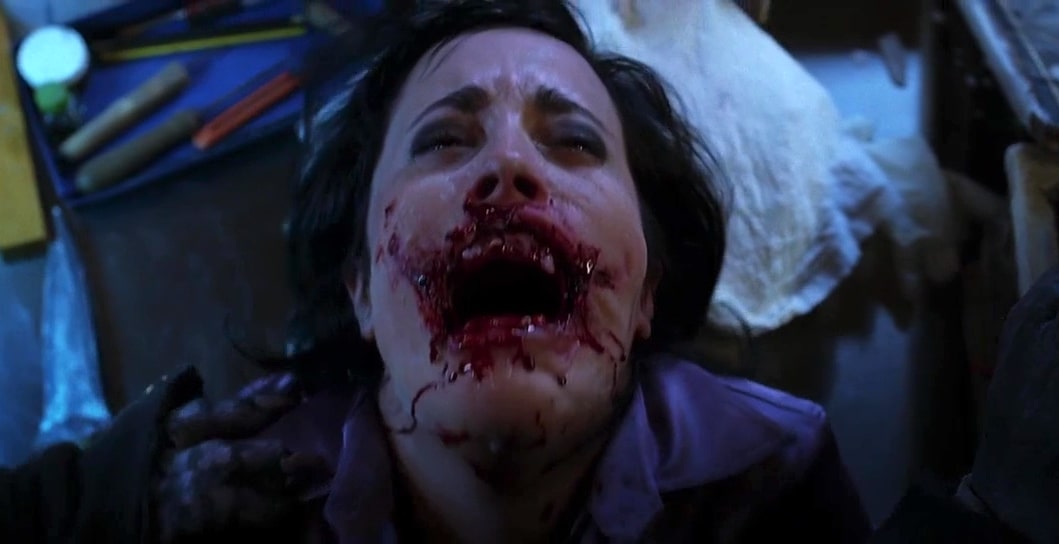
A glimpse of Argento doing just that appears in the behind-the-scenes featurette on Dimension Extreme/Genius Products’ just-released DVD of Mother of Tears, the director’s latest film and highest-profile feature in years. The conclusion to his Three Mothers trilogy, following up Suspiria and Inferno, casts Cataldi-Tassoni alongside Argento’s daughter Asia as art-museum workers who receive a mysterious urn that has been unearthed during the renovation of a religious cemetery. Opening this object leads to all sorts of hell on Earth, with Cataldi-Tassoni on the receiving end of the first and most horrifying act of violence at the claws of a group of demons. Making the sequence all the more unnerving is the filmmaker’s decision to play it close on the actress’ tortured reactions—one arrived at only after its initial round of filming.

“After we shot it the first time,” Cataldi-Tassoni remembers, “Dario didn’t like the way the demons looked. So I got called back to Italy. I was in Chicago, starting another project, and I flew back and we reshot my death where everything’s pretty tight on me. We don’t see the creatures, unfortunately, but it still works; it’s a very emotional death.” Restaging her disfigurement involved donning Sergio Stivaletti’s prosthetics again (“We were concerned that we couldn’t find the mouth piece, but it was still there, and intact”), as well as her old costume. “The grossest part was that some of my clothes were still damp! It was amazing; there was so much blood on them. They save everything, because you never know, and of course they preferred to use the same ones just for continuity reasons. It was a couple of weeks later, but they were still wet, and it was kind of freaky.”
Just to make the experience even more intense, the director employed another of his traditional techniques—playing loud, mood-setting music on set—while capturing the initial demon attack on film. Portions of that can be seen on the Mother DVD as well. “The fact that it’s in the featurette makes me happy, because I wanted people to see that,” Cataldi-Tassoni says. “The music, the demons, the whole walk from the table and then they’re on me—it was crazy. One of them, actually, was pulling my guts around my neck a little too much, and I think I was kicking him or punching him, to get him to loosen up a bit. They were getting very adamant about it.”
Audiences too have had extreme reactions to the setpiece; reportedly, viewers actually fainted in certain areas of Italy, leading ambulances to be posted outside and the movie to be pulled early from theaters. “I guess I must have done a really good job,” Cataldi-Tassoni says, “but I never had any intentions to send anyone to the hospital!”
The actress herself had a much more positive experience when she caught Mother of Tears on opening night during its Manhattan theatrical run earlier this year. “I was born in New York City, so to come back to my hometown and be able to go and see a movie I did in Italy with all my friends and my mom, just a few blocks from where I live, was a little bit of an accomplishment, and very exciting.”
Mother is the latest chapter in the long saga of Cataldi-Tassoni’s professional association with the Argentos, which began over 20 years ago with the Dario-produced, Lamberto Bava-directed Demons 2, followed shortly by another memorable demise in Dario’s Opera. Since then, Cataldi-Tassoni has appeared opposite Asia in her father’s version of Phantom of the Opera, as well as in Bava’s recent Ghost Son, art-house/genre director Pupi Avati’s The Childhood Friend and The Bitter Chamber (a.k.a. The Room Next Door), which Avati scripted and was helmed by Fabrizio Laurenti. Over those years, she has forged a close bond with Italy’s king of horror and his offspring.
“Dario and I have developed a major shorthand,” she says. “It has always been kind of the same since Opera and Demons 2; there’s an understanding there. He will stop me if there’s something he doesn’t like; if not, it’s kind of, ‘Do what you want.’ And Asia—I know she’s said this about me, but she is like my little sister in many ways. There’s an unspoken bond. I really admire her work ethic, and she’s very protective of me. I appreciate that when we’re on set together, she always keeps an eye on me and makes sure I’m OK. At the same time, I’ve watched everything about her evolve. She’s so active in her personal life that it’s only natural that her acting has developed too. She has matured in every way.”
As of now, though, the actress has no concrete plans for another collaboration with either of the Argentos. “Things are always thrown out there, and there always could be something spur-of-the-moment,” she says, “but right now, nothing is seriously happening.”
Cataldi-Tassoni did share a set again with Stivaletti as well as longtime Argento composer/former Goblin frontman Claudio Simonetti late last year, when she took a leading role in the short psychological chiller The Dirt, directed by Simonetti with his sister Simona. The movie, which casts the actress as a woman desperate for a child who shares her home with a very unusual plant, has screened with Mother of Tears at Montreal’s Fantasia festival and other showcases, and at an event in Rome to celebrate Claudio Simonetti’s biography Profondo Rock. “The Dirt has been received very well,” Cataldi-Tassoni says, “and I’m happy to have been given the opportunity to work with Simona, Claudio and Sergio once again. I’m very pleased that I decided to be part of that project.”
She’s grateful, in fact, to have become a regular part of a circle of Italian genre practitioners whom she has admired since childhood. “They’re part of this incredible generation; I mean, who’s really doing Italian horror [now]?” she says. “These are the maestros. I grew up being a huge fan of Dario and Claudio, and it’s a group that I’m very excited to be part of. It’s like those family reunions you’re actually happy to go to and don’t want to leave, which is rare.” She also appreciates the heightened attention that has been bestowed on her work with Argento et al. over the last decade thanks to the DVD revolution. “I say over and over again, God bless America for that. It’s not only because of DVD, but also because the movies were brought to a place that appreciates them. The films went to other countries, I’m sure, and nothing happened. But Americans’ enthusiasm really makes you feel like you did something productive, and the more they give you, the more you want to give back.” She adds that she has been approached by American filmmakers to do horror films in this country, “but nothing I can discuss.”
And it’s not just her screen work that occupies Cataldi-Tassoni’s creative energies; she’s an accomplished artist and singer as well, with samples of both visible and audible at her official website. This past year, she has performed with Goblin keyboardist Maurizio Guarini as Orco Muto at venues in Canada, and she’s currently involved in a major literary project as well. “A very young and talented journalist named Filippo Brunamonti has been following my career for a long time, and recently has been writing many articles about me,” Cataldi-Tassoni explains. “He came to me recently and said, ‘I want to write your biography.’ I always thought I’d write a book; I’ve kept a journal for almost 20 years, every day, and I’d think, ‘Is this going to serve a purpose someday?’ But God knows when I was really going to write my autobiography, so I’m quite honored that Filippo wants to do this with me. It will be a mixture of fantasy and reality on one big canvas, a mix of interviews with good friends and some very interesting big names, and other things. It’s going to be a kind of enigma, a mystery that needs to be solved through my paintings, etc. I’m actually quite scared by this project, but I’m gonna do it anyway!”
Despite her 20 years before the cameras, Cataldi-Tassoni admits that viewing her own work also makes her nervous. “I can be at home with my friends watching one of my movies with the remote control, and either I go in the other room or I fast-forward,” she reveals. “So then they’re yelling at me—‘We want to see the movie!’ I’m very blessed to have worked, and I think sometimes we actors and actresses need to remind ourselves of how fortunate we are, that we do have those opportunities. And you know what? One day I’m sure when I’m a little old lady, I’ll think how silly I was, and that I should have been in front of that TV telling everybody, ‘Hey, look at me, this is great,’ you know? Why be embarrassed? I’m getting better at that, though; I don’t fast-forward as much as I used to. I try to be a little kinder to myself.”
