
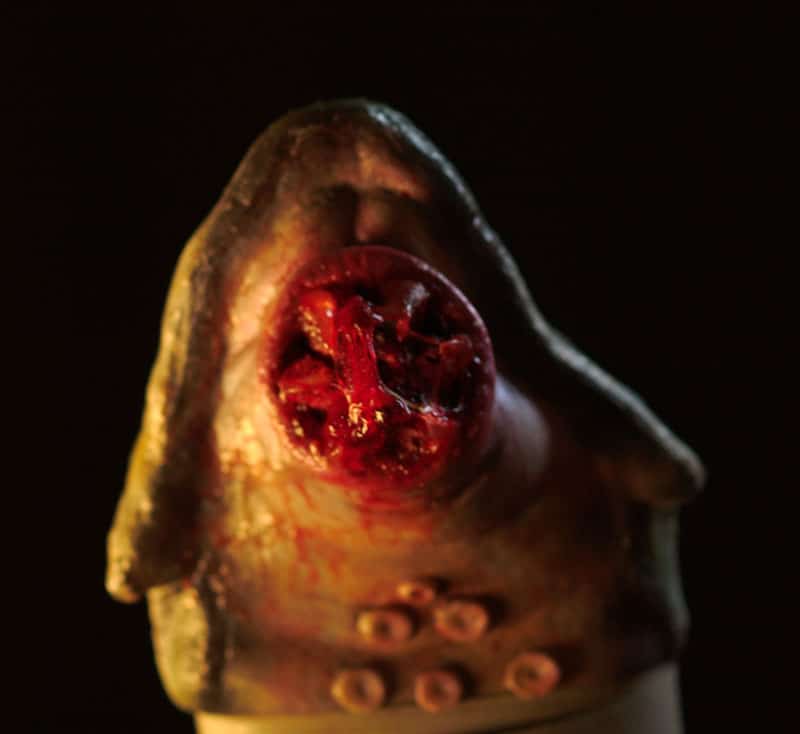
Editor's Note: This was originally published for FANGORIA on August 26, 2003, and we're proud to share it as part of The Gingold Files.
So, how did I wind up landing the job of writing a film in which a swarm of killer leeches attack an unsuspecting college campus?
“That’s easy,” I hear you reply. “You work at FANGORIA; getting into the horror scripting field was probably a snap.” To be sure, the connections I’ve made here have been helpful, but it’s also true that it took nearly a decade at the mag before I was on the road to being produced. Surely there are quicker ways of breaking into the movie biz…
At any rate, Leeches! was first spawned shortly after we ran a story about David DeCoteau, who had departed Full Moon to strike out with his own company, Rapid Heart Pictures. I’d known Dave for a while and decided to send him my spec screenplay Nightcrawlers, a students-vs.-creeping-monsters opus, as both a potential project and a writing sample. (That script—which is still available, if any producers are reading this—has gone through several title changes since then, as other projects have kept cropping up with monikers similar to mine.)
Dave liked Nightcrawlers and expressed interest in pursuing it, in the meantime hiring me to write a couple of other projects: Boyz II Death (which just wrapped, under the new title Ring of Darkness, after a lengthy development and rewrite process) and Cutting Rooms (which remains unproduced). Nightcrawlers itself never made it off the ground, but in the midst of attempting to launch it, Dave (who had wanted for a while to do a nature-on-the-rampage movie) called me and asked if we could change the focus. In that script, the creatures are a fictitious type unrelated to any real-life species, but… “What if it was about leeches,” Dave proposed, “and they go after the swim team?”

It sounded like a good idea to me; while certain animals have suffered overexposure in the recent boom (how many killer-snake movies, all with the exact same video cover art, have we seen in the last few years?), the slimy bloodsuckers hadn’t been the focus of a feature since 1959’s Attack of the Giant Leeches. Only problem was, working leeches and the swim team into my current story would have required completely reworking Nightcrawlers, so I asked if I could come up with a whole new plotline instead. Dave agreed, and I put my writer’s thinking cap on: “Leeches…swim team…leeches…swim team…”
Then suddenly, I had one of those wonderful moments in which, as Stephen King once put it so well, the muse shat on my head. It came to me in a flash: The swim team is taking steroids to improve their performance, and when the leeches suck their blood, the critters grow big and hungry. Not completely scientifically sound, but certainly workable enough for a low-budget horror feature. And it kept with an approach I try to take in all the genre scripts I write: the horrific element is directly connected to the characters’ life situations. To me, this gives the scary stuff more resonance than if, say, a group of college kids just happened to stumble upon genetically mutated leeches that have escaped from a government lab. It was also a natural way to generate human drama in between the attack scenes. Dave liked the idea, and I went to work on a treatment, which he and his co-producer, Gary Barkin of Sidekick Entertainment, subsequently revised.
In my original concept, the swim team’s coach is intentionally using leeches to bleed the steroids out of his star swimmers’ systems so they won’t show up on drug tests, little knowing that he’s inadvertently breeding monsters. I guess Dave and Gary felt this was kind of a far-out premise, since in their final revision, the coach isn’t responsible for the leeches preying on the guys (though he remains a nasty character). The other significant change is that the film’s hero in my first pass was a newcomer to the campus, which is always handy for expositional purposes; audiences can learn about a situation as the protagonist does. In the final storyline, everybody’s already caught up in things, which made the dialogue a challenge. I always cringe when I hear awkward movie lines that are clearly only being spoken to impart information to the audience, and did my best to make it all seem natural while scripting Leeches!

The rest of the screenplay writing process was fairly smooth, in no small part because I had the fully worked-out treatment to base it upon. If I can impart any advice to aspiring scriptwriters, it is this: Always get your basic story problems cracked on the outline level. If you have a plot and characters that make sense at this stage before proceeding to the final screenplay, you’ve got more than half the battle won. There will be changes as you continue through later drafts (and probably even while you write the first one), but having that treatment to guide you will make the journey much easier.
As I wrote, I did have to keep the budget in mind; this was going to be a low-cost film, and I couldn’t write any extravagant setpieces into the script. The trick was coming up with a variety of different ways and scenarios in which the leeches could attack people, and to keep the dialogue scenes as tight and to the point as possible. Bearing in mind that the number of locations would be limited as well, I tried to bounce around among them frequently instead of bogging down in any one setting for too long.
My model for the film’s tone was one of my favorite nature-amok films, Piranha, in which a frankly outrageous premise is played straight, yet with just enough of a comic undercurrent that you know the filmmakers aren’t taking themselves or the project too seriously. Without indulging in self-referentialism or getting too campy (well, OK, maybe there are a couple of places where I do) and while going for straight scares in the leech scenes, I tried to add humor in certain areas—including those having to do with the, let’s say, hunk factor. Anyone who has seen Dave’s previous Rapid Heart films (particularly the Brotherhood franchise) knows that he likes to stock the landscape with scantily clad guys, and the moment he said the words “swim team,” I knew Leeches! would be no exception. So I threw a number of double-entendres and innuendo into the dialogue to put a different spin on the material, while also adding a few scantily clad girls for my own interest—though not all of them made it to the screen (memo to Dave: When Casey takes her blouse off in the bedroom scene, she wasn’t supposed to have another top on underneath it).
Yet despite the male-centric nature of Dave’s films, it’s interesting that in every project I’ve written for him, he’s asked me to change a character who was male in the first draft to female for the final film. In the case of Leeches!, it was a doctor who ended up being played by Julie Briggs (though she retains the name “Dr. Manning”).
Once I turned in my first draft, the revision process began. Yes, rewrites are as standard in the low-budget arena as on studio pix, but I was fortunate in that both Dave and Gary were clear on what they wanted, and all of their changes made sense. Dave, with his long experience in the indie field, knew exactly what he would and wouldn’t be able to accomplish with the resources at hand, and asked for a few alterations for budgetary reasons. And Gary proved to be a creative producer whose input was inspired by storytelling concerns, not commercial/marketing ones. He even called me on a bit of bogus science in a line of dialogue, and researched all the slang terms for steroids that I wound up sprinkling throughout the script.
The aforementioned cost-cutting changes cropped up in a few unexpected places. One of my heroines, for example, owned a cat in the first draft, with the poor feline becoming an early victim of the leeches (and not, I hasten to point out, used for a cheap “cat scare.” If you ever see a bit like this in a movie with my name on it, assume I was rewritten). But Dave pointed out, quite rightly, that having a cat on set requires a handler, plus the likely expense of multiple takes until the animal does what it’s supposed to do. Exit cat, enter an aquarium whose fishy occupants become an early leech meal.
Then there was the climax, which I initially wrote to take place in the campus swimming pool. Everyone thought it worked well on the page, but before the location was secured, there was concern that staging it would be too expensive. So I rewrote the action to take place in a shower room instead, and that’s how it played in the final draft I sent off. But I was in for a happy surprise when Dave called me the day after wrapping the shoot, sounding exhausted and saying, “We were up till 3 a.m. filming the ending in the swimming pool.” It turned out that not only did he find a pool location that allowed him to stage the climactic mayhem there, it also had a subaquatic window to another room, which allowed Dave and cinematographer Gary Graver to film underwater shots, upping the scene’s production value.
Dave and Gary, in fact, gave the film a look far beyond what one would expect of a low-budget chiller shot in a week’s time. You don’t find too many movies on this level shot in 35mm widescreen, but Dave, to his credit, won’t have it any other way. I also applaud his decision to go with all live creature FX, instead of CGI. And as for how my script plays? Well, that’s really for you to decide; all I can say is that I’m very happy with how closely Dave hewed to what I wrote, that the young actors all perform with conviction and that my two favorite scenes (one horrific, one comic) play just how I envisioned them. And as a longtime nature-on-the-rampage fan, I’m thrilled that my first produced script is of that genre. Leeches! is now available at Blockbuster, Hollywood and other video stores August 26 for rental, with sell-through to follow a couple of months later; after years of judging other people’s movies, I now wait with a mix of anticipation and apprehension to see what it’s like on the other side.
