

Last Updated on March 16, 2024 by Christopher Stewardson
Boris Karloff. His name, his films, and his performances are immortal. When I was a child, Karl Fruend’s 1932 version of The Mummy was one of the first horror films I ever saw, and it undeniably left an impression. The nearly imperceptible twinkle in Karloff’s eye as Imhotep comes back to life and the phrase “Karloff the Uncanny” haunted me as I slept next to the film’s poster. Of course, he was later joined by Vincent Price, Christopher Lee, and Peter Cushing in my adoration, but Karloff was still the first. And all these years later, he remains one of my favorite actors.
I’d wanted to see one of Karloff’s last films, 1968’s Targets, for many years, but tracking down a decent copy was a struggle. The BFI’s recent Blu-ray release allowed me to experience the film in brilliant high definition, and the wait was worth it. Karloff’s vulnerability was striking, with the actor essentially playing a version of himself. In turn, as the film drew to a close, I felt as though I was experiencing a taste of his real passing, and I found myself with a heavy heart. The many monsters, villains, and rogues Karloff played throughout his long career were soulful in abundance, from his Frankenstein monster to the disfigured Bateman of The Raven. But here, Karloff is at his most incandescent, for he is an image of himself.
In Targets, Karloff plays an aging horror icon named Byron Orlack. He wants nothing more than to retire, feeling outdated in a world where the nightly news offers more horror than the spooky castles and ghosts for which he’s known. Meanwhile, a young man begins a mass shooting spree, culminating in a massacre at a drive-in theatre where Orlack is set to make an appearance.

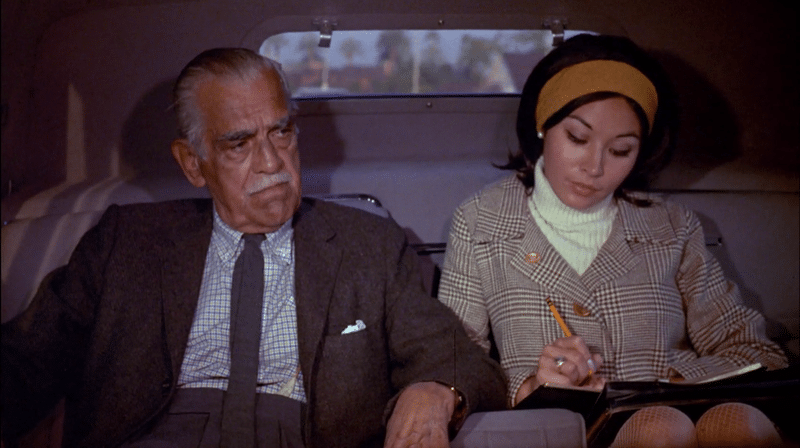
By 1968, Karloff was still a welcome face in horror, regularly appearing in the genre output of American International Pictures. In 1963, he starred in both Roger Corman’s adaptation of The Raven and The Terror, the latter of which is an entertaining hodgepodge of incongruous elements thrown together when shooting on The Raven finished early. Further blurring the line between fiction and biography, The Terror is used in Targets as the final film of Byron Orlack, facilitated by Corman, who also produced Targets.
But horror was shifting. While Alfred Hitchcock’s Psycho pointed toward a new direction in horror cinema, George A. Romero’s unrivaled Night of the Living Dead forcefully asserted it with an unflinching modern urgency. That Targets was released the same year as Living Dead feels pertinent, with Orlack’s style of horror – and therefore Karloff’s, too – becoming outmoded with intense immediacy.
Karloff believed that the horror films he made weren’t really horror, but fantasy fairy tales; this was a sentiment shared by his contemporaries, Vincent Price and Peter Cushing. Real horror, to Karloff, was the everyday world of horrifying headlines. Targets sees Karloff, via Orlack, confronting that real world that’s superseded his filmography.
The mass shooter’s name is Bobby. He’s got everything: a wife, a job, a home in the suburbs with his parents, dinner waiting for him, and even a white picket fence. Looking like a missing Beach Boy, Bobby lives the so-called American Dream. And he wants to kill people. Based on the real-life mass shooter, Charles Whitman, who in 1966 became known as the “Texas Tower Sniper.”
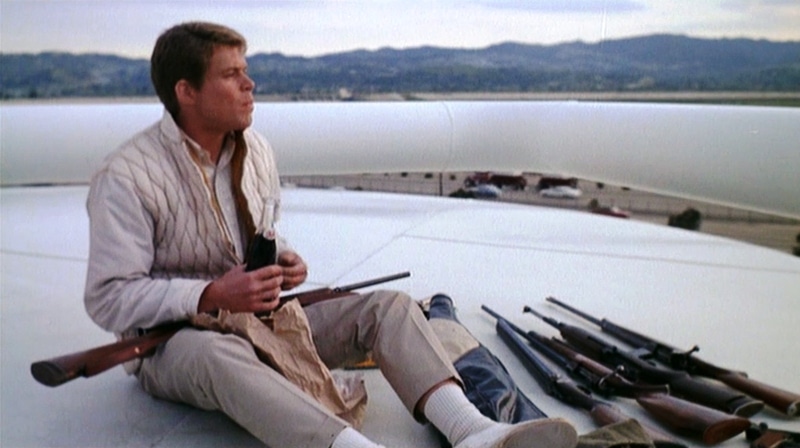
There are hints of some inner turmoil within Bobby; he awkwardly tries to talk about things with his wife but can’t. A photo of Bobby in military uniform suggests what this anxiety could be, but nothing is certain, and it doesn’t need to be. There isn’t a clear or singular reason why he feels compelled to murder people, for Bobby’s compulsion isn’t uniquely his. He’s evocative of a wider sickness in the fabric of 1960s America, a country whose leaders were embroiled in a bloodthirsty imperialist crusade in Vietnam, whose civil rights leaders were being assassinated, and whose culture was struggling and succeeding to reflect this upheaval. Maybe the American Dream is a lie, or maybe this is what happens to its beneficiaries. Bobby has it all, why stop there?
When Byron and Bobby meet at the film’s end, the retiring actor sees the face of the world he believes has surpassed him and his horror film legacy. But there’s no spectacle. In fact, Bobby seems rather pathetic and small – because he is. All throughout the film, Orlack’s thoughts on obsolescence have remained abstract. But now they’re here in the flesh: a young man with everything who decided to murder as many people as he could. Orlack looks at him in bewilderment. The face behind the terrible headlines isn’t some monster any worse than those played by Orlack, it’s just a sad and entitled America looking back at us like a spoiled child caught misbehaving. The increased visibility of cruelty in late-sixties America is far scarier than any spook or ghoul, and so Orlack (and Karloff) slips out into the night.
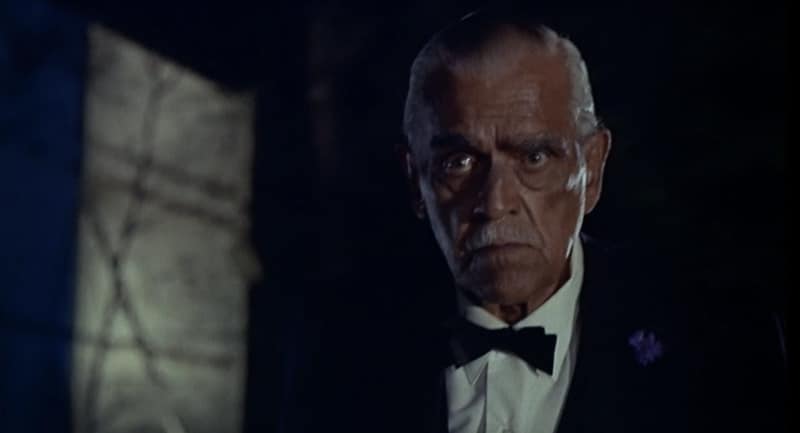
We don’t get a drawn-out ending after Orlack leaves. It’s sad and cold. This swansong for Karloff ends on an empty drive-in theatre, the site where many of the actor’s final film roles were projected. But perhaps the most poignant scene of all occurs earlier when Orlack listens to a local disc jockey preparing inane questions to ask during his appearance at the drive-in. Orlack ignores them and instead offers to tell a short story, a retelling of Appointment in Samarra. What follows is a masterclass in suspenseful delivery, complemented by a camera inching closer to Karloff as his tale reaches its twist ending. For all that Orlack – and perhaps Karloff – worries about becoming obsolete, he’s effortlessly timeless, and his short story proves it. In fact, after Karloff performed the story on set during production, the crew erupted into applause. Nobody else could have delivered it like him. And there will never be another Karloff.
Targets is a solemn send-off for one of the screen’s greatest performers. It’s bittersweet and melancholic, but also loving in recognizing Karloff as the person, not just the persona. After the actor passed away in February 1969, his cremated remains were buried in the Garden of Remembrance at Guildford Crematorium. Included in his entry in the Book of Remembrance was the following quote: “To live in the hearts we leave behind, is not to die.”
And in that respect, Karloff will never die. Every time we experience his films, his Frankenstein monster, his Imhotep, or his Byron Orlack, he lives on. A guardian ghoul watching over cinema.
