

Last Updated on March 16, 2024 by Rich Johnson
“A wolf and a star. What does that mean?” ― Larry Talbot
December 12th, 1941. Released five days after the attack on Pearl Harbor [1], George Waggner’s Universal monster movie, The Wolf Man, redefined werewolf lore and set the blueprint for years to come. Entertaining, for sure, but through screenwriter Curt Siodmak’s conscientious approach to the material, it is another perfect example of how the monster metaphor ― these allegorical tales of the “Other” ― have given birth to the modern fable.
After the success of James Whale’s Frankenstein, Tod Browning’s Dracula, and the dual nature of Rouben Mamoulian’s Dr. Jekyll and Mr. Hyde in 1931, Universal went on to exploit other (invisible) mad scientists and creatures of the night. Lycanthropy seemed the next obvious choice, with a conscious move towards creating an original Universal monster. First, there was Werewolf of London (1935) before developing another incarnation of their “Wolf Man” for Boris Karloff. However, based on a proposed transformation scene in a confessional, it was considered too extreme by studio executives who were concerned about upsetting the Catholic Church. A decade after those first iconic movies, Universal would finally add the latest incarnation to their rogues’ gallery, one that carried its own distinctive mark.
Other Origins
Religious connotations began to have less impact within literature during the 19th century. Rather than a demonic presence, the wolf metaphor ― much like the witch and the vampire ― had now stood in for the presence of minorities. Such anti-Semitic leanings, and preoccupation of race, raised its ugly head in Bram Stoker’s Dracula (1897) ― the romanticized Other ― a foreign and insidious agent of fear. For the werewolf, it had originally tapped into something more primordial — “If you’re not killing, you’re screwing” [2] — where man returns to the uncontrollable beast within.
The threat of the wolf can be found in both Yiddish lore and German fairy tales warning red hooded “innocents” not to venture into the woods in fear of being snatched, baked, or eaten alive. But it has even more ancient references, as Esther Saks illustrates, “The wolfish-Jewish association goes as far back as the Biblical Benjamin, who a Medieval commentator, Rabbi Efraim ben Shimshon, described as not just like a ‘ravenous wolf,’ but capable of turning into a wolf itself. Notably, the rabbi’s fear was not that Benjamin would kill others, but that he would change among strangers and be killed by them.” [3] Revolutionary Jewish writer, H. Leivick’s poem “The Wolf,” (1920) is a natural inheritor of such themes, as a rabbi ― the last survivor of anti-Semitic violence ― finds himself transformed into the titular howling beast. Saks goes on to highlight, “If Leivick’s desire was to remain the Other, [werewolf movies] express the terror of becoming the Other in a hostile world. You fit in, until you can’t. You’re one of us, until you’re not.” [4]
In evolutionary terms ― caught somewhere between Charles Darwin’s natural selection and P.T. Barnum’s freak shows ― any (explicit) resemblance to a werewolf was exploited, where those afflicted with hypertrichosis — also known as “werewolf syndrome” — were presented as hairy men, bearded ladies, and feral children. It is, therefore, no coincidence that the birth of more “transformative” creatures was inspired by crucial writings of the period, such as Darwin’s On The Origin of the Species (1859) and The Descent of Man (1871); scientific theory that reprogrammed a large of portion of society, questioning faith and the existence of God.
Darwin concluded that humankind had descended not only from apes but even further back, other hairy beasts and amphibious life forms that evoked something more dormant, growing inside all of us. This was acted out by the likes of mad doctors Jekyll and Moreau, in an attempt to understand their distant evolutionary heritage. The actions of H. G. Wells’s antagonist — a buffet of bestial behavior brought to life in Erle C. Kenton’s Island of Lost Souls (1932) — even foreshadowed what was to come with Hitler’s eugenics and terrifying imperial vision.
A Marked Man
Siodmak was no stranger to the Nazis and their rise to power; his experiences and observations from overseas were crucial in the development of The Wolf Man. Born in Germany in 1900, Siodmak [5] originally wrote short stories, novels, and screenplays during the inter-war years of the Weimer Republic. After hearing Joseph Goebbels’ anti-Semitic tirade, he emigrated to the UK before moving onto the US in 1937. Hounded; on the run; this was his own curse, “I was forced into a fate I didn’t want: to be a Jew in Germany … The swastika represents the moon. When the moon comes up, the man doesn’t want to murder, but he knows he cannot escape it, the Wolf Man destiny.’” [6] [7]
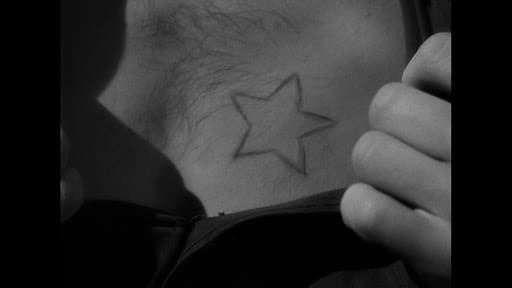
Much like the medieval period, he began to see that the Star of David had, once again, become a mark of death. Now a compulsory yellow badge; the symbol branded the Jewish population, their segregation a prelude to deportation and the inevitable holocaust. Within the context of the Wolf Man, another bastardized version of the Star was presented as a pentagram but still remained a vital message and reminder of pain and suffering. Therefore, in relation to Siodmak’s heritage and the persecution of the Jews, it becomes an extremely potent symbol that works on a number of horrific levels. However, this is a concept of the werewolf that was “not how Siodmak felt as a Jew but how he felt others perceived him. Larry Talbot [Lon Chaney Jr.] was an interesting substitute for what was going on with the Jewish people in the early 1940s.” [8]
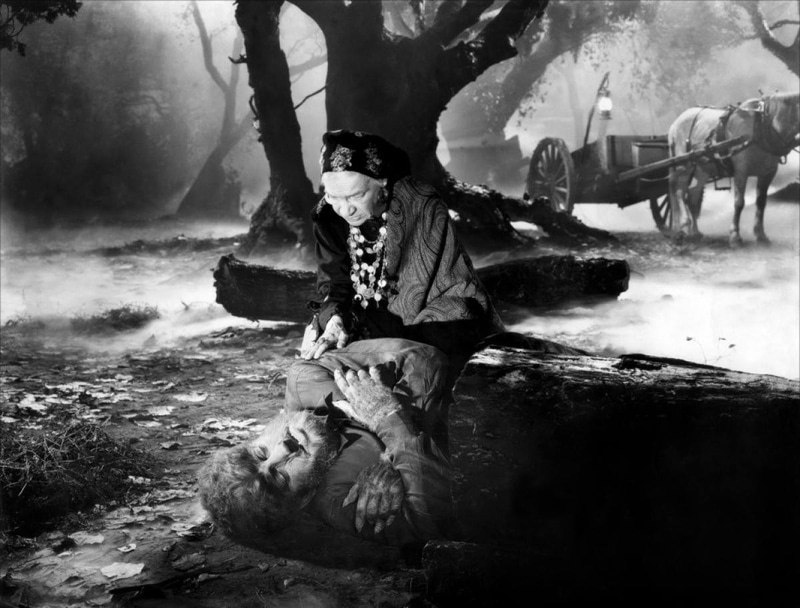
Larry Talbot’s story plays out as something more akin to a Greek Tragedy wrapped up in the Golden Age of classic horror. Vulnerable, marked, and cursed; he is a victim who refuses to embrace his monstrous, predatory behavior [9]. His bewilderment is reinforced by how “unreal” the story is. Taking place in what appears to be an alternate realm — emphasized by the interchangeable Universal backlot — it is a film populated by English gentry, Romanian gypsies, modern cars, horse-drawn wagons, and an American nobleman. It is a setting Joe Dante perfectly summed up as, “On the outskirts of places people are fighting” [10], which makes complete sense considering the climate during production.
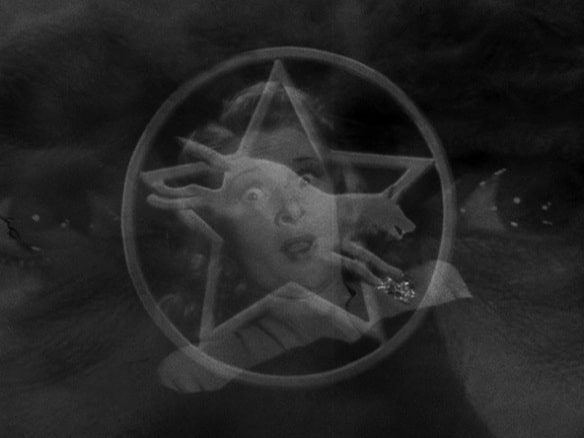
The aggression boils under the skin of the film. In Talbot’s nightmarish vision [11] —an expressionist montage reminiscent of both folklore and the axis power sweeping through Europe — a potent wolf’s head, five-pointed star, and subsequent beating genuinely hit home. Ironically, nothing is “imagined” — as Sir John Talbot (Claude Rains) insinuates. What will eventually play out on screen is the “conclusive proof” that monsters and monstrous acts were as real in 1941 as they are now; intensified by far-right attitudes that have given rise to yellow badged anti-Vaxxers [12].
Universal Lore and Legacy
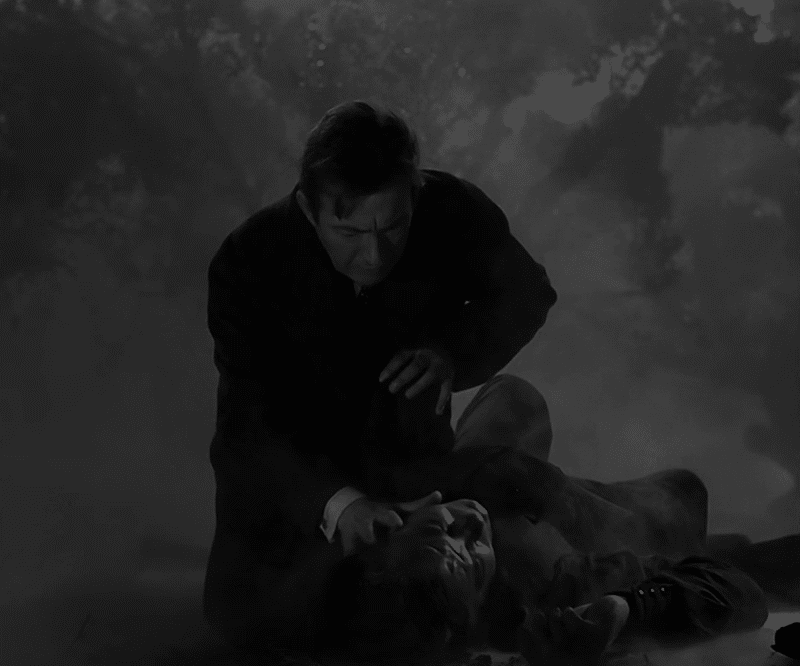
At just under 70 minutes, The Wolf Man is a lean beast. Jack Pierce’s moonlit makeup effects are revealed 40 minutes in, while — due to the nature of filmmaking during this period — the violence is predominantly blocked or off-camera; jugulars severed through characters’ descriptions at the scene of the crime. As a Universal horror, it makes full use of dark shadows; the forest draped in a signature fog. Director George Waggner’s tease of Talbot’s inevitable change works narratively rather than peaking too soon; his facial transformation saved for the final scene, where, in a heartbreaking moment, the father realizes he has killed the son.
Siodmak’s genius as a writer is not in the forced dialogue — a commonality of the time [13] — but in his rebuilding of werewolf lore, from wolfbane [14] to silver-tipped cane. Preexisting pagan celebrations and superstition are with us from the first frame as a book presents a brief overview of lycanthropy, the supernatural, and pentagrams. The idea of silver bullets is another Siodmak concept; a hint towards the element of material wealth attributed to Jewish culture and stereotypes. Goldsmiths and silversmiths can be traced back to biblical times where such finely crafted work was used for rituals and ceremonies. However, throughout the ages, their work was plundered and, much like the creation of such eponymous bullets, melted down for other (financial) means.
Over the years since the release of The Wolf Man, there have been a handful of crucial werewolf movies that have considered Siodmak’s lore. We have the vibrant vision (yet troubling “rape” origin story) of Terrence Fisher’s Hammer horror, Curse of the Werewolf (1961), returning to gothic roots. Then, in 1981, Joe Dante’s The Howling and John Landis’ An American Werewolf in London (a postmodern Universal monster movie) [15] carefully reappropriated the rules. There is a genuine contrast in this double feature; Rob Bottin’s howling bipeds are killed by silver bullets; while Rick Baker’s hulking lupine — the most vulnerable and realistic (Jewish) werewolf — is gunned down in a dark alley. In Joe Johnston’s remake, The Wolfman (2010) — Baker once again on makeup — the story leans more heavily into lunatic mode [16]; the curse becoming something more personal as Talbot Sr. (Anthony Hopkins) and Jr. (Benicio del Toro) enter full alpha mode. Where in the original father kills son, we now fall into Freudian territory as the son kills the father.
Through a mix of myth and social commentary, Siodmak redefined the werewolf for the modern age and set a new path for filmmakers when conjuring their monsters. Romero reflected his time when revitalizing zombie tropes, while Landis’ self-awarewolf almost single-handedly reinvented how we think of genre filmmaking and practical effects. So far, 21st Century horror has seen the werewolf embrace genuine physical change and (blood) cycles — John Fawcett’s Ginger Snaps (2000) — or even display an equal measure of parody and paranoia in (spoiler alert! [17]) Josh Ruben’s Werewolves Within (2021). [18]
Both ancient and modern in its narrative, The Wolf Man remains a seminal film and, as a work of art, epitomizes the conflicted nature of humanity. Not only is this a defining moment in cinema, its arrival onscreen was a liminal moment when the entire world was transformed, unleashed, and out of control. It remains influential for the lore and its craft, but also, once you scratch at its surface, the film’s genius is in how it manages to dress personal and political tensions as pure entertainment. All of this is truly its full moon legacy.
