
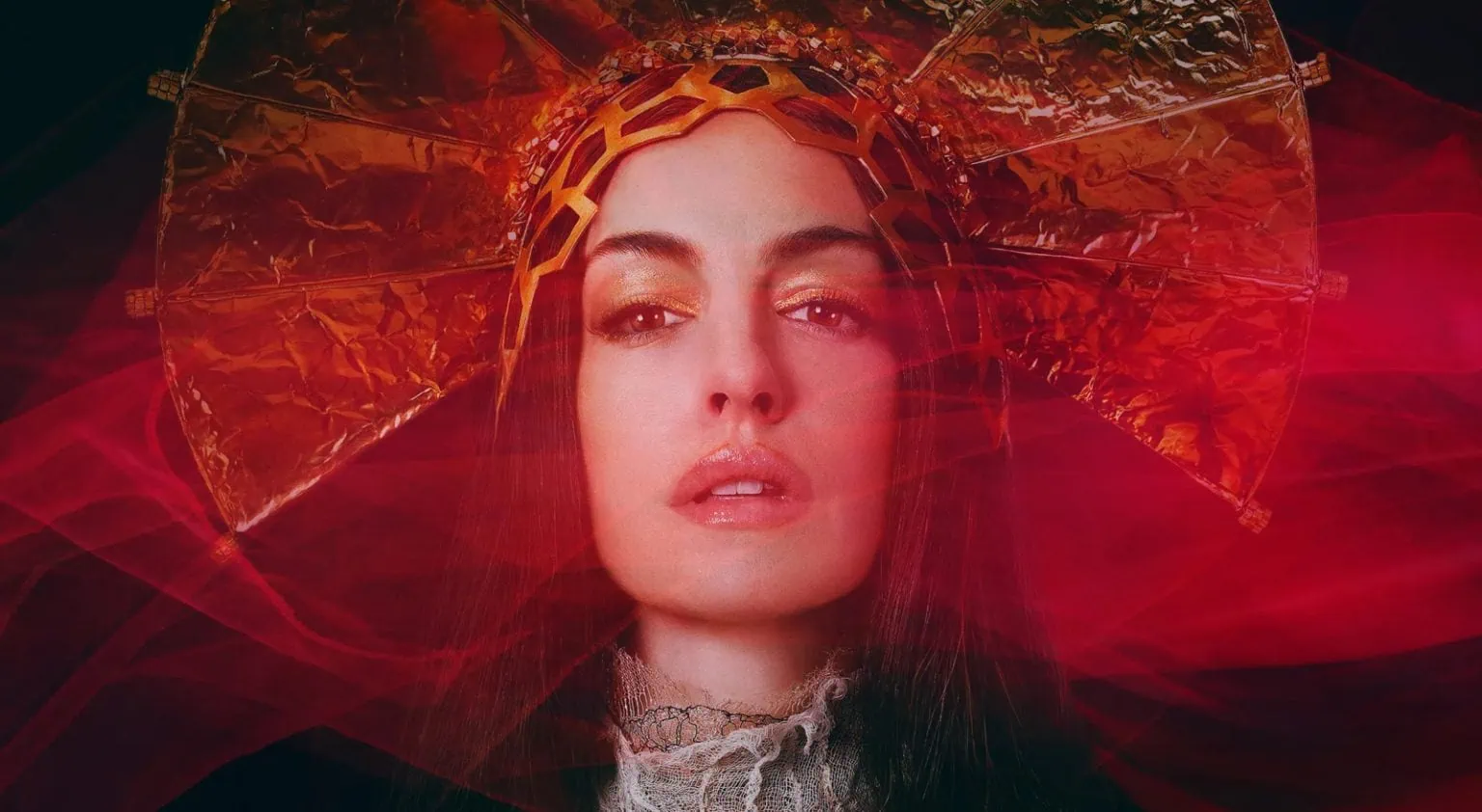
There’s a dark cerebral quality found within David Lowery’s Mother Mary. Similar to his previous features, like The Green Knight and A Ghost Story, Lowery’s work is incredibly heady, filled with ambiguity and deep examinations of everything from the interrelationship between life and death, to the physics of time. During a recent Q&A after a screening, he talked at length about his interest in quantum mechanics and the idea of “quantum entanglement” to describe relationships, which pops up here.
This is all to say that Mother Mary is a film that offers its viewer no quarter, nor does it offer easy answers. What it does provide is the opportunity to watch two phenomenal actresses at the top of their game engage in a theatrical, maximalist exploration of obsession, love, and hatred, swathed in the glitter and jewels of pop stardom.
Mother Mary (Anne Hathaway) is a successful pop star who has come back to the stage after a traumatic accident. Haunted by something she can’t explain, she makes a spontaneous trip to visit her former friend and designer, Sam (Michaela Coel), in the hopes of getting Sam to make her a dress. The pair had an acrimonious split years ago which, according to Sam, she’s totally gotten over. Through the course of the night the two will confess intimate secrets and grapple with the question of whether they can get the ghosts of their past to rest.

Mother Mary is a movie that runs on vibes, fueled by a bare modicum of story. The movie has been described as a “psychosexual pop opera thriller” and all of those elements are here, at some point, twisting and weaving into each other to make the sculptural piece on display. But those disparate elements can make for a piece that feels cold and empty despite everything that’s on the screen. There’s a similarity in composition and storytelling as Nicolas Winding Refn’s The Neon Demon, both dark stories of stardom where everything is outsized and doused in a heavy amount of diamonds and gore. (Ken Russell also feels like a major influence here.)
We aren’t given much in terms of characterization for our heroines. Hathaway’s Mother Mary is exclusively referred to as “Mother Mary” as if that’s her government name. We know she’s an ultra-successful pop star who possibly tried to commit suicide during a musical performance and survived, and Hathaway in pop star mode is utterly amazing. During her performances, the frame explodes with a pulsing beat and infectious songs crafted by Charli XCX and FKA Twigs. Cinematographers Andrew Droz Palermo and Rina Yang give audiences a stage show on par with Taylor Swift’s “Eras” tour (though Lowery has said her “Reputation” tour was an inspiration). And yet, like any good pop star, Mother Mary isn’t happy. A sequence of her lurching from one performance to the next, her team dancing alongside her as if they’re backup while she continuously slows down, is a formulaic if stark rendering of the fame hamster wheel.
Stripped down to her blonde hair/black roots and in grungy sweatpants, Mother Mary off-stage is a stark contrast. She’s scared, meek, constantly running her hands through her hair or covering her mouth as if to keep herself together (or to keep something in). But it is Coel who brings an air of gravitas and control, centering the picture where it often feels adrift.
There’s a hypnotic quality to how Coel recites Lowery’s purple prose, her dialogue playing out like a snake playing with its prey. Upon seeing Mother Mary again, years after the pair split up, Coel’s Sam appears to analyze her former friend, and she’s soon demanding complete subservience from Mother Mary in order to make the dress of her dreams.
Other faces like Hunter Schafer, Kaia Gerber and Sian Clifford pop up for brief moments but the crux of the movie is really Mother Mary and Sam talking. It starts out mundane before the pair discuss their breakup (or, more accurately, how Sam feels the singer destroyed her life). The questions lie in between these moments. How much of each person’s fear, anger, hostility is true, or just their interpretation of events?
The movie could have coasted on being a two-hander between Hathaway and Coel arguing but Lowery ends up injecting something he has enjoyed doing with a few movies now: how much space ghosts and death inhabit in our minds and our physical spaces. Mother Mary’s ads say, “This is not a ghost story” and one could make that argument. Mother Mary and Sam both tell stories of engaging with an entity they can’t explain. Like any good Gothic story, it’s certainly possible to see the ghost angle as literal or metaphorical. In fact, the entire movie could be seen as a metaphor for everything from unresolved anger to purgatory itself. The inclusion of a ghost narrative turns the movie down a path that makes it feel like Ken Russell’s Gothic, in that bizarre things start happening and the audience just kind of has to sit back and go with it.
Mother Mary is David Lowery’s most ambitious movie, though it’s up for debate about whether it’s his best. The beauty, style, and confidence of its heroines, coupled with a script packed with breathtaking dialogue works so well. But the overly light narrative struggles to maintain balance with odd moments of abstraction. It is a movie that can, at times, feel pretentious, but there’s just enough there to keep you entertained.
