
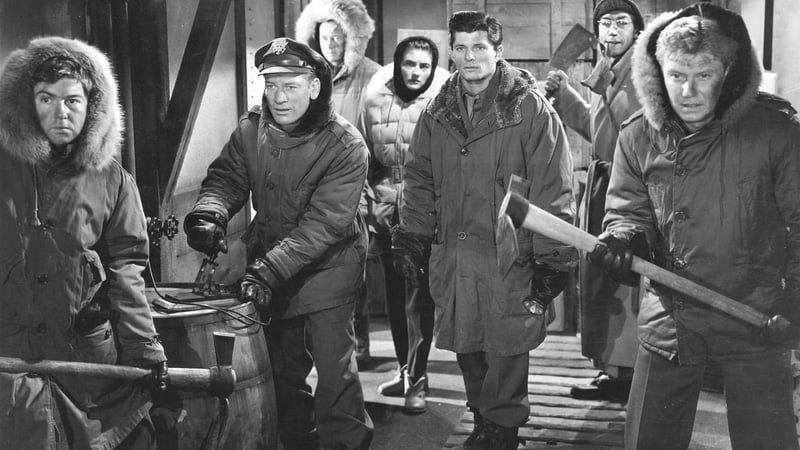
The 1951 sci-fi feature The Thing From Another World culminates with the declaration to “Keep looking. Keep watching the skies.” For the audiences of the 1950s, who’d spent the last few years digging themselves out of WWII and seeing the devastation wrought on Hiroshima and Nagasaki with the nuclear bomb, those words rang true. There was something to fear in the skies, whether that was an alien invader or government bombs. On its 75th anniversary, that fear of what lies beyond is still omnipresent and keeps The Thing From Another World’s legacy (and that of its 1982 remake) relevant.
The film started as a loose adaptation of John W. Campbell’s 1938 novella “Who Goes There,” focused on a group of researchers in Antarctica dealing with a shape-shifting alien imprisoned in the ice for decades. Much of the novella was changed for the 1951 feature and it’d be easy to surmise the decisions were more budget related. The limitations of 1950s filmmaking would have made shape-shifting cost prohibitive if not hokey with the tech at the time. Instead, the alien threatening the researchers at the base is one lone humanoid, a male alien of some stripe played by James Arness.
As essayist Richard Hodges wrote in 1959, this transition from an ancient alien who shapeshifts to one lone being whose spaceship recently crashed, “is a most radical betrayal of its source” and cemented a formula that “proved that some money could be made by ‘science fiction’ that preyed on current fears symbolized crudely by any preposterous monster, and the only special expense involved would be for one monster suit.” No disrespect to Hodges, but it’s possible he was too close to the material, as well as living in the 1950s itself, to see what makes it effective.

He is certainly right about science fiction symbolizing the fears of the times, and Thing From Another World certainly does that. A mysterious foreign invader, a being not only un-American but from an entirely different galaxy, arrives in a hail of fire and proceeds to commit chaos. But unlike other 1950s films that use that as a springboard for the next 90 minutes of terror, The Thing From Another World is more interested in the human characters trying to survive and make sense of what’s happening. There’s three different schools presented: the Alaskan Air Command leader Patrick Hendry (representing the military), journalist Ned Scott (representing the fourth estate), and Nobel laureate Dr. Nigel Carrington (the science side).
What plays out is a series of chess moves representing what the larger organizations might do in this situation. Ned (Douglas Spencer) is constantly trying to find a story to tell, not only to make money and garner prestige, but because he believes Americans should know what’s happening. Captain Patrick Hendry (Kenneth Tobey) is committed to destroying the monster and protecting everyone on the base and, by extension, the American people. Then there’s Carrington (Robert Cornthwaite), who believes there’s something that can be learned from the alien, and that it’d be irresponsible to just kill it.
The 1950s saw a steady backlash against science, or at least a presumed belief that science and law and order were diametrically opposed. The Thing From Another World feels like the beginnings of that. But considering the original source material, coming from the 1930s, it’s also a callback to that same era where eugenics were starting to fall out of vogue. Other books like H.P. Lovecraft’s At the Mountains of Madness, as well as the revival of Gothic tomes like Mary Shelley’s Frankenstein and H.G. Wells’ Island of Doctor Moreau tread similar territory. Interestingly enough, the scientific community had the hardest time with The Thing From Another World, with Isaac Asimov calling it the worst movie he’d ever seen.

There is something remarkably relevant in rewatching The Thing From Another World in a time where trust in science is eroded, as well as trust in journalism and the military. To watch the various groups squabble over the alien feels quaint. On top of that, everyone works together to unearth the alien, taking the initial steps to uncover something they know nothing about and see what happens for the 1950s equivalent of FAFO. (“Don’t unearth aliens” and “don’t read the Latin” are still rules to live by.)
And yet the fact that everyone, Carrington aside, is able to band together shows the enduring power of the human spirit. Ned’s proclamation to “watch the skies” leaves the movie on an air of foreboding, but it seems more hopeful than sci-fi movies released just five years later, like 1956’s Invasion of the Body Snatchers. Unlike The Thing, that movie ends with its hero screaming in the middle of the street about how the coming invasion is meant to doom us all.
Instead, there’s an otherworldly element to The Thing From Another World, a question that while we should be watching the skies, maybe not everything that comes from it will be as terrible. Or maybe this is just the feeling of watching the movie in 2026 where everything is bad. Either way, the movie still connects to me and others 75 years later.
Read more about THE THING FROM ANOTHER WORLD (from Diana Prince) here.
